

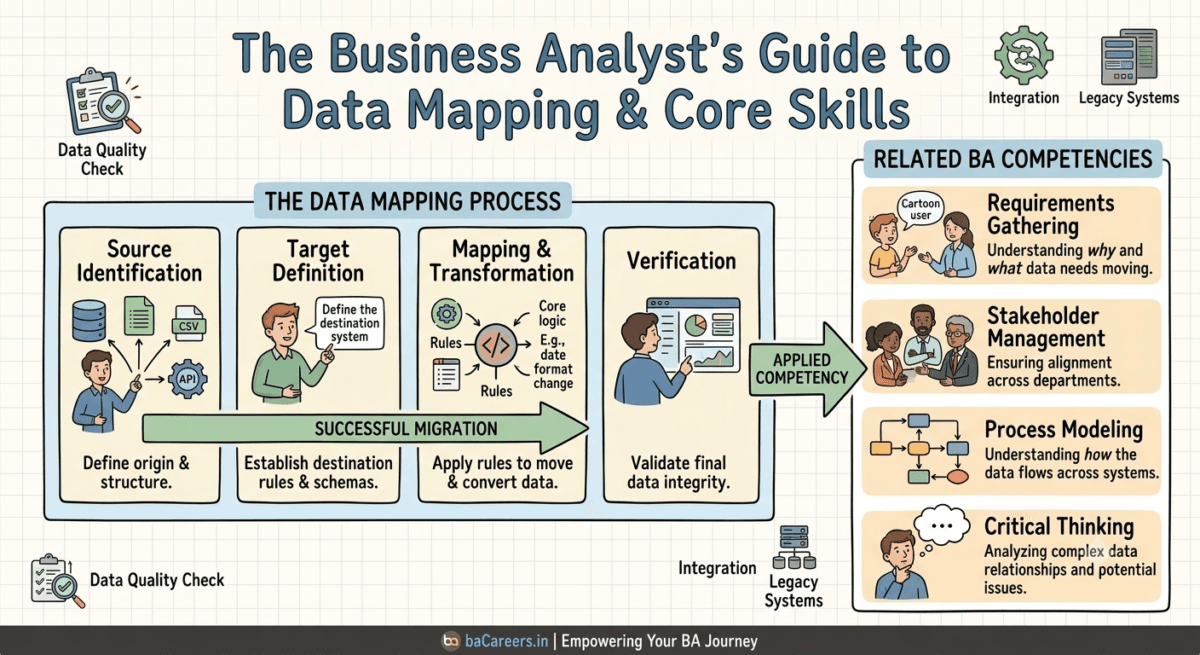
Today every organization is running their business through multiple software, legacy databases, and cloud platforms. The biggest hurdle for any business is getting all their disconnected software talking to each other without losing or damaging the important information. Data integration plays a huge role in overcoming such issues and the very basic concept behind integration is technical. In this article, we’ll define what is Data Mapping, step-by-step guide on the DataMapping process, and explain why you as a business analyst MUST master it.
“Understanding Data Mapping Formats and Definitions”.
Put in simple terms, DataMapping is the process of matching data elements between two different data models. It describes how the source system’s data will travel to, transform and then eventually reside correctly into a target system’s database. Think of DataMapping as a universal language translator. Suppose that the source system has the name stored in one field as FullName:John Smith, but the target system needs the name separated into FirstName: John and LastName: Smith. The data map then would act as an instruction document for the software that dictates how it breaks up the data and passes it.
“Why Data Mapping is a Critical Business Analyst Competency”.
Many of us are under the impression that data management solely belongs to database administrators or software engineers. Well, no. The BA is best placed to own DataMapping as they grasp both the business context as well as the technical intricacies.
The business analyst makes Data-Mapping successful by utilizing their BA competencies such as:- “Requirements Gathering”, “Stakeholder Management”, “Process Modeling”, “Critical Thinking”
“Step-by-Step Data Mapping Process”.
1. Identify the Source The BA determines the origin system by listing out the various fields, tables and their respective formatting in the source system. This can be data pulled from a legacy CRM, an excel sheet, a csv export file or an external API etc. “
2. Define the Target The BA examines the target system structure. This involves defining the target fields, max character length for each, data types like integer, text or date, and whether any field is mandatorily required. “
3. Establish the Mapping and Transformation Rules This is the most critical step of data mapping. The BA designs a mapping specification document that includes details of the rules for converting data from the source into the target. This rule might include changing the date format from DD/MM/YYYY to YYYY-MM-DD or assigning default values to fields if the source is empty. “
4. Test and Verify After designing and implementing the data mapping rules, a BA must collaborate with a quality assurance team to test the migration using sample data and ensure that data from the source matches perfectly with the data in the target.
“Frequently Asked Questions (FAQs)”.
Does a Business Analyst need to write SQL code for data mapping?
It is beneficial to be familiar with some SQL commands but it is not always necessary to write SQL code. A business analyst should define the logical rules and the field-to-field mapping in the mapping specification document which is later used by developers to write the actual code.
What is data mapping and data modeling?
Data modeling involves designing the overall architecture of a database whereas data mapping refers to the linking between existing data structures to facilitate data transfer between them.
What happens if data mapping is done wrongly?
Incorrect data mapping can lead to data corruption, break system integrations and generate misleading reports that impact business decisions. For instance, wrong mapping of financial fields can result in transaction errors or inaccurate dashboards.
Related Articles :
- What is DataMapping?
- Data Modeling challenges / DataMapping Challenges
- Effective Data Visualization Techniques
- The 19 Best Data Visualization Tools and Software for 2022
“Conclusion: Bridging the System Gap”.
A Business Analyst who masters data mapping will stand out from generalists, moving from managing a project to actively owning and leading its technical implementation and success.
By applying it to the complex system integration projects, you ensure that your company’s data continues to serve it faithfully and efficiently across its various systems.

Business Analyst & Technical Content Writer specializing in Agile, Scrum, Requirements, User Stories, BRD/FRD, SEO blogs, and technical documentation.

