BA’s Guide to AI-Powered Tools: Boosting Efficiency in 2026

AI-powered tools for Business Analysts

Are you a Business Analyst feeling pushed to deliver more, faster, and with greater impact?

The truth is tough but clear β€” traditional ways of working are no longer enough.
Manual requirement reviews, repetitive documentation, and reactive decision-making are slowing BAs down.

The solution lies in AI-powered tools.

From intelligent requirements analysis to automated documentation and predictive insights, AI is no longer optional.
By 2026, it will be a core capability that helps Business Analysts not just survive β€” but lead.


The Changing BA World: Why AI Is Necessary

The Growing Efficiency Gap

Today’s Business Analysts operate in an environment where:

  • Digital transformation is accelerating

  • Data volumes are exploding

  • Agile and hybrid delivery models are common

  • Stakeholders demand faster outcomes

Yet many BAs are still:

  • Writing requirements manually

  • Reviewing documents line by line

  • Managing risks after issues arise

  • Spending more time documenting than thinking strategically

This creates a growing efficiency gap β€” the difference between business expectations and what traditional BA methods can deliver.


Why Old Methods Are Not Working Anymore

Real-world example:
A BA working on a fintech platform receives inputs from:

  • Product managers

  • Compliance teams

  • Developers

  • UX designers

Requirements are scattered across emails, meeting notes, Jira, and Confluence.

Manually consolidating this information:

  • Takes days

  • Delays delivery

  • Increases the risk of missing critical details

By 2026, this way of working will no longer be sustainable.


AI Isn’t Taking Your Job β€” It’s Making You Better

There’s a common fear that AI will replace Business Analysts.
The reality is different:

  • AI handles repetitive, time-consuming tasks

  • BAs focus on analysis, judgment, and strategy

  • AI supports decision-making β€” it doesn’t replace it

AI doesn’t remove the BA’s role.
It elevates it.


AI-Powered Requirements: From Mess to Clarity

Smart Requirements Analysis Using AI

AI-powered tools use Natural Language Processing (NLP) to:

  • Analyze user stories and BRDs

  • Identify vague or ambiguous language

  • Detect missing acceptance criteria

  • Highlight conflicting requirements

Instead of reviewing every line manually, the BA receives actionable insights instantly.


Example: AI Helps Refine User Stories

Traditional user story:
β€œAs a user, I want faster login so that I can access my account quickly.”

AI flags issues such as:

  • What does β€œfaster” mean?

  • Which users are impacted?

  • What performance metrics are missing?

Revised user story:
β€œAs a registered user, I want the login process to complete within 2 seconds so that I can securely access my account without delay.”

This improves:

  • Clarity

  • Testability

  • Development accuracy


Real-Time Project Example

In a healthcare Agile project:

  • AI reviewed 120+ user stories

  • Identified duplicate and overlapping requirements

  • Reduced rework by 30%

The BA focused on aligning business goals with compliance needs instead of editing text.


Automating Documentation & Managing Knowledge

Creating Docs from Meetings and Designs

Documentation is one of the biggest time drains for Business Analysts.

AI tools can now:

  • Convert meeting recordings into structured notes

  • Generate BRDs, FRDs, and user stories automatically

  • Keep documents synchronized with Jira and Confluence


Real-Time Scenario: Meetings to Docs in Minutes

A BA attends a 90-minute stakeholder meeting.

  • AI records the discussion

  • Extracts key requirements

  • Produces a draft document

What once took 2–3 days now takes less than an hour.

The BA’s role shifts from writing documents to validating content and shaping strategy.


AI-Driven Knowledge Bases

Modern AI knowledge tools can:

  • Automatically organize project artifacts

  • Search across past projects

  • Provide context-aware answers

Example query:
β€œShow similar requirements from past CRM projects.”

This enables BAs to:

  • Reuse proven solutions

  • Avoid repeated mistakes

  • Work faster with greater confidence


Predictive Analytics & Supporting Strategic Decisions

Moving from Reactive to Proactive BA

Traditional risk management is reactive:

  • Issues are identified after they occur

  • Scope creep is discovered too late

AI changes this approach completely.


How AI Predicts Risks and Scope Creep

AI-powered analytics can:

  • Analyze historical project data

  • Predict schedule delays

  • Detect patterns of scope expansion

  • Forecast resource shortages


Real-World Example: Finding Trouble Before It Happens

In a large ERP implementation:

  • AI identified high-risk modules based on past failures

  • Recommended early stakeholder interventions

  • Prevented a potential 6-week delay

The BA became a trusted advisor, not just a requirement writer.


Strategic Value for Business Analysts

With AI-driven insights, BAs can:

  • Recommend feature prioritization

  • Advise leadership on trade-offs

  • Ensure delivery aligns with business objectives

This is where the BA moves into strategic influence.


Your BA Future: Using AI for Big Impact

How to Start Today

You don’t need to be a data scientist to use AI.

Start small:

  • Use AI to review requirements

  • Automate meeting notes

  • Explore AI-driven dashboards

  • Integrate AI tools with Agile platforms


The Role of a BA by 2026

From:

  • Manual requirement writing

  • Document-heavy work

To:

  • Solving complex business problems

  • Providing data-backed recommendations

  • Driving innovation and change

AI expands the BA’s impact across the organization.


Final Thoughts: AI Is the Best Tool for BAs

Ignoring AI is not a neutral decision β€” it’s a career risk.

Business Analysts who adopt AI will:

  • Deliver faster

  • Reduce errors

  • Influence strategy

  • Stay relevant in 2026 and beyond

AI is not here to replace you.

It’s here to make you more valuable.

Related Articles:

1️⃣ Digital Transformation Context

Anchor Text:
Digital transformation for Business Analysts

Link:
https://www.bacareers.in/digital-transformation-for-business-analysts/

Where to use:
Under β€œThe Evolving BA Landscape: Why AI Is Non-Negotiable”


2️⃣ Requirements & Elicitation

Anchor Text:
Effective requirement elicitation techniques

Link:
https://www.bacareers.in/effective-requirement-elicitation-techniques/

Where to use:
In β€œAI-Powered Requirements: From Chaos to Clarity”


3️⃣ Agile & Modern BA Role

Anchor Text:
Role of Business Analyst in Agile Scrum

Link:
https://www.bacareers.in/agile-methodology-for-business-analysts/

Where to use:
When discussing AI integration with Agile tools and workflows

🌐 Outbound Links (External Authority Sources)

1️⃣ IIBA – Business Analysis Authority

Anchor Text:
International Institute of Business Analysis (IIBA)

URL:
https://www.iiba.org/

Why this link:

  • Global authority for Business Analysts

  • Reinforces credibility of BA role evolution

  • Perfect for explaining future-ready BA skills

Where to place:
Under β€œThe Evolving BA Landscape: Why AI Is Non-Negotiable”


2️⃣ Gartner – AI & Digital Transformation

Anchor Text:
Gartner’s research on artificial intelligence in enterprises

URL:
https://www.gartner.com/en/information-technology/insights/artificial-intelligence

Why this link:

  • Trusted technology research firm

  • Supports claims about AI adoption and efficiency

  • Excellent for predictive analytics sections

Where to place:
In β€œPredictive Analytics & Strategic Decision Support”

Business Analyst’s Guide to Prompt Engineering for Next-Gen Requirements

Prompt engineering for Business Analysts

Prompt Engineering for Next-Gen Requirements

Are you a Business Analyst feeling worried about AI taking over your job?

Have you heard stakeholders say, β€œCan’t AI just write the requirements?”

You’re not alone.

In many industries, AI tools like ChatGPT, Copilot, and enterprise LLMs are now part of requirement discussions. But here’s a key point many people miss:

AI doesn’t replace Business Analysts β€” it actually helps them do more.

This guide shows how prompt engineering lets BAs stay relevant, grow, and take the lead in gathering requirements using AI as a partner, not a threat.

Imagine this scenario:

A stakeholder says, β€œWe want a smarter system that improves customer experience.”

Traditionally, this would involve:

Several meetings

Long discussions to clarify

Unclear requirements

Frequent changes

Now imagine turning that simple idea into:

Clear functional requirements

Nonfunctional rules

Edge cases and risks

Acceptance criteria that match stakeholder needs

This isn’t just a dream. It’s real β€” and it happens with prompt engineering and BA experience. It’s time to stop thinking AI is taking over your role.

AI can’t:

Understand company politics

Settle disagreements between stakeholders

Use business judgment

Balance feasibility, value, and risk

But with the right prompts, AI can:

Speed up analysis

Find gaps

Suggest alternatives

Improve the quality of requirements

The BA becomes the main person guiding the process.

AI is changing how BAs work. This is a big shift for all of us.

Think of this as an β€œaha” moment for every Business Analyst. AI isn’t here to do your thinking for you β€” it’s here to help you think better.

Instead of manually:

Looking through many stakeholder notes

Checking conflicting requirements

Spotting unclear parts

AI can help you do this faster β€” as long as you give it clear instructions.

Traditional requirement gathering has issues like:

Different interpretations

Incomplete documentation

Conflicts found too late

When used properly, AI can:

Compare stakeholder views

Point out where things don’t match

Ask better questions for clarification

But the BA still makes the key decisions β€” AI just helps surface these insights quicker.

Here’s a real example:

Traditional way

A BA collects requirements for a loan processing system.
Later, compliance finds out some rules are missing β€” this leads to rework and delays.

AI way

The BA asks AI:

β€œAnalyze these stakeholder notes and find any missing compliance or regulatory issues for a loan process in Indian banking.”

Result:

Early risk finding

Better conversations with stakeholders

Less need for rework later

Prompt engineering is like a new superpower for Business Analysts. Prompt engineering is about turning structured thinking into clear instructions for AI.

It’s not about using fancy language β€” it’s about:

Knowing the context

Understanding limits

Choosing what you want the output to look like

Exactly what BAs already do.

The ABCs of Good Prompts
A β€” Who and why

Tell AI:

The industry

The user role

The goal of the work

Example: β€œYou are helping a Business Analyst build a healthcare appointment scheduling system.”

B β€” What to follow

Give AI:

Rules and limits

Technical and policy boundaries

Example: β€œMake sure it follows HIPAA rules and don’t include technical details.”

C β€” What to expect

Define:

How it should look

How much detail is needed

What point of view to use

Example: β€œGive me clear, bulletpointed functional requirements with acceptance criteria.”

Prompt Example:

Stakeholder says: β€œWe want faster onboarding.”

BA Prompt: β€œCreate detailed functional and nonfunctional requirements for a retail banking customer onboarding system, including KYC, compliance, and mobile users.”

BA adds value by:

Checking the AI’s work

Making sure it’s feasible

Ensuring it matches what stakeholders want

AI is a partner in requirement gathering, not just a tool for writing down notes.

AI can help BAs understand stakeholders better by analyzing:

Meeting notes

Survey responses

Email conversations

To find out:

What people are feeling

What’s conflicting

What’s hidden

BA Use Case: β€œSummarize stakeholder feelings and show where departments have different expectations.”

Instead of putting together information manually, BAs can ask AI to:

Group user stories

Find duplicates

Suggest missing scenarios

The BA ensures that:

The requirements are aligned with business value

Priorities are clear

Everything is traceable

Working together β€” human and AI β€” gives better, more complete requirements.

AI has strengths and BAs have their own. AI is fast, good at finding patterns, scalable, and consistent. BAs have judgment, understand context, make decisions, and think strategically. Together, they create better requirements.
AIpowered requirements can actually save time and improve quality.

Real example:

Reduces rework by 20%

Helps align stakeholders quicker

Shortens the time to understand needs

Prompt-engineered AI helps BAs:

Find unclear parts early

Create questions for clarification instantly

AI can also check requirements for:

Contradictions

Missing assumptions

Missing regulatory rules

This lets BAs:

Point out risks early

Make sure requirements are complete

BAs who learn prompt engineering:

Can lead AI adoption discussions

Influence digital strategy

Can become leaders in change

This directly affects career growth and visibility.

To futureproof your Business Analyst career, you need skills like:

Prompt engineering basics

Awareness of AI ethics and bias

Datadriven analysis

Managing stakeholders and working with AI

Why Business Analysts are perfectly suited for this change?

Because no other role combines:

Understanding business

Knowing processes

Ownership of requirements

AI needs guidance β€” and BAs provide it.

It’s time to start.

Try using prompts in your next requirement workshop.

Share AI-generated ideas with stakeholders.

Show that you’re an AI-enabled Business Analyst.

The future isn’t replacing BAs β€” it’s rewarding those who adapt first.

RELATED ARTICLES:

OUTBOUND LINKS

  1. IIBA – Future of Business Analysis
    πŸ‘‰ https://www.iiba.org/business-analysis-profession/future-of-business-analysis/

  2. Gartner – AI and Digital Transformation Insights
    πŸ‘‰ https://www.gartner.com/en/information-technology/insights/artificial-intelligence

  3. McKinsey – AI Productivity & ROI Research
    πŸ‘‰ https://www.mckinsey.com/capabilities/quantumblack/our-insights/the-economic-potential-of-generative-ai

  4. Microsoft – Responsible AI Framework
    πŸ‘‰ https://www.microsoft.com/ai/responsible-ai

Agile BA: Beyond the Daily Stand-up β€” The Hidden Power of the Business Analyst in Agile

Agile Business Analyst role

Introduction:

Are you a Business Analyst feeling stuck in the daily stand-up meetings and wondering if your real value in Agile is being missed?
You’re not alone.
Many Agile Business Analysts attend meetings, update progress, and still feel like their work is only about giving status updates.

This article explores the deeper role of the Business Analyst in Agile.
It shows how your skills play a key part in making a product successful at every stage of the Agile process.
It’s time to move from just joining meetings to taking the lead and driving meaningful results.

Beyond the Daily Stand-Up: The Real Impact of an Agile BA

There’s a common belief that Business Analysts in Agile don’t do much beyond attend standups.
This idea has stopped teams from seeing the full value a BA can bring.

What teams miss because of this belief:

User stories that aren’t clear enough
– Conflicts about which features to build first
– Not matching what the business wants with what the team builds
Redoing work because requirements aren’t welldefined

Reallife Example:

A fintech startup had delays in their sprints because the user stories weren’t well written.
When they gave a BA full control of making sure requirements were clear and features were prioritized, their sprint speed went up by 38% in two months.

Lesson: The Agile BA isn’t just someone who takes notes β€” they are the person who builds value by making sure everything is clear, aligned, and focused on the customer.

Β Strategic Visioning and Backlog Mastery

A Business Analyst plays a big role before the first sprint even starts.

Setting the Vision Through Discovery

The BA works with stakeholders to:
Make sure the business needs are clear
Find out what users are struggling with
Decide what success looks like
Ensure the product plan matches the business goals

Example:

During a new ecommerce product launch, the BA brought together Sales, Customer Support, and UX teams.
They found that people were leaving items in their carts, which was the biggest problem for sales. This led the team to focus on solving that issue, which became the top valuedriven task.

Refining User Stories

Agile isn’t just about creating user stories β€” it’s about improving, splitting, and prioritizing them to get the best return on investment.

A strong BA:
– Challenges assumptions
Explains the business value clearly
Breaks big goals into smaller, manageable stories
Makes sure stories are ready to be worked on

Shaping the Product Roadmap

The BA helps turn the big vision into a detailed, measurable roadmap

What a BA does in creating the roadmap:| Task | BA Contribution |
|——|——————|
| Feature Planning | Links business goals to when they’ll be delivered |
| Release Sizing | Finds a balance between what’s possible and what’s important |
| Value Delivery | Focuses on what’s best for the customer and the business |

Sprint Power-Up: During and After the Code

As the development starts, the BA becomes the main person keeping the sprint on track.

Helping with Sprint Planning

The BA makes sure:
– Developers understand the user stories well
– Acceptance criteria are clear so there’s no confusion
Estimates match what the business expects

Clearing Up Confusion and Solving Conflicts

When developers are unclear about the rules or there’s a disagreement, the BA:
– Talks to the stakeholders to clarify
Explains the business rules clearly
– Prevents rework and delays

Reallife Scenario:

In a healthcare app, developers misunderstood some rules about privacy.
The BA explained these rules as the project moved forward β€” avoiding a major compliance problem and saving three weeks of rework.

Preparing for the Demo

The BA helps structure the demo around what matters most to the business, not just the features.
This makes it easier for stakeholders to give useful feedback for the next steps.

Β Feedback Loops and Continuous Improvement

An Agile BA doesn’t stop after the product is delivered β€” they help close the loop.

Bringing Business Insights to Retrospectives

A BA helps teams learn from the sprint by looking at:
– Gaps in the requirements
Places where different teams are relying on each other
– Patterns that slow down results

Using the Right Metrics

The BA looks at:
– How fast the team completes work (velocity)
– How long it takes to deliver a feature
– How much the users are actually using the product
Key performance indicators for the business

This helps teams make smart decisions, not just react emotionally.

Supporting Continuous Delivery

The BA makes sure that each part of the product solves real user problems and aligns with business goals, not just the development team’s interests.

The FutureProof Agile BA: Evolving to Stay Relevant

The Agile world is always changing.
So should the Business Analyst role

Being Ready for Change

Modern BAs are using:
– AI to help with analysis
Advanced data tools
Process mining
Automation
– Digital product thinking

From Requirements to Results

The Agile BA of the future:
– Doesn’t just write requirements
Tracks how value is actually delivered after the product is launched
– Works with product and UX teams to validate how well the product meets goal

Call to Action

To be a key player in your Agile team:
Take ownership of the product’s value
– Don’t just attend meetings β€” drive real outcomes
Help shape both the business strategy and user experience

Conclusion:

The Agile Business Analyst role is more than just daily standups.

A Business Analyst is the person who connects the business strategy, user needs, and technical work throughout the entire Agile process.

When used properly, the BA is not just part of the process β€” they are the driver of Agile success.

Related Articles:

πŸ”— External Helpful Resources

Behavioral Economics for BAs: Understanding User Needs

Cracking the User Code: Why BAs Need Behavioral Economics .

Finding out exactly what users need can be tough.
Traditional methods for gathering requirements often miss the real reasons behind user actions. Behavioral economics helps Business Analysts go deeper than just the numbers and understand what really motivates human choices.

Example:
A BA working on a mobile banking app notices that even with a good design, many users stop signing up.
By using behavioral economics, the BA finds out users are worried about losing control of their data β€” it’s a mental block, not a technical issue. The fix? Being clear about security and showing progress β€” which leads to more signups.

Why Traditional User Research Misses the Mark on True Needs

Surveys and interviews commonly capture what users say, not why they say it.
People aren’t always aware of their real motivations because their choices are influenced by things they don’t think about.

BA Insight:

As a Business Analyst, you need to dig deeper.
When a user says they want a β€œsimple” dashboard, they might really mean β€œless mental effort.” Behavioral economics helps you understand that hidden desire and create solutions that fit how people behave, not just what they tell you.

Learn more about Effective Requirement Elicitation Techniques

The Hidden Biases Influencing Every User Decision You Analyze

Every decision a user makes β€” whether it’s clicking a button or giving up on a form β€” is affected by mental shortcuts.
Knowing these biases helps BAs predict and guide behavior more effectively.

Common Biases Affecting Users:

Confirmation bias: Looking for information that supports what you already believe
Anchoring bias: Relying too much on the first piece of information you see
Loss aversion: People care more about avoiding losses than gaining something of equal value
Framing effect: The way something is presented affects how people see it

By checking how these biases affect user journeys, a BA can better predict behavior and avoid design mistakes.

How UnderstandingIrrationalChoices Leads to Better Solutions?

Humans sometimes make decisions that seem odd.
As a BA, knowing that these β€œirrational” choices often follow patterns gives you an advantage.

Example:
In an ecommerce app, users might leave items in their cart not because they’re too expensive, but because they’re overwhelmed by choices.

A BA using behavioral insights can simplify the checkout process β€” which improves sales.

Read more on behavioral decisionmaking at BehavioralEconomics.com

Cognitive Biases: Your User’s Invisible Architects

These mental shortcuts shape how users see things β€” often without them even realizing it.
Let’s look at a few that BAs should understand.

Loss Aversion: Why Users Fear Losing More Than They Desire Gaining

People often prefer to avoid losing something than to gain the same value.

BA Application: When designing subscription renewals, frame it as β€œDon’t lose your premium access” instead of β€œRenew to continue.”

Anchoring Effect: The Subtle Power of the First Piece of Information

The first thing users see acts as a reference point.

Example: If your pricing page starts with the premium plan, users will think the standard options are less expensive β€” which affects their final choice.

Framing Effect: How Presenting Options Differently Changes User Preference

The same information, shown in different ways, can change how people feel about it.

BA Scenario: When explaining project results, β€œ90% system uptime” sounds better than β€œ10% downtime,” even though they mean the same.
Knowing this helps BAs explain things in a way that feels more positive.

Heuristics in Action: Shortcuts Your Users Take (and You Can Leverage)

Heuristics are the brain’s quick decisionmaking rules β€” fast but sometimes lead to mistakes.
As a BA, recognizing them helps you create better usability and engagement.

Availability Heuristic: Why Vivid Examples Trump Data Every Time

People often trust stories more than numbers.

Example: When showing a risk assessment, use a relatable story like, β€œRemember when our last update crashed?”
rather than just giving numbers.

Representativeness Heuristic: The Danger of Stereotypes in User Segments

Users β€” and even analysts β€” sometimes assume that if something seems typical, it must be true.

BA Lesson: Don’t assume all β€œtechsavvy” users like automation.
Check your assumptions with testing and data.

Nudge Theory: Gentle Pushes that Guide User Behavior Ethically

Nudges are small design choices that influence decisions without forcing people to do something.

Example for BAs:
In an HR system, making β€œEnroll in benefits” the default option increases participation β€” a classic ethical nudge.

RealWorld BA Scenarios: Applying Behavioral Principles Today

1. Designing Onboarding Flows with Choice Architecture

Limit the decisions users have to make during onboarding.

Example: Offer β€œRecommended settings” as the default option.

2.Crafting Compelling User Stories

Instead of β€œUser wants a faster checkout,” write β€œUser feels anxious when checkout takes too long.”
Emotional storytelling builds understanding.

3.Identifying Friction Points

Look for areas where people might get stuck, like unclear instructions or too many steps, and simplify them.

FutureProofing Your BA Toolkit: Beyond Just Features

The Competitive Edge of Anticipating Human Behavior

In the age of AI and automation, BAs who understand human psychology can create solutions that feel natural and trustworthy.

Building User-Centric Solutions That Stick

Behavioral insights help your designs not only work well but also become habits β€” which improves adoption and keeps users coming back.

Actionable Steps to Integrate Behavioral Economics into BA Practice

Study common biases and heuristics
– Use A/B testing to test behavioral ideas
Think about nudges when analyzing requirements
Work with UX and product teams early in the process

IIBA: The Evolving Role of the Business Analyst

Conclusion: Designing with Human Nature in Mind

Behavioral economics gives Business Analysts a special skill β€” the ability to see what users really want.
When you combine this knowledge with your ability to analyze and communicate, you move beyond collecting requirements β€” you create experiences that truly connect.

To uncover the hidden reasons behind user choices β€” using real examples like loss aversion, nudges, and cognitive biases β€” is how you can change the way users interact with systems.

Related Articles:

Learn more about Effective Requirement Elicitation Techniques

Explore Agile Methodology for Business Analysts

Read about Soft Skills for Business Analysts

External Link:
πŸ“– IIBA: The Evolving Role of the Business Analyst

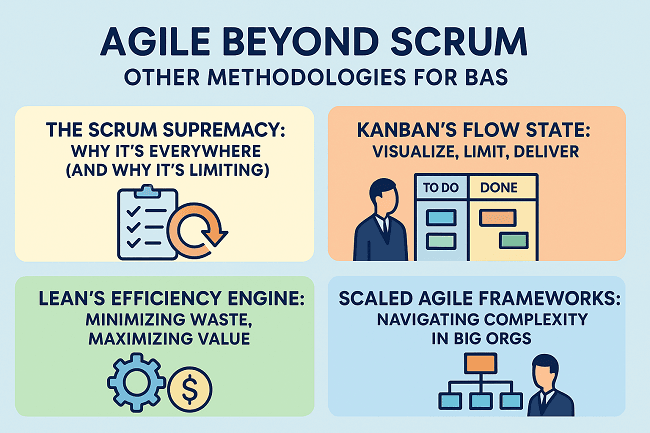
Agile Beyond Scrum: Other Methodologies for BAs

Introduction: Expanding the Agile Horizon

Many Business Analysts (BAs) today work within Scrum frameworks β€” sprint planning, daily stand-ups, and retrospectives have become part of everyday vocabulary. But Agile is much broader than Scrum. Limiting yourself to one framework can restrict your effectiveness, especially in dynamic project environments where flexibility is key.

As the Agile ecosystem evolves, BAs must expand their toolkit to include Kanban, Lean, and Scaled Agile frameworks such as SAFe, LeSS, and Nexus. Understanding these methodologies helps BAs choose the right approach depending on project size, team structure, and delivery goals.

πŸ‘‰ If you’re a BA seeking to future-proof your career, exploring these alternatives is no longer optional β€” it’s essential.


The Scrum Supremacy: Why It’s Everywhere (and Why It’s Limiting)

Why Scrum Became Popular

Scrum is simple, structured, and effective for small, cross-functional teams. It emphasizes iterative development and rapid feedback, making it perfect for product-based organizations.
For BAs, Scrum provides clarity through defined ceremonies:

  • Sprint Planning: Helps translate business needs into user stories.

  • Daily Stand-ups: Keep communication transparent.

  • Sprint Reviews: Allow BAs to confirm stakeholder expectations.

However, despite its popularity, Scrum isn’t a one-size-fits-all solution.

When Scrum Hinders BA Effectiveness

Scrum can become restrictive when:

  • Teams handle unpredictable workloads (like support or operations projects).

  • Organizations operate in multi-team environments where coordination is complex.

  • Continuous flow or frequent releases are critical (e.g., DevOps pipelines).

Real-World Scenario

A BA in a financial institution noticed that constant production fixes were interrupting Scrum sprints. The rigid two-week sprint cadence slowed down response times. After analysis, the team shifted to Kanban, allowing continuous flow without the burden of sprint planning β€” significantly improving delivery speed.

πŸ‘‰ Lesson: A skilled BA identifies when Scrum works β€” and when it doesn’t.


Kanban’s Flow State: Visualize, Limit, Deliver

What is Kanban?

Kanban is a visual workflow management system that promotes continuous delivery and work-in-progress (WIP) limits. Unlike Scrum, it doesn’t prescribe fixed iterations. Instead, tasks flow smoothly from β€œTo Do” to β€œDone.”

BA’s Role in Kanban

Business Analysts are crucial in defining and refining workflow policies:

  • Defining Work Items: Categorize requests, change requests, or production bugs.

  • Setting WIP Limits: Prevent bottlenecks by balancing team capacity.

  • Tracking Metrics: Use Lead Time and Cycle Time for process improvement.

Real-World Example

At an IT service firm, a BA used Kanban boards (via Jira) to manage application maintenance requests. By visualizing tasks and enforcing WIP limits, the BA reduced turnaround time by 40%. Stakeholders gained transparency, and the team avoided burnout.

Learn More

For deeper insights into Kanban principles, visit Kanban.org.


Lean’s Efficiency Engine: Minimizing Waste, Maximizing Value

Understanding Lean Principles

Lean focuses on maximizing customer value while minimizing waste. Originating from Toyota’s production system, Lean principles have been widely adopted in software and business analysis.

The BA as a Waste Detective

A BA applies Lean by:

  • Identifying non-value-add activities like redundant approvals.

  • Reducing handoffs between departments.

  • Enhancing feedback loops between business and IT.

Lean Tools for BAs

  • Value Stream Mapping (VSM): Helps visualize and analyze the flow of materials and information.

  • Kaizen: Continuous improvement mindset for incremental change.

Scenario Example

In a healthcare project, the BA conducted a Value Stream Mapping workshop and discovered that 25% of time was wasted in manual claim verifications. Automating this step saved the client both time and cost β€” a perfect demonstration of Lean thinking in action.

πŸ‘‰ Check out more on Lean concepts from the Lean Enterprise Institute.


Scaled Agile Frameworks: Navigating Complexity in Big Organizations

Why Scaled Agile?

When multiple teams work on interconnected components, a single Scrum framework can’t handle the coordination. That’s where Scaled Agile Frameworks (SAFe, LeSS, Nexus) come in.

SAFe 6.0 and the BA Role

In SAFe 6.0, BAs:

  • Contribute to Program Increments (PIs) β€” large planning sessions aligning multiple teams.

  • Work within Solution Trains to ensure alignment between business strategy and delivery.

  • Collaborate on Feature Breakdown, ensuring requirements flow from strategic themes down to user stories.

Real-World Scenario

A BA working on a telecom program with 10+ Scrum teams used SAFe to align product vision with team-level execution. During PI Planning, the BA clarified dependencies and ensured every user story tied back to a business objective β€” minimizing rework and confusion.

Other Frameworks

  • LeSS (Large-Scale Scrum): Extends Scrum principles across multiple teams.

  • Nexus: Adds integration layers for teams working on a single product.

For more details, visit the Scaled Agile Framework official site.


Your Agile Future: Choosing the Right Tool for the Job

Hybrid Agile Models

In practice, most organizations adopt a hybrid approach β€” combining Scrum, Kanban, and Lean elements.
Example:

  • A product team may use Scrum for feature development.

  • The same team uses Kanban for production support.

  • Lean principles guide overall process efficiency.

A Business Analyst who can recommend and tailor these combinations becomes a strategic advisor, not just a requirements gatherer.

The Adaptive BA

To succeed in diverse environments, the adaptive BA should:

  • Assess project context (team size, goals, constraints).

  • Understand multiple frameworks and select the best fit.

  • Promote continuous learning through certification and community engagement.

Pro Tip: Certifications like ICAgile’s Agile Analysis Certification (IIBA-AAC) can boost your credibility and deepen your understanding of advanced Agile methods.


Continuous Learning: Staying Ahead of the Curve

The Agile world is evolving rapidly. With each new release β€” such as SAFe 6.0 β€” roles, ceremonies, and practices are being refined. Business Analysts must stay updated through:

  • Communities of Practice (CoP) in their organizations.

  • Webinars and courses from IIBA, PMI, or Scaled Agile.

  • Reading resources like Agile Alliance or bacareers.in for practical BA insights.


Conclusion

Scrum may have started your Agile journey, but true mastery lies in understanding the entire Agile landscape. From Kanban’s visual flow to Lean’s waste reduction and SAFe’s scalability, each framework equips Business Analysts with tools to adapt, collaborate, and deliver higher business value.

The modern BA is no longer limited to gathering requirements β€” they’re strategic enablers of agility.

🌟 The more methodologies you master, the more valuable you become to your organization.


Related Articles:


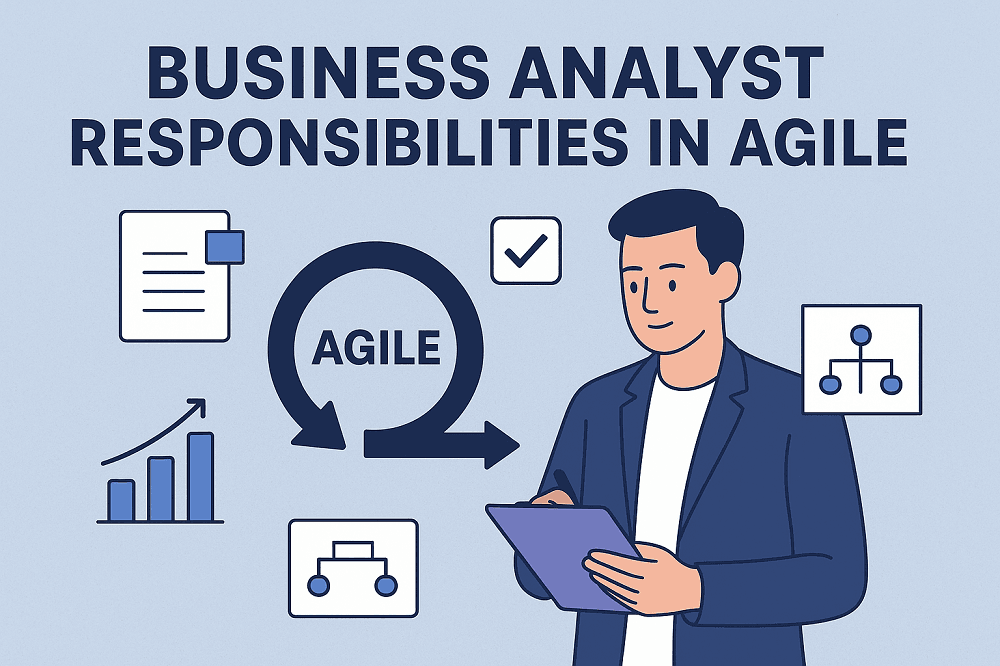
Business Analyst Responsibilities in Agile: Role, Scenarios & Best Practices

Business Analyst Responsibilities in Agile: Role, Scenarios & Best Practices

In today’s fast-paced software and product development environment, Agile methodologies (Scrum, Kanban, SAFe, etc.) have become the norm. But in many Agile teams, there is still a question: what does a Business Analyst (BA) do in an Agile context? How is that role different compared to traditional Waterfall-based BA work? And how does a BA contribute to Agile transformation at organizational scale?

In this article, we’ll dive deep into:

  • The evolving role of a BA in Agile
  • Core responsibilities (with examples)
  • Real-world scenarios
  • The BA’s role during Agile transformation
  • Best practices & tips
  • Suggested internal/external links to complement your site content

Why a Business Analyst is Still Relevant in Agile

Some purists argue that Agile teams should be self-organizing and that a separate BA role isn’t needed. But in practice, many teams and organizations find the BA role indispensable. Here’s why:

  1. Bridging business and technical domains
    Business stakeholders often express needs in high-level language; developers need clarity, scope, and constraints. A BA helps translate.
    As noted by Agile Alliance: in Agile, a BA collaborates with team members to determine how much analysis is needed and decide what documentation is sufficient rather than over-specifying everything up front. agilealliance.org
  2. Supporting the Product Owner
    In many teams, Product Owners (POs) may lack deep domain or analytical skills. The BA can support backlog refinement, stakeholder communication, and requirement decomposition. modernanalyst.com+1
  3. Ensuring value delivery
    Agile is more than just incremental deliveryβ€”it demands constant alignment with business value. A BA helps the team stay focused on delivering the right features at the right time. Avenga+1
  4. Enabling continuous feedback & iteration
    Because requirements evolve, the BA’s work is ongoingβ€”not a one-time upfront activity. They help the team learn, adapt, and evolve requirements. agilealliance.org+1

Hence, the BA in Agile is not a relic of the past, but a modern enablerβ€”so long as they adapt their mindset, tools, and approach to suit iterative delivery.


Key Responsibilities of a Business Analyst in Agile

Below is a detailed breakdown of typical responsibilities of a BA in an Agile environment, along with explanations and example scenarios.

Responsibility AreaWhat It Means / Why It MattersExample / Scenario
Requirement Elicitation & DiscoveryIn Agile, requirements often emerge gradually. The BA works with stakeholders, customers, and the team to elicit needs, uncover constraints, and discover latent requirements.Suppose a bank wants to build a β€œloan-eligibility checker.” The BA meets with loan officers, underwriters, and customers to explore edge cases (e.g. fluctuating income, co-applicants). They surface that the system must account for special income types (freelancers, commissions) that weren’t initially mentioned.
User Story Writing & Acceptance CriteriaThe BA transforms high-level needs into well-formed user stories (or epics), with clear acceptance criteria (given/when/then).From the β€œloan-eligibility checker” above, a user story might be: β€œAs an applicant, I want to input my variable income so that my eligibility is calculated fairly.” Acceptance criteria: β€œIf income varies month-to-month by more than 25%, system flags for manual review.”
Backlog Grooming / Refinement SupportThe BA helps the team break down epics into smaller stories, clarifies backlog items, resolves questions, and ensures stories are β€œready” for sprint planning.In a grooming session, the development team asks whether negative salary entries are allowed. The BA clarifies: no, but they should support zero income in initial months. The BA updates the story accordingly.
Prioritization & Value AssessmentWorking with the PO and stakeholders, the BA helps to rank features based on business value, cost, risk, and dependencies.The BA prepares a cost/benefit analysis showing that integrating with credit bureau APIs now (though complex) yields far higher ROI compared to adding cosmetic UI tweaks.
Stakeholder Management & CommunicationThe BA interacts with stakeholders (business, marketing, operations, compliance) to align expectations, capture feedback, and communicate trade-offs.Monthly demo to compliance officers, collecting feedback on regulatory checks they need. The BA translates compliance feedback into feature requests that the team can implement.
Analysis & ModellingUsing techniques such as process flows, data models, decision tables, mockups, prototypes, or domain models to clarify complex business logic.For loan eligibility, a decision table is created: depending on credit score, debt-to-income ratio, and employment stability, the status is approved/under review/rejected.
Testing / Validation / AcceptanceThe BA helps define test cases from acceptance criteria, participates in user acceptance testing (UAT), and ensures the delivered functionality meets stakeholder needs.After the β€œloan-eligibility” feature is developed, the BA writes edge test cases (e.g. income = 0, fluctuating months, co-applicant with negative credit) and validates results with business users.
Iteration Review & Feedback CaptureIn sprint reviews, the BA solicits feedback, documents requested changes, and assimilates them into backlog updates.During sprint review, marketing suggests adding localization of currency formats. BA captures it as a new backlog item, estimates impact, and helps prioritize it.
Continuous Improvement & RetrospectivesThe BA participates in retrospectives, suggesting process improvements (analysis techniques, tools, communication) and helps the team evolve.In a retrospective, BA observes that the team often lacks clarity on domain assumptions. She proposes adding a short β€œdomain walkthrough” session before grooming.
Coaching & Knowledge SharingThe BA helps other team members (developers, testers) understand domain, facilitates workshops, and encourages shared understanding of the problem space.The BA runs a whiteboard session explaining business domain (loans, interest, amortization) to the dev team, so they better understand the context of decisions.
Supporting Release Planning & RoadmappingThe BA contributes to the product roadmap by aligning feature release plans with business strategy, helping schedule incremental delivery.For the loan product, BA suggests delivering a β€œbasic eligibility checker” in version 1, and a β€œwhat-if scenario simulator” in version 2, so users start getting value early.

Let’s illustrate one of these in a full scenario:

Scenario: Rolling Out a β€œSmart Payment Reminder” Feature
A fintech company wants to send smart payment reminders. The BA works with product, collections, and compliance to discover rules (e.g. when to remind before due date, grace periods, regulatory constraints). The BA writes stories like:

  • β€œAs a customer, I want to receive a reminder 3 days before due date unless I have auto-pay set up.”
  • β€œIf a payment is overdue by more than 10 days, send escalation reminder with late fee notice.”
    The BA helps groom these, clarifies edge cases (e.g. weekends, holidays), participates in sprint planning, and in review captures feedback (e.g. β€œWhat about partial payments?”). Later, the BA writes test scenarios and verifies functionality with collections team.

Role of the Business Analyst in Agile Transformation

When an organization embarks on Agile transformation, it’s not just about changing frameworksβ€”it’s a cultural, structural, and mindset shift. A BA can play a pivotal role in that journey.

1. Change Agent & Agile Advocate

Because BAs often straddle business and technical realms, they can advocate for Agile thinking (incremental delivery, feedback loops, value-based prioritization). In transformations, BAs may mentor or train stakeholders and teams in Agile practices.

2. Process Redesign & Scaling

During transformation, existing business processes (e.g. change control, governance, budgeting) need adjustment to align with Agile. A BA can analyze the current state, identify friction points, and propose new β€œagile-friendly” processes.

3. Align Business Strategy & Agile Implementation

Transformation is meaningless if Agile teams are not aligned to larger business strategy. A BA helps map strategic goals to epics, features, and cross-team dependencies, ensuring alignment.

4. Governance, Metrics & Reporting

In scaling Agile (e.g. SAFe, LeSS, or hybrid models), governance and metrics frameworks are essential. BAs help define what metrics matter (e.g. lead time, throughput, business value delivered), and ensure the reporting is meaningful to stakeholders.

5. Enabling Cross-team Coordination

As multiple Agile teams emerge, dependencies, architectural decisions, and cross-cutting concerns need coordination. The BA can help by facilitating planning, integration, and synchronization across teams.

Real-life transformation example:
In a large bank migrating from project-based waterfall to SAFe, BAs were assigned as Release Train Analysts to coordinate multiple Agile teams, align epics with business domains, and help leadership understand trade-offs. They also ran β€œAgile requirement clinics” to coach teams in writing better stories.


Best Practices & Tips for Agile BAs

To succeed as a BA in Agile, consider the following guiding practices:

  • Adopt an Agile mindset
    Be open to change, embrace uncertainty, and value working software over perfect documentation.
  • Follow β€œjust enough” documentation
    Produce artifacts only when they add valueβ€”don’t overburden with heavy specs. (This is a key Agile shift vs. Waterfall) agilealliance.org+1
  • Collaborate early and often
    Use domain walkthroughs, story workshops, whiteboards, or prototyping to get shared understanding.
  • Do vertical slices
    Help teams break down features into end-to-end slices rather than horizontal chunks (e.g. UI separate from backend).
  • Use visual models
    Flowcharts, decision tables, state diagrams, story maps, journey maps help everyone see the big picture.
  • Encourage team ownership of analysis
    Don’t hoard analytical workβ€”teach developers/testers to participate in analysis so handoffs reduce.
  • Focus on business value
    Use metrics such as ROI, cost of delay, or value scoring to prioritize backlog.
  • Stay close to stakeholders
    Frequent stakeholder feedback avoids surprises late in the development.
  • Iterate & adapt your own practice
    Reflect in retrospectives on how BA practices could improve (e.g. grooming format, pre-read sessions).

Related Articles :

When adding external links, prefer linking to pages that are stable and authoritative to improve credibility (and avoid linking to low-quality or ephemeral content).


Conclusion

The role of a Business Analyst in Agile is both nuanced and vital. Far from being obsolete, a good Agile BA becomes the glue that holds business vision, stakeholder needs, and technical execution togetherβ€”while embracing iteration, collaboration, and value delivery. In transformations, BAs often step up as enablers, aligning business strategy to Agile execution, redesigning processes, and coaching teams.

Agile Business Analysis Techniques – Detailed Guide with Examples

Agile Business Analysis Techniques – Detailed Guide with Examples

Agile Business Analysis TechniquesΒ  –Β  Agile Business Analysis focuses on delivering value quickly and efficiently. Unlike traditional models, Agile Business Analysts (Agile BAs) work closely with the development team and stakeholders throughout the project, not just at the beginning. Below, we’ll dive into key Agile techniques and explain them with real-world examples.

In today’s fast-paced digital world, businesses need to adapt quickly. That’s where Agile methodology and Agile Business Analysis techniques come into play. A Business Analyst (BA) working in Agile projects acts as a bridge between stakeholders and development teams, ensuring that business needs are clearly understood and delivered in small, iterative cycles.

Continue reading “Agile Business Analysis Techniques – Detailed Guide with Examples”

Design Thinking for Business Analysts : A User-Centric Approach to Problem Solving

Design Thinking for Business Analysts : A User-Centric Approach to Problem Solving

Design Thinking for Business Analysts : In today’s fast-paced digital world, Business Analysts (BAs) are not just responsible for gathering requirements or analyzing data β€” they are also expected to create innovative and user-centric solutions. That’s where Design Thinking for Business Analysts becomes a powerful tool.

In this article, we will explore:

  • What is Design Thinking in Business Analysis?

  • Why is Design Thinking important for Business Analysts?

  • Key steps of Design Thinking with examples

  • How Business Analysts can apply Design Thinking

  • Tools and techniques used in Design Thinking

  • FAQs and SEO-rich keywords like: Design Thinking examples for business analysts, Design Thinking business analyst resume, Design Thinking approach in business analysis, and more.

Continue reading “Design Thinking for Business Analysts : A User-Centric Approach to Problem Solving”

Business Analyst Skills Required: A Comprehensive Guide

Business Analyst Skills Required: A Comprehensive Guide

Business Analysts play a crucial role in bridging the gap between business needs and technological solutions. Whether you’re a fresher aspiring to enter this field or an experienced professional looking to upskill, understanding the essential skills required for a Business Analyst is vital. This article will explore the key technical and soft skills, the importance of SQL, and the tools used in business analysis.

Continue reading “Business Analyst Skills Required: A Comprehensive Guide”

Business Analysis Templates and Examples

Business Analysis Models and Models

Business Analysis Templates and Examples : Business analysis is a key activity that helps organizations understand needs, solve problems and achieve goals. To simplify this process, business analysts often use templates, which provide a structured format for writing and organizing good information. In this article, we will discuss what a business analysis template is, how to write a business analysis template, how to prepare a business analysis report, and examine the five elements of a business analysis based on circumstances. that’s right.

Business Analysis Templates and Examples


What
is a business analysis model?

Continue reading “Business Analysis Templates and Examples”

Industry-specific Business Analysis: Healthcare and Finance

In the evolving landscape of business, industry-specific business analysis has become a crucial element in enhancing operational efficiency, driving growth, and ensuring compliance with regulatory standards. This article explores the role of business analysts in the healthcare and finance sectors, providing insights into salaries, roles and responsibilities, requirements, certifications, skills, and job opportunities.

Continue reading “Industry-specific Business Analysis: Healthcare and Finance”

error

Enjoy this blog? Please spread the word :)