

Get new posts by email:
Powered by follow.it

Agile vs Waterfall for Business Analysts: Key Differences, Roles & Real Examples (2026 Guide)

Agile vs Waterfall for Business Analysts: Complete Beginner Guide with Real Examples

Are You Confused Between Agile and Waterfall?

Agile vs Waterfall for Business Analysts – Imagine spending 8 months collecting requirements for a project and just before release the client says:

πŸ‘‰ β€œThis is not what we wanted.”

Now imagine another project where requirements keep changing every 2 weeks and the Business Analyst is struggling to manage the changes.

So which methodology actually works better for Business Analysts β€” Agile or Waterfall?

Understanding the difference between Agile and Waterfall is extremely important for Business Analysts in 2026 because most IT companies expect BAs to understand both methodologies during interviews and real-time projects.

In this article, we will understand:

  • Agile vs Waterfall explained simply
  • Business Analyst responsibilities in both models
  • Real banking and e-commerce examples
  • Which methodology pays more
  • Which one is easier for freshers
  • Interview questions related to Agile and Waterfall
  • Why most companies now use hybrid models
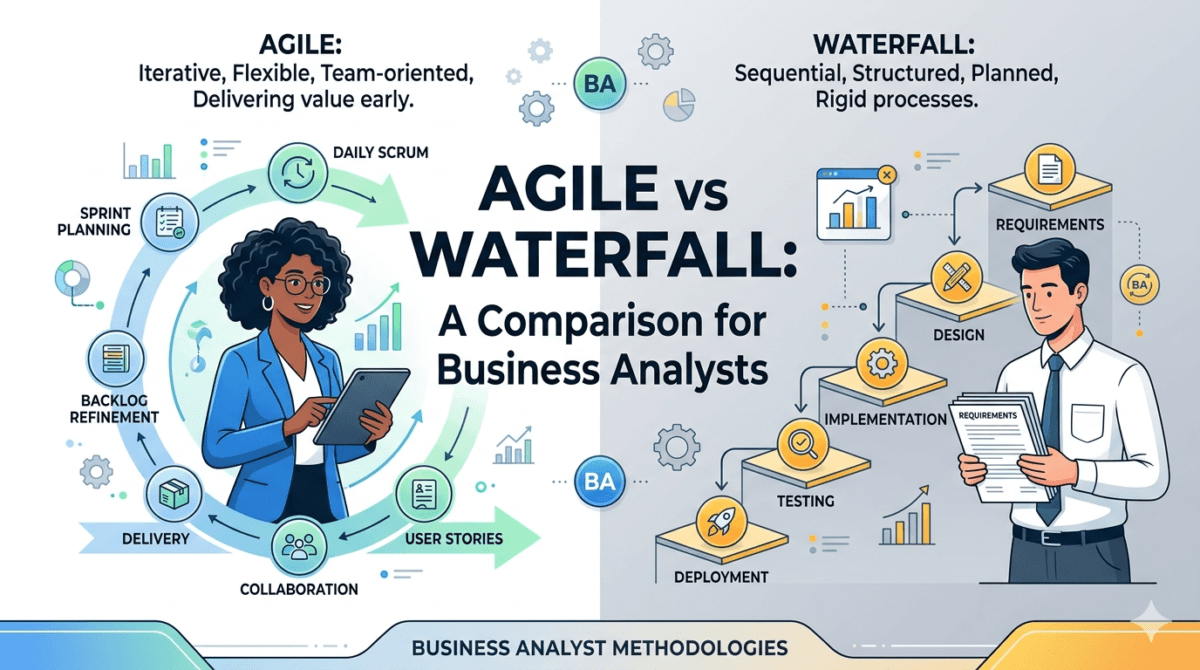
Agile vs Waterfall methodology comparison for Business Analysts
Difference between Agile and Waterfall methodologies for Business Analysts

πŸŽ₯ Watch the complete YouTube video explanation below for real-time examples and interview tips.Β 


What is Waterfall Methodology?

Waterfall methodology is a traditional project management approach where work happens in sequence.

That means one phase must finish before the next phase starts.

Waterfall Process Flow

  1. Requirements Gathering
  2. Design
  3. Development
  4. Testing
  5. Deployment

In the requirement phase, Business Analysts and stakeholders gather all requirements.

After gathering the requirements, the team designs the solution and decides:

  • Technologies to use
  • Development approach
  • Architecture design

Once the design is completed:

  • Developers start development
  • Testers perform testing
  • Finally, the product is deployed to production

Real-Time Banking Example in Waterfall

Imagine building a banking loan application system.

The Business Analyst collects all requirements upfront, including:

  • Loan rules
  • Interest calculations
  • Eligibility criteria
  • Security requirements
  • Reports

Only after completing documentation does development begin.

This is one of the biggest characteristics of Waterfall methodology.


Business Analyst Role in Waterfall

In Waterfall projects, Business Analysts spend most of their time on documentation and requirement management.

Main Responsibilities of BA in Waterfall

  • Gathering detailed requirements
  • Writing BRD documents
  • Writing FRD documents
  • Getting stakeholder approvals
  • Managing requirement sign-offs
  • Supporting UAT testing

Biggest Problem in Waterfall Methodology

The biggest challenge in Waterfall is handling requirement changes.

Imagine the product is already developed and currently in testing phase.

Suddenly the client says:

πŸ‘‰ β€œWe need requirement changes.”

Now changing the requirement becomes:

  • Expensive
  • Time-consuming
  • Difficult to implement

This is one of the major disadvantages of Waterfall methodology.


What is Agile Methodology?

Agile methodology focuses on continuous delivery and continuous feedback.

Instead of waiting 8 months for final delivery, Agile teams release features continuously in small cycles called sprints.

Agile Example

Most Agile teams work in:

  • 2-week sprint cycles
  • Continuous development model
  • Incremental delivery approach

Real-Time E-Commerce Example in Agile

Imagine an online shopping application like:

  • Amazon
  • Flipkart

Instead of building the entire website together, Agile teams deliver features step by step.

For example:

Sprint 1

  • Login functionality

Sprint 2

  • Product search

Sprint 3

  • Shopping cart

Sprint 4

  • Payment gateway integration

This helps teams receive continuous customer feedback.


Business Analyst Role in Agile

In Agile methodology, Business Analysts work closely with Scrum teams.

Main Responsibilities of BA in Agile

  • Writing user stories
  • Clarifying requirements daily
  • Participating in sprint planning
  • Supporting Product Owner
  • Managing backlog refinement
  • Collaborating with development teams

Biggest Mistake Business Analysts Make in Agile

Many Business Analysts continue writing huge 200-page BRD documents in Agile projects.

But Agile focuses more on:

  • Collaboration
  • Communication
  • Continuous feedback

Agile does not require massive documentation like Waterfall.


Agile vs Waterfall: Key Differences

FeatureWaterfallAgile
Requirement ChangesDifficultEasy
DocumentationHeavyLightweight
Customer FeedbackLateContinuous
Delivery SpeedSlowFast
FocusDocumentationCollaboration
Best ForStable ProjectsDynamic Projects

Which Methodology is Better for Business Analysts?

This is one of the most common interview and career questions.

The answer depends on project type and company requirements.


Advantages of Agile Methodology

Why Agile is Popular

  • High demand in IT industry
  • Better salary opportunities
  • Faster project delivery
  • Strong collaboration culture
  • Preferred in modern software companies

Most Business Analyst job descriptions today mention Agile methodology.

That is why understanding Agile is very important for interviews.


Advantages of Waterfall Methodology

Why Waterfall is Still Important

  • Clear documentation
  • Easier requirement tracking
  • Better for government projects
  • Better for banking applications
  • Structured process

Many banking and government projects still use Waterfall methodology.


The Truth Recruiters Won’t Tell You

Most companies today use:

Hybrid Models

That means companies combine:

  • Agile practices
  • Waterfall documentation
  • Scrum processes
  • Traditional approvals

So Business Analysts must understand both Agile and Waterfall methodologies.


Agile vs Waterfall Interview Questions for Business Analysts

Question 1

What is the difference between Agile and Waterfall?

Question 2

What is your role as a BA in Agile projects?

Question 3

How do requirement changes work in Waterfall?

Question 4

What are user stories in Agile?

Question 5

Why is Agile preferred in modern IT companies?


Key Takeaways

Waterfall

βœ… Best for stable projects
βœ… Heavy documentation
βœ… Sequential process
βœ… Difficult requirement changes

Agile

βœ… Best for dynamic projects
βœ… Continuous feedback
βœ… Faster delivery
βœ… Collaboration-focused


Final Thoughts

Now that you understand Agile vs Waterfall, it becomes easier to decide which methodology fits your Business Analyst career goals.

If you are preparing for interviews in 2026, make sure you understand:

  • Agile concepts
  • Waterfall concepts
  • Scrum basics
  • User stories
  • Requirement gathering
  • Hybrid project models

Because most companies today expect Business Analysts to work in Agile environments while still understanding traditional Waterfall processes.


Real-Time Examples

Banking Example (Waterfall)

A banking loan application project collects all requirements before development starts.

This includes:

  • Loan eligibility
  • Interest calculations
  • Security rules
  • Reports

E-Commerce Example (Agile)

An online shopping application delivers features sprint by sprint:

  • Login
  • Product search
  • Cart
  • Payment integration

This helps teams gather continuous feedback.

Related Articles :

  1. Agile Methodology for Business Analysts
  2. User Story Writing Best Practices
  3. BRD vs FRD Explained
  4. Scrum Master vs Business Analyst
  5. Requirement Gathering Techniques
  6. https://Scrum.org
  7. https://IIBA.org

FAQ’s

What is Agile methodology?

Agile is a software development methodology where teams deliver features in small sprint cycles with continuous customer feedback.

What is Waterfall methodology?

Waterfall is a traditional step-by-step project methodology where one phase finishes before the next phase starts.

Which is better Agile or Waterfall?

Agile is better for dynamic projects while Waterfall is better for stable projects with fixed requirements.

What is the role of a Business Analyst in Agile?

Business Analysts in Agile write user stories, clarify requirements, support sprint planning, and manage backlog refinement.

Why do companies prefer Agile?

Companies prefer Agile because it supports faster delivery, continuous feedback, and quick requirement changes.

Is Waterfall still used?

Yes. Waterfall is still widely used in banking, healthcare, and government projects.

error

Enjoy this blog? Please spread the word :)