

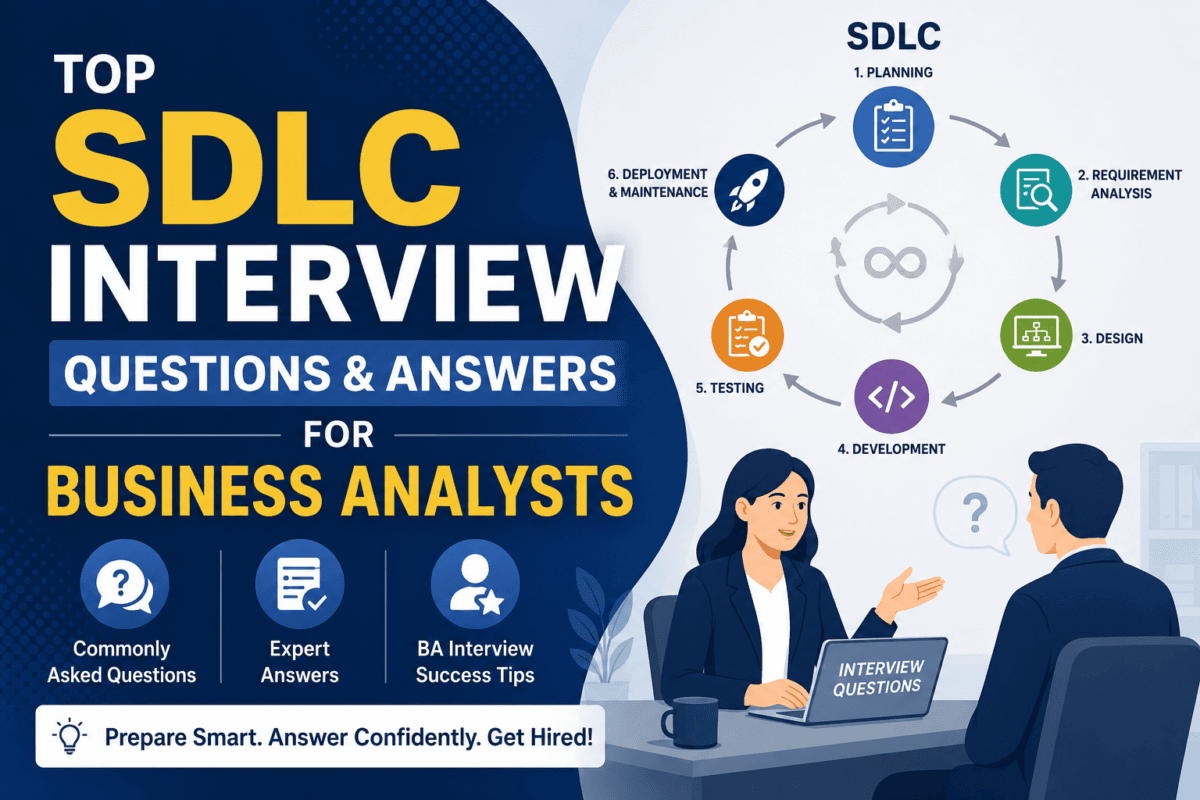
SDLC Interview Questions For Business Analyst
Let us observe some of the important SDLC Interview Questions for Business Analyst.
Best Business Analyst Interview Questions –SDLC
Here is the rundown of some typical questions related to SDLC for Business Analysts. The goal behind asking this SDLC interview question is to gauge the BA’s approach to requirements during different phases of the software development life cycle. The SDLC questions can include aspects such as BA deliverables per phase,difference between Waterfall and Agile,how to handle mid-project change request,or BA role during UAT.
Introduction
The Software Development Life Cycle (SDLC) is the foundation for the design, development, testing, and deployment of any software product or service.
During your Business Analyst interview, you will be presented with an array of SDLC interview questions designed to understand how you translate loose initial ideas into actual usable software applications, whether at junior, senior, or lead BA level. Getting the answer right will set you apart from your competitors.
Below you will find some common SDLC interview questions, together with model answers and phase-mapping information.
Section 1: Core SDLC Phase Questions & Answers
Q1.What are the phases of SDLC and how does a Business Analyst contribute?
Model Answer : The SDLC goes through several main phases:
1. Feasibility and inception: We assess whether the proposed project is viable, conduct a feasibility study, and calculate ROI.
2. Requirements analysis: We gather and analyze the detailed needs of users and stakeholders, documenting them as specifications such as business requirement documents (BRDs), functional requirement documents (FRDs) or user stories.
3.System design: We design the overall system architecture, including user interfaces and data models, based on the requirements.
4. Development (coding): We build the software code based on the specifications created.
5. Testing (QA and UAT): we verify that the software works correctly against the agreed acceptance criteria through quality assurance (QA) and User Acceptance Testing (UAT).
6.deployment and maintenance: We release the software to production and provide ongoing support and updates.
A Business Analyst has responsibilities across all phases, but the area of most significant impact is usually requirements analysis.
During this stage, my primary responsibility is to bridge the gap between business stakeholders and the development team, ensuring clarity, precision, and completeness of business requirements and specifications. It’s the most cost-effective stage to catch errors, as it is considerably less expensive to identify a defect in the requirements stage than in a released product (as much as 100x less expensive!).
Q2.What is the difference between BA deliverables in Waterfall and Agile SDLCs?
Model Answer :
In a Waterfall SDLC, requirements are collected at the beginning of the project, resulting in extensive documentation like BRDs and FRDs that require explicit stakeholder sign-off before the development process can begin.
In contrast, Agile SDLCs employ iterative development cycles, often using a Product Backlog which is continuously refined, with requirements broken down into user stories that have specific ‘Given-When-Then’ acceptance criteria and delivered incrementally in short sprints.
Q3. Can you define UAT and outline a BA’s involvement in it?
Model Answer :
User Acceptance Testing (UAT) is the stage where the end-users or client testers evaluate the software to ensure it meets the business requirements and is ready for production deployment.
As a BA during UAT, I facilitate this process by designing and developing comprehensive test plans and test cases based on the business requirements, guiding business users with less technical expertise, helping triage bugs (distinguishing actual defects from feature enhancements or change requests), and coordinating the formal business sign-off for the product.
Section 2: Scenario-Based SDLC Questions
Q4. How do you handle a Change Request (CR) introduced mid-development?
Model Answer
“If someone introduces a feature request while a team is in active development, the process is the formal change control process.
*First, we’ll perform an impact analysis. This covers scope, timeline, budget, architecture, and release schedule implications.
* Second, we identify the trade-offs to present to the Product Owner or Sponsor (i.e., add more budget, extend release date, or remove an equivalent sized feature). If accepted, we document the Change Request (CR) and then ensure we update the user stories and functional requirements document.”
* Q5.What is a traceability matrix and its importance during SDLC?
Model Answer
“A requirements traceability matrix (RTM) connects business requirements to functional specifications, code defects, and test cases. It helps to ensure that requirements are tested by providing coverage evidence and helps scope creep by spotting features added by someone that were not actually requested.”
BA Deliverables Across SDLC Phases
Use this reference table to articulate your deliverables in interviews:
| SDLC Phase | BA Key Activity | Primary Deliverable / Artifact |
| Inception | Business case evaluation & feasibility analysis. | Project Charter, Stakeholder Map, Vision Doc. |
| Requirements | Elicitation interviews, JAD workshops, workflow design. | BRD, FRD, User Stories, Acceptance Criteria. |
| Design | Visualizing workflows & user interactions. | Wireframes, Mockups, Activity Diagrams, Use Cases. |
| Development | Clarifying functional logic & managing scope updates. | Backlog Refinement, Change Request (CR) Logs. |
| Testing | Facilitating UAT & defect management. | UAT Test Scripts, RTM, Defect Log, UAT Sign-off. |
| Deployment | Preparing organizational change readiness. | User Manuals, Standard Operating Procedures (SOPs). |
Few More Important Interview Questions.
What is SDLC?
SDLC stands for software development lifecycle. It is a set of processes and activities that are performed throughout the entire life cycle of developing software. These processes help ensure quality products are delivered to customers.
How does SDLC differ from waterfall model?
The waterfall model is a traditional approach to software development where requirements are gathered at the beginning of the project and then followed by design, coding, testing, and deployment. In contrast, the agile methodology focuses on delivering working software frequently, responding to changing customer demands, and incorporating feedback early and often.
How do you define Agile?
Agile is a collection of methods, techniques, and practices that promote collaboration among cross-functional teams to produce high-quality software. Agile emphasizes self-organizing teams, continuous integration, and short iterations.
What are some advantages of using Agile methodologies?
Using Agile methodologies helps teams focus on building great products rather than spending time managing processes. Teams can respond to changes in their environment more effectively. By focusing on delivering working software frequently and iterating continuously, teams can incorporate feedback early and often. Agile methodologies encourage transparency and communication between team members.
What are some disadvantages of using Agile method?
Teams may not have enough time to plan ahead and prepare for upcoming tasks. Using Agile methodologies requires a lot of upfront planning and preparation.
What is Scrum?
Scrum is a framework for organizing work and tracking progress in small increments called sprints. Each sprint contains a series of tasks that are completed over a period of two weeks. At the end of each sprint, the team meets to review what was accomplished and discuss how they can improve upon the previous sprint.
What is Kanban?
Kanban is a visual management tool that provides a way to track workflow and prioritize tasks. Kanban boards display information about current projects and allow users to visualize the flow of work. Kanban boards are useful for keeping track of the status of ongoing projects.
What is the difference between a waterfall model and agile methodologies?
Waterfall Model: In the waterfall model, each phase of the project is completed before moving onto the next phase. Agile Methodologies: In agile methods, teams work together to complete the project at the same time.
How would you define SDLC?
The Software Development Life Cycle (SDLC) is a series of steps followed while developing software. These steps include requirements gathering, design, coding, testing, deployment, and maintenance.
What should I expect from an SDLC interview?
What do you want to achieve?
This question is often asked at the beginning of any project. You need to know what you want to accomplish before you begin working on the project. If you don’t have a clear idea of what you want to accomplish, then you won’t be able to create a plan to get there.
How long does the project take?
The length of time it takes to complete the project is dependent upon many factors including scope, complexity, team size, skill level, etc. However, if you’re not sure how much time it’s going to take, you might consider breaking down the project into smaller pieces. That way, you’ll be able to estimate the amount of time each piece will take and adjust accordingly.
How will you measure success?
Successful projects are measured by their outcome. You may choose to use quantitative measures (e.g., number of units produced) or qualitative measures (e.g. customer satisfaction). Regardless of the type of measurement you choose, make sure that you define what success looks like for your organization.
Who else will be involved in the project?
You should always involve others who will be affected by the project. These people could be internal stakeholders (i.e., employees), external stakeholders (i.e. customers), or both. Make sure that everyone understands the goals of the project and agrees to those goals.
What are the risks associated with the project?
Risks are anything that can happen that would prevent the project from being successful. Risks can be divided into two categories: known and unknown. Known risks are things that you already know about and can account for them ahead of time. Unknown risks are things that you don’t know about until they occur. When dealing with unknown risks, you should try to mitigate them as best as possible.
What are the dependencies of the project?
Dependencies are tasks that must be completed before you can start work on the project. Dependencies can be broken down into three types: mandatory, recommended, and optional. Mandatory dependencies are tasks that must be done first. Recommended dependencies are tasks that you should do first unless there is a compelling reason not to. Optional dependencies are tasks that you can do later if necessary.
What is the schedule for completing the project?
A schedule is a timeline that shows when different activities will be performed. A good schedule helps you to stay organized and manage expectations. It also gives you a sense of urgency and lets you know when you need to start doing something.
How do I prepare for an SDLC interview?
Research the company
Before applying for any job, research the company thoroughly. Find out what their mission statement is, how they operate, who their clients are, etc. You want to make sure you’re going to fit in well with them and that you’ll have something in common with the people you work with.
Prepare yourself mentally
Prepare yourself mentally for the interview. Know what questions you’re going answer and what you’re going say beforehand. Practice answering these questions aloud if possible. If not, then write down some sample answers beforehand and practice reading them off of paper.
Dress appropriately
Dress professionally. Wear clothes that are clean and pressed. Make sure your hair is neat and tidy. Don’t wear anything that might distract others from your appearance.
Be confident
Be confident! Even if you don’t feel confident, fake it until you make it. Pretend you’re excited about the opportunity and act like you know everything about the company.
Smile
Smile! A genuine smile goes a long way. People will notice it and it will give you a positive vibe.
Have fun
Have fun! Enjoy yourself and enjoy the experience.
Show enthusiasm
Show enthusiasm for the position. Show interest in the company and show excitement about the opportunity.
These are the some of the important SDLC Interview Questions for Business Analyst.
Below articles will help you to understand on Waterfall Methodology and Agile Methodology and provide some of SDLC Interview Questions.
- What is SDLC ?
- What is Waterfall Methodology or Model in SDLC ?
- What are the Advantages of Waterfall Model?
- Agile vs Waterfall or Difference between waterfall and Agile
- Agile Methodology in Software Development Life Cycle
🎁 Become a Better Business Analyst
Join 1,200+ Business Analysts learning every week.
Get instant access to:
📘 FREE Business Analyst Templates
🎯 Interview Preparation Guides
🚀 Agile & Scrum Tutorials
🤖 AI for Business Analysts
📈 Career Growth Tips
100% Free • No Spam • Unsubscribe Anytime
