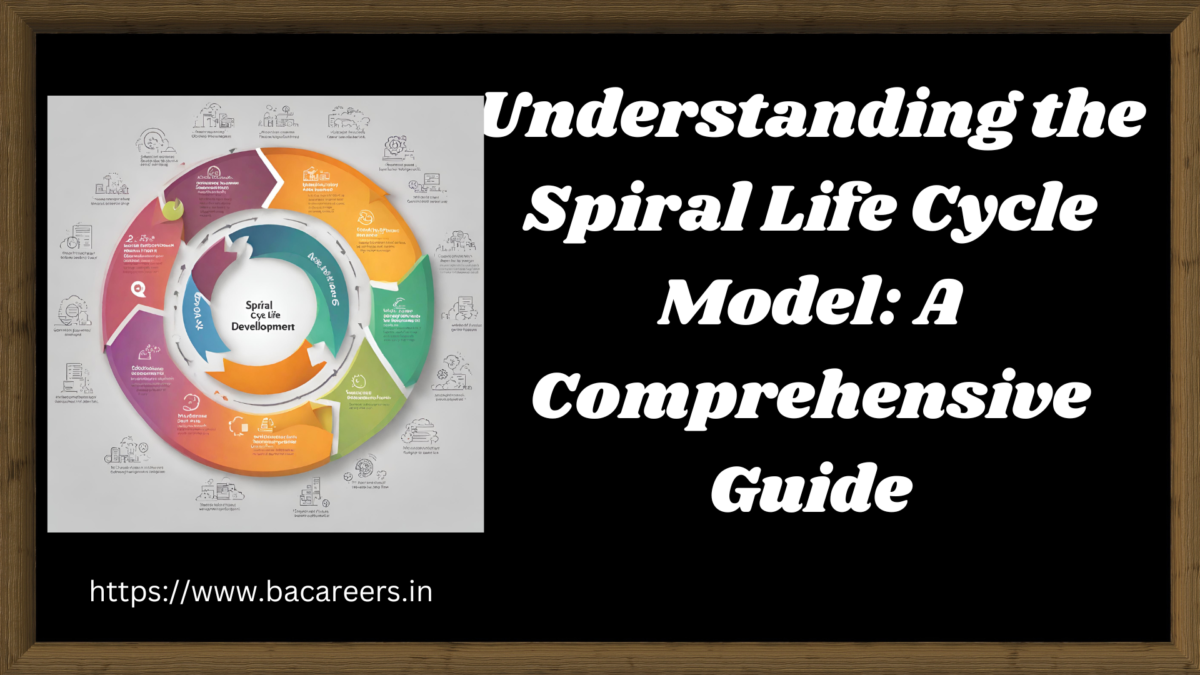
The Spiral Life Cycle Model is a risk-driven Software Development Life Cycle (SDLC) model that combines the iterative nature of Agile development with the controlled, systematic aspects of the traditional Waterfall model. First introduced by Barry Boehm in 1986, the Spiral model is specifically designed for high-risk, large-scale, complex software projects where requirements may evolve over time.
Unlike purely linear or strictly iterative models, the Spiral model explicitly centers around risk analysis and management at every stage of development.
spiral life cycle model
What Is the Spiral Life Cycle Model?
The Spiral model visualizes project progress as a expanding spiral with multiple loops (or iterations). Each loop represents a phase of the software development process, starting from the center (project initiation) and moving outward as the product matures.
Core Focus: Continuous risk identification, assessment, mitigation, and prototyping before moving to subsequent phases.
Key Characteristic: Flexible and adaptable—allows teams to incorporate user feedback and handle changing requirements early in the project lifecycle.
The 4 Quadrants of the Spiral Model
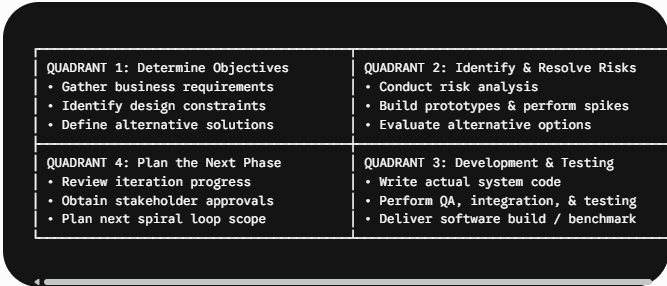
Each loop/iteration of the spiral is divided into four distinct quadrants that every development cycle must pass through:
The 4 Quadrants of the Spiral Model
1. Quadrant 1: Objective Setting & Identification
In this initial stage of each loop, the team gathers business requirements, identifies operational constraints, and defines functional objectives. Business Analysts work to map out what the iteration aims to accomplish.
2. Quadrant 2: Risk Assessment & Mitigation
This is the defining feature of the Spiral model. The team analyzes potential technical, financial, and operational risks. Technical prototypes, proof-of-concept builds (POCs), or architectural spikes are developed to test feasibility and resolve ambiguities.
3. Quadrant 3: Development & Validation (Engineering)
Once risks are mitigated, actual engineering takes place. Developers build software components based on the approved iteration design, followed by system integration, quality assurance, and User Acceptance Testing (UAT).
4. Quadrant 4: Review & Planning for Next Phase
The iteration outcome is evaluated with key business stakeholders. The team reviews progress, assesses budget/timeline parameters, and plans the scope for the next spiral loop.
When to Use the Spiral Model
While effective, the Spiral model involves significant management overhead and expertise. It is best suited under specific project conditions:
High-Risk Projects: System implementations where failure carries catastrophic financial, operational, or legal consequences (e.g., aerospace, medical devices, defense, core banking).
Unclear or Complex Requirements: Projects where initial specifications are incomplete or expected to evolve significantly over time.
Large-Scale Enterprise Applications: Long-term software products requiring continuous prototyping and customer evaluations before full release.
Spiral Model vs. Waterfall vs. Agile
Feature / Aspect
Spiral Life Cycle Model
Waterfall Methodology
Agile Framework
Primary Focus
Risk evaluation & reduction
Plan-driven sequential execution
Rapid value delivery & flexibility
Requirements
Elicited iteratively per spiral loop
Defined completely upfront
Captured in backlogs as User Stories
Prototyping
Extensive & mandatory each loop
Minimal / None
Incremental working software delivered
Flexibility
High (accommodates changes via loops)
Low (requires formal Change Control)
Maximum (adaptable per sprint)
Cost & Overhead
High (requires risk management experts)
Moderate / Fixed upfront
Flexible / Continuous estimation
Real-World Scenario: Healthcare Patient Portal Development
Context: A medical technology company is building an AI-assisted diagnostic patient portal with strict HIPAA compliance requirements.
Spiral Loop 1 (Core Feasibility): Focuses on testing AI diagnostic accuracy. The team builds a working prototype (Quadrant 2) to validate medical data algorithms before writing production code.
Spiral Loop 2 (Data Security & Integration): Focuses on secure integration with Hospital Information Systems (HIS). Encryption mechanisms and compliance risks are analyzed and tested.
Spiral Loop 3 (Full Product Release): Adds user interfaces, patient billing, and complete workflow features, leading to final regulatory audits and deployment.
Principles of the Spiral Life Cycle Model
The Spiral Model is founded on several key principles:
Iterative Development: Unlike traditional linear models like the Waterfall, the Spiral Model embraces iteration. It recognizes that software development is an iterative process where requirements evolve over time.
Risk Management: One of the distinguishing features of the Spiral Model is its emphasis on risk management. It acknowledges that software projects are inherently risky due to uncertain requirements, technical challenges, and changing environments. The model integrates risk analysis and mitigation strategies into each iteration.
Prototyping: Prototyping is integral to the Spiral Model. It allows stakeholders to visualize the system early in the development process, gather feedback, and refine requirements iteratively.
Flexibility: The Spiral Model is highly adaptable to various project types and sizes. It can accommodate both small-scale projects with limited resources and large-scale projects with complex requirements.
Phases of the Spiral Life Cycle Model
The Spiral Life Cycle Model consists of four main phases, which are iteratively repeated throughout the development process:
Planning: In this phase, project objectives, constraints, and alternatives are identified. This includes defining the scope, schedule, and resources required for the project. Additionally, risk analysis is conducted to identify potential risks and develop mitigation strategies.
Risk Analysis: Risk analysis is a critical component of the Spiral Model. In this phase, risks are identified, assessed, and prioritized based on their potential impact on the project. Strategies are then developed to mitigate or manage these risks effectively.
Engineering: The engineering phase involves the development of the software incrementally. Each iteration focuses on implementing a subset of requirements and features. Prototypes may be developed to gather feedback from stakeholders and validate design decisions.
Evaluation: The evaluation phase involves reviewing the progress made in the previous iterations. This includes assessing the quality of the developed software, identifying areas for improvement, and updating the project plan and risk analysis as necessary. Based on the evaluation, the decision is made to proceed to the next iteration or cycle.
How to Use the Spiral Life Cycle Model
Define Objectives and Requirements: Clearly define the project objectives and gather requirements from stakeholders. Identify key features and functionalities that need to be developed.
Risk Analysis and Planning: Conduct a thorough risk analysis to identify potential risks and uncertainties associated with the project. Develop a plan that outlines the project scope, schedule, resources, and risk mitigation strategies.
Iterative Development: Implement the Spiral Model in iterative cycles. Begin with small iterations focusing on high-priority features. Develop prototypes to gather feedback and refine requirements iteratively.
Continuous Evaluation and Adaptation: Regularly evaluate the progress made in each iteration. Assess the quality of the software and identify areas for improvement. Update the project plan and risk analysis based on the evaluation findings.
Iterate: Repeat the cycle of planning, risk analysis, engineering, and evaluation until the project objectives are achieved satisfactorily. Each iteration builds upon the previous one, resulting in a refined and validated software product.
Conclusion
The Spiral Life Cycle Model offers a flexible and iterative approach to software development, particularly suitable for projects with evolving requirements and inherent risks. By integrating risk management, iterative development, and prototyping, the Spiral Model enables teams to effectively manage uncertainties and deliver high-quality software products. By understanding the principles and phases of the Spiral Model and following best practices, software development teams can leverage its benefits to successfully navigate complex projects and deliver value to stakeholders.
Overall, the Spiral Life Cycle Model offers a flexible and adaptive approach to software development, making it a valuable tool for projects with evolving requirements or uncertain constraints. By understanding the principles and phases of this model, teams can enhance their development processes and deliver high-quality software products efficiently.
The Spiral Life Cycle Model is a risk-driven Software Development Life Cycle (SDLC) model that combines iterative prototyping with systematic, controlled planning across four distinct quadrants.
By conducting continuous risk analysis and mitigation during every phase, Business Analysts, Solution Architects, and Project Managers can manage high-risk, large-scale enterprise software projects effectively.
📄 Business Analysis Documentation Hub
Explore where the Spiral Model fits into the complete software lifecycle and requirements documentation ecosystem:
Contrast long-term risk iteration tracking with daily sprint burndown tracking in Agile delivery management.
Frequently Asked Questions (FAQs)
What is the main advantage of the Spiral Life Cycle Model?
The main advantage is its proactive focus on risk management and prototyping, which significantly reduces project failure rates for complex or high-risk initiatives.
Why is the Spiral model not ideal for small projects?
Because each spiral loop requires rigorous risk evaluation, feasibility studies, and documentation, the overhead cost and complexity make it inefficient for small or low-budget applications.
Who leads risk management in a Spiral project?
Business Analysts, System Architects, and Risk Management Leads collaborate to identify operational gaps, technical constraints, and compliance requirements in Quadrant 2 of each loop.
🎁 Become a Better Business Analyst
Join 1,200+ Business Analysts learning every week.
Get instant access to:
📘 FREE Business Analyst Templates
🎯 Interview Preparation Guides
🚀 Agile & Scrum Tutorials
🤖 AI for Business Analysts
📈 Career Growth Tips
100% Free • No Spam • Unsubscribe Anytime
Author: Pallavi Kunduri
Experienced Business Analyst, SME (Subject Matter Expert), and Educator specializing in Agile and Scrum methodologies, requirement gathering, BRD/FRD documentation, User Stories, and Business Process Management.
View all posts by Pallavi Kunduri