
FREE DOWNLOAD: Business Analyst Documentation Toolkit
Get instant access to real-world BRD, FRD, and project story templates used by senior BAs.
Download Free Templates PDFWhat is a Scrum Master? (Definition & Core Meaning)
A Scrum Master is a dedicated servant-leader and Agile facilitator responsible for promoting and supporting the Scrum framework within an organization. They act as a bridge between the Product Owner and the Development Team, ensuring that Scrum theory, practices, and values are understood and adhered to while removing impediments that hinder sprint velocity.
Unlike a traditional project manager, a Scrum Master does not assign tasks or manage people top-down; instead, they coach the team on self-organization, cross-functional collaboration, and continuous process improvement.
The 3 Pillars of Scrum Master Responsibilities
1. Serving the Product Owner $\rightarrow$ Helping find techniques for effective Product Backlog management, clearly communicating product goals, and facilitating backlog refinement sessions.
2. Serving the Development Team $\rightarrow$ Coaching team members in self-organization and cross-functionality, removing blockers, and fostering a high-performance, collaborative engineering environment.
3. Serving the Organization $\rightarrow$ Leading Agile adoption across departments, planning Scrum implementations, and collaborating with other Scrum Masters to optimize organizational effectiveness.
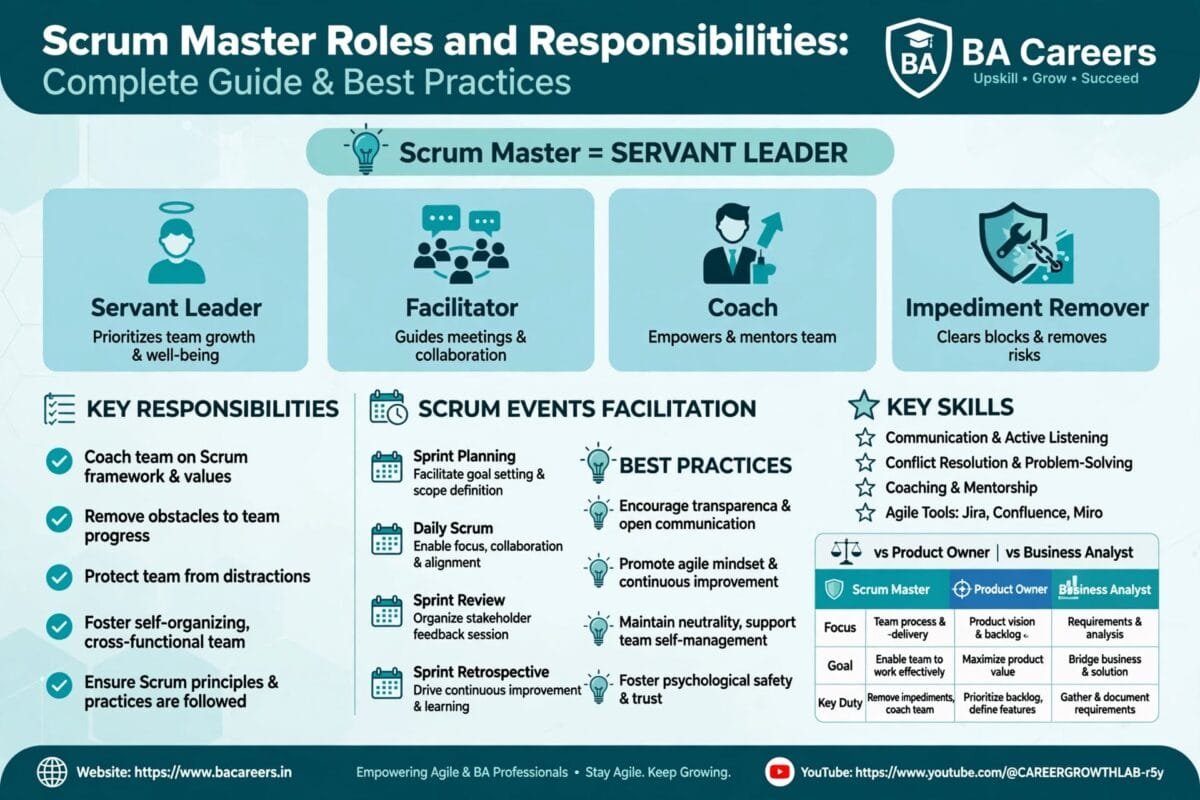
Daily & Sprint-Level Scrum Master Responsibilities Flow
Sprint Planning $\rightarrow$ Facilitating the planning session to ensure the team commits to a realistic, achievable sprint goal and backlog scope.
Daily Standup / Scrum $\rightarrow$ Ensuring the 15-minute daily sync stays focused on progress toward the sprint goal rather than deep technical problem-solving.
Sprint Review / Demo $\rightarrow$ Helping the Product Owner organize stakeholder reviews and collecting actionable feedback on increment deliverables.
Sprint Retrospective $\rightarrow$ Hosting continuous improvement workshops where the team inspects processes and sets up actionable experiments for the next sprint.
Scrum Master vs. Product Owner vs. Project Manager
| Role | Primary Focus | Key Responsibilities | Authority Style |
| Scrum Master | Process, team coaching, impediment removal. | Facilitates Scrum ceremonies, removes blockers, protects team. | Servant-Leader (no direct authority). |
| Product Owner | Product value, backlog prioritization, ROI. | Manages product backlog, defines acceptance criteria, stakeholder alignment. | Value-Driven Decision Maker. |
| Project Manager | Scope, budget, timelines, resource allocation. | Traditional project planning, risk management, budget tracking. | Directive Management. |
🏦 Real-Time Scenario: Removing Impediments in a FinTech Sprint
Context & Objective
During a 2-week sprint for a digital banking app, the development team’s velocity drops because developers are waiting 48 hours for third-party sandbox API keys from the security compliance team.
Scrum Master Intervention Workflow
Step 1: Impediment Identification $\rightarrow$ During the Daily Standup, the Scrum Master notes that 3 developers are blocked on external API access.
Step 2: External Escalation $\rightarrow$ The Scrum Master steps outside the development team to coordinate directly with the IT Security Manager, bypassing bureaucratic email delays.
Step 3: Process Unblocking $\rightarrow$ Secures expedited temporary sandbox credentials within 4 hours, restoring team momentum and protecting the sprint goal.
🔗 Business Analysis Resource Hub
📋 Scrum Roles: Scrum Roles: A Detailed Guide with Real-Time Examples — Explore the intersection of BAs, Product Owners, and Scrum Masters.
✍️ Agile Artifacts: How to Write User Stories with Examples — Master backlog refinement and user story mapping.
🛠️ Agile Toolkits: Agile BA Tools: Essential Tools with Real-Time Scenarios — Learn how Jira and Confluence track sprint workflows.
Related Articles :
What is a Scrum Master : Why Critical to Project Success
Scrum Master Interview Questions and Answers
Scrum Master Certification vs Agile Certification
What is a scrum master and their responsibilities?
Frequently Asked Questions (FAQ)
The primary responsibilities include facilitating Scrum ceremonies (Daily Standups, Retrospectives, Planning), removing operational blockers, coaching the team on Agile principles, and protecting the team from outside distractions.
No. A Scrum Master is a process and leadership facilitator, not a technical developer or a traditional budget-managing project manager.
No. Combining the Product Owner role (who defines what to build and prioritizes the backlog) with the Scrum Master role (who coaches the team and removes process bottlenecks) creates a severe conflict of interest in accountability.
🎁 Become a Better Business Analyst
Join 1,200+ Business Analysts learning every week.
Get instant access to:
📘 FREE Business Analyst Templates
🎯 Interview Preparation Guides
🚀 Agile & Scrum Tutorials
🤖 AI for Business Analysts
📈 Career Growth Tips
100% Free • No Spam • Unsubscribe Anytime
