

FREE DOWNLOAD: Business Analyst Documentation Toolkit
Get instant access to real-world BRD, FRD, and project story templates used by senior BAs.
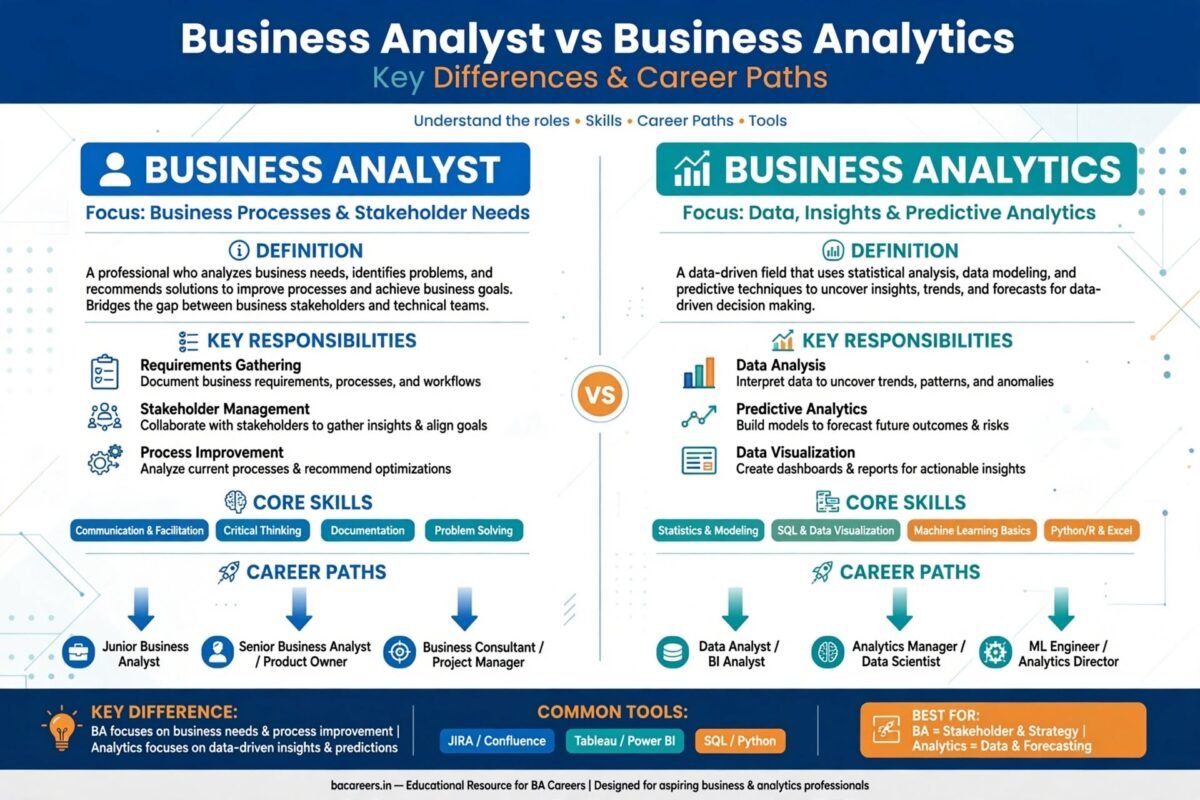
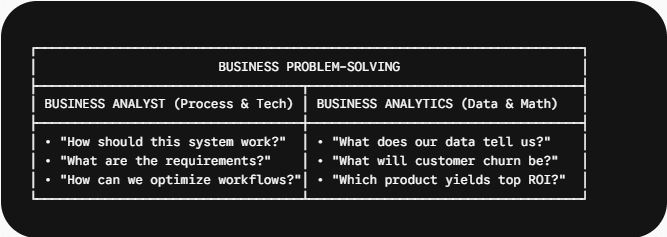
Download Free Templates PDFBusiness Analyst and Business Analytics – which are similar, but different As Business Analyst vs Business Analytics terms seem same but there’s a thin line of difference between Business Analyst and Business Analytics which is their approach of solving a business problem- processes & solutions and data & statistics.
Core Difference at a Glance
- Business Analyst (The “HOW & WHAT“): The Business Analyst focuses on processes, software needs and system capabilities. A Business Analyst functions as a translator between the technical and non-technical worlds to produce solutions to real business problems.
- Business Analytics (The “WHY & WHAT NEXT“): Concentrates on quantitative data, statistical algorithms and predictive modeling. A Business Analytics expert analyzes past data to identify patterns, improve decision making and predict future outcomes.
Detailed Comparison Matrix
| Aspect | Business Analyst (BA) | Business Analytics Specialist |
| Primary Focus | Business processes, requirements elicitation, system workflows, and solution design. | Data mining, statistical analysis, predictive modeling, and data visualization. |
| Primary Question | “How can we design or improve a system to meet stakeholder needs?” | “What trends and insights does our data reveal to guide strategic decisions?” |
| Key Deliverables | BRD/FRS documents, User Stories, Acceptance Criteria, As-Is/To-Be Process Maps, UAT Test Plans. | Data Dashboards, Predictive Models, Trend Reports, Statistical Forecasts, Regression Analyses. |
| Core Methodologies | Agile/Scrum, BABOK, SWOT/PESTLE, Joint Application Development (JAD), Prototyping. | CRISP-DM, Descriptive/Predictive/Prescriptive Analytics, Machine Learning, Hypothesis Testing. |
| Essential Tools | JIRA, Confluence, Visio, Lucidchart, Figma, Balsamiq. | SQL, Python, R, Tableau, Power BI, Excel (Advanced), SAS, Snowflake. |
| Target Audience | Software Developers, QA Engineers, Product Owners, End Users. | Data Engineers, Chief Data Officers, Executive Leadership, Marketing/Sales Directors. |
Real-World Example: An E-Commerce Sales Decline
If an e-commerce platform experiences a sudden drop in customer checkouts:
The Business Analytics Specialist queries database records using SQL and Python to run predictive models. They discover that 68% of drop-offs occur specifically on the payment selection page when users attempt to pay via digital wallets.
The Business Analyst steps in to examine the payment process, talk to the customer support team, and identify system timeouts. They document technical requirements, write Agile user stories with explicit acceptance criteria, and work with software engineers to redesign the payment checkout workflow.
Frequently Asked Questions (FAQs)
Yes. In smaller organizations or cross-functional product teams, BAs often use basic data analysis (SQL, Power BI, Excel) alongside process modeling. However, dedicated Business Analytics roles focus much more heavily on statistics and advanced programming.
Choose Business Analysis if you enjoy facilitation, communication, requirements gathering, process optimization, and working as a liaison between business and software engineering teams.
Choose Business Analytics if you enjoy mathematics, data modeling, writing code (Python/R), creating visual dashboards, and uncovering quantitative insights.
Understanding the distinction between Business Analyst vs Business Analytics is essential when navigating career growth and defining software delivery roles.
While Business Analytics relies on data modeling to drive executive decisions, a Business Analyst focuses on requirements engineering, process optimization, and bridging business goals with technical software execution.
📄 Business Analysis Knowledge & Career Hub
Explore how core Business Analyst capabilities connect with documentation, elicitation techniques, and Agile frameworks:
| Knowledge Area | Deep-Dive Guide | Why It Matters for a Business Analyst |
|---|---|---|
| Core Roles & Duties | BA Roles & Responsibilities Guide | Master foundational duties across discovery, specification, and testing. |
| Documentation Standards | BRS vs FRS vs SRS Comparison Guide | Learn how BAs structure business, functional, and technical requirements. |
| Elicitation Mastery | Requirement Elicitation Techniques Guide | Extract precise business rules through JAD workshops and process mapping. |
| Agile Delivery Roles | Scrum BA Role Guide | Understand how Scrum BAs manage user stories and product backlog refinement. |
| Interview Strategy | BA Interview Tips for Freshers | Prepare for questions distinguishing business analysis from data science and analytics. |
🎁 Become a Better Business Analyst
Join 1,200+ Business Analysts learning every week.
Get instant access to:
📘 FREE Business Analyst Templates
🎯 Interview Preparation Guides
🚀 Agile & Scrum Tutorials
🤖 AI for Business Analysts
📈 Career Growth Tips
100% Free • No Spam • Unsubscribe Anytime
