

FREE DOWNLOAD: Business Analyst Documentation Toolkit
Get instant access to real-world BRD, FRD, and project story templates used by senior BAs.
Download Free Templates PDFWhat is BRS vs FRS vs SRS? Business Analysis Requirements and Technical Requirements Wireframes and mockups provide visual cues to the finished product. Specification documents provide clarity to the technical team on how the feature should work. The three main Specification documents that Business Analysts and technical teams utilize include the following: BRS or Business Requirement Specification; FRS or Functional Requirement Specification; SRS or Software Requirement Specification.
Understanding BRS vs FRS vs SRS helps teams understand who creates each document, when it is written during the SDLC, and how requirements transition from business needs to technical execution.
High-Level Overview of the Three Specifications
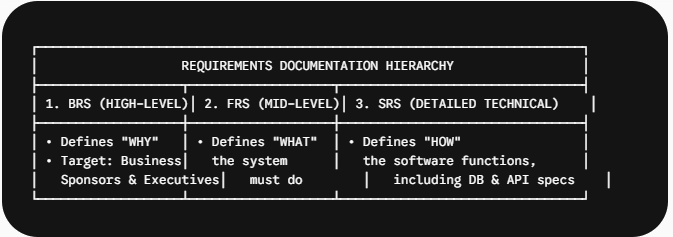
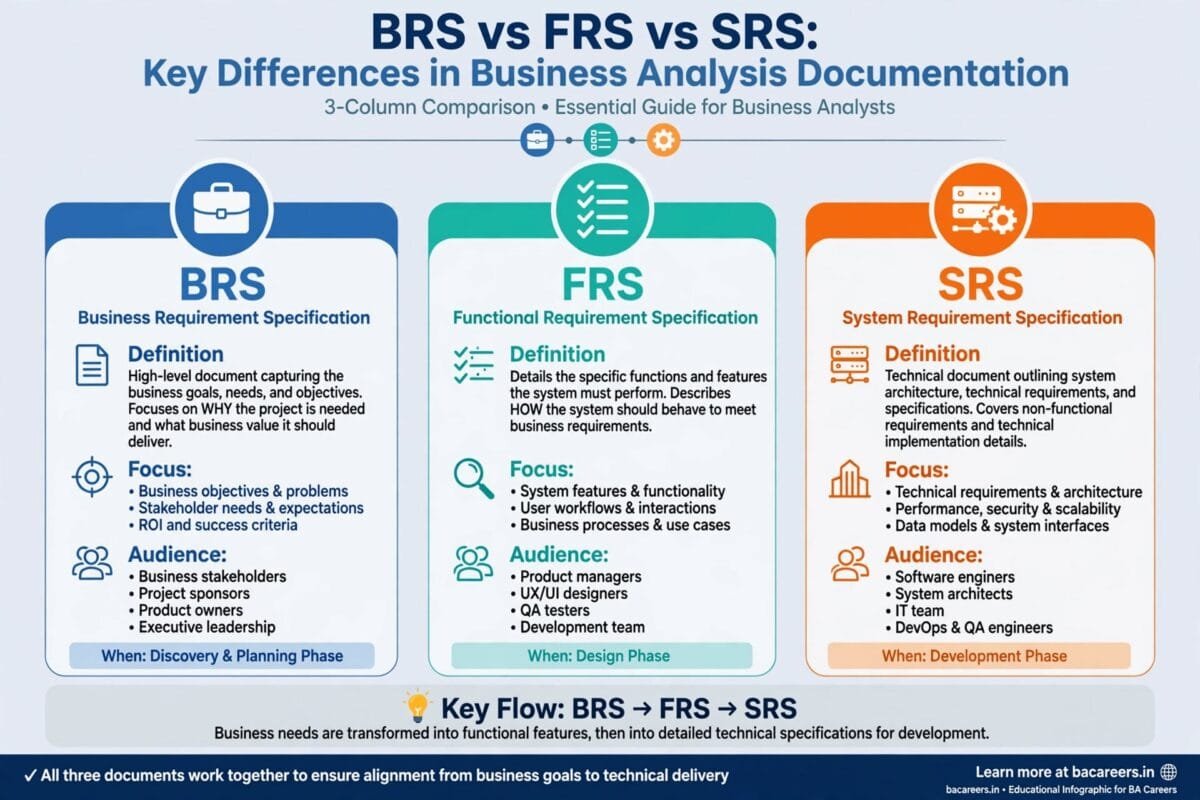
BRS (Business Requirement Specification): Focuses on business vision, ROI, high-level objectives, and enterprise constraints. Written primarily for business executives and project sponsors.
FRS (Functional Requirement Specification): Translates high-level business goals into functional behavior, screen flows, and system interactions. Written for end users, functional leads, and BAs.
SRS (Software Requirement Specification): Combines functional behavior with non-functional requirements (performance, security, scalability) and technical architecture boundaries. Written for software engineers, database administrators, and QA teams.
BRS vs FRS vs SRS Comparison Table
| Feature / Aspect | BRS (Business Requirement Specification) | FRS (Functional Requirement Specification) | SRS (Software Requirement Specification) |
| Primary Focus | High-level business needs and goals (“Why”). | Functional behavior and user workflows (“What”). | Technical details and implementation specs (“How”). |
| Primary Audience | Business Sponsors, Executives, Stakeholders. | Business Analysts, System Designers, Product Leads. | Developers, Architects, Testers, QA Engineers. |
| Key Content | Business objectives, scope, ROI, market context. | Use cases, wireframes, inputs/outputs, business rules. | System architecture, APIs, DB schemas, security rules. |
| Non-Functional Requirements? | Rarely included (only high-level compliance). | Minimal focus (mostly UI/UX and functional flows). | Extensively detailed (performance, uptime, throughput). |
| Author / Owner | Business Analyst / Business Lead. | Business Analyst / System Analyst. | System Architect / Senior BA / Lead Developer. |
| SDLC Phase | Initiation & Discovery Phase. | Analysis & Requirements Elaboration Phase. | Technical Design & Architecture Phase. |
Frequently Asked Questions (FAQs)
While some teams merge them into a single document, they serve distinct purposes. An FRS focuses strictly on functional user flows and system behavior, whereas an SRS incorporates technical constraints, non-functional requirements, and system design specifications.
In pure Agile environments, these heavy documents are often replaced by epics, user stories, and acceptance criteria in tools like JIRA. However, many enterprise organizations (such as finance, healthcare, and insurance) still maintain formal BRS/SRS specifications for compliance, regulatory auditing, and vendor contracts.
Understanding the differences between BRS vs FRS vs SRS is fundamental for effective requirements engineering and software project delivery.
By establishing clear boundaries between high-level business needs, functional behaviors, and technical specifications, Business Analysts ensure seamless alignment across executive sponsors, product teams, and development leads.
📄 Requirements Engineering & Business Analysis Hub
Explore how requirements documentation connects with discovery techniques, best practices, and career progression:
| Knowledge Area | Deep-Dive Guide | Why It Matters for a Business Analyst |
|---|---|---|
| Documentation Standards | BRS vs FRS vs SRS Comparison Guide | Master the differences between business, functional, and software requirements. |
| Requirements Discovery | Requirement Elicitation Techniques Guide | Gather accurate business logic to populate specifications and avoid scope creep. |
| BA Best Practices | Dos and Don’ts for Business Analysts | Avoid common documentation traps and ensure specifications remain lean and readable. |
| Interview Strategy | BA Interview Tips for Freshers | Prepare for core interview questions comparing BRD, FRD, SRS, and Agile user stories. |
| Agile Requirements | Scrum BA Role Guide | Transition traditional specifications into agile product backlogs and sprint user stories. |
🎁 Become a Better Business Analyst
Join 1,200+ Business Analysts learning every week.
Get instant access to:
📘 FREE Business Analyst Templates
🎯 Interview Preparation Guides
🚀 Agile & Scrum Tutorials
🤖 AI for Business Analysts
📈 Career Growth Tips
100% Free • No Spam • Unsubscribe Anytime
