

FREE DOWNLOAD: Business Analyst Documentation Toolkit
Get instant access to real-world BRD, FRD, and project story templates used by senior BAs.
Download Free Templates PDFWhen working within modern software development and Agile teams, three critical roles frequently overlap: Business Analyst (BA), Product Owner (PO), and Scrum Master (SM). While all three collaborate closely to deliver value, their core responsibilities, daily workflows, and primary focus areas are fundamentally distinct.
Whether you are transitioning into Agile or deciding which career path to pursue, this comprehensive guide breaks down the key differences, skill requirements, and career prospects for each role.
1. Role Overview & Core Focus
| Feature | Business Analyst (BA) | Product Owner (PO) | Scrum Master (SM) |
| Primary Focus | Strategy, requirements analysis, and business solutioning | Product vision, backlog prioritization, and ROI | Process facilitation, team enablement, and Agile adherence |
| Key Question | “What problem are we solving, and what are the detailed requirements?” | “What features should we build next to deliver maximum business value?” | “How can the team work more effectively and overcome blockers?” |
| Target Audience | Business stakeholders, end-users, subject matter experts (SMEs) | Customers, business executives, product strategy teams | The Development Team, Product Owner, and Organization |
2. In-Depth Breakdown
Business Analyst (BA)
The Business Analyst acts as a bridge between business stakeholders and technical teams. Their primary role is to understand business problems, analyze processes, and translate high-level business goals into precise functional and technical specifications (such as BRDs, FRDs, and detailed User Stories).
Core Responsibilities:
Eliciting requirements through workshops, interviews, and process modeling.
Creating detailed documentation (BRD, FRD, Process Flow Diagrams, Gap Analysis).
Defining acceptance criteria and validating end-user requirements.
Performing root-cause and feasibility analysis for business requests.
Product Owner (PO)
The Product Owner is a key role within the Scrum Framework responsible for maximizing the value of the product resulting from the team’s work. The PO owns the Product Backlog and represents the customer’s voice inside the Sprint ecosystem.
Core Responsibilities:
Defining the product vision, roadmap, and release strategy.
Maintaining and prioritizing the Product Backlog items based on ROI and business value.
Writing high-level User Stories and defining Definition of Done / Acceptance Criteria.
Making clear trade-off decisions on scope versus timelines.
Scrum Master (SM)
The Scrum Master is a servant-leader and coach for the Scrum team. Rather than managing people or defining what gets built, the SM focuses entirely on how the team works, ensuring Scrum principles are practiced and removing obstacles that slow the team down.
Core Responsibilities:
Facilitating Scrum events (Daily Standups, Sprint Planning, Reviews, and Retrospectives).
Removing roadblocks, impediments, and external distractions for the development team.
Coaching team members and the organization on Agile/Scrum practices.
Fostering team efficiency, psychological safety, and continuous improvement.
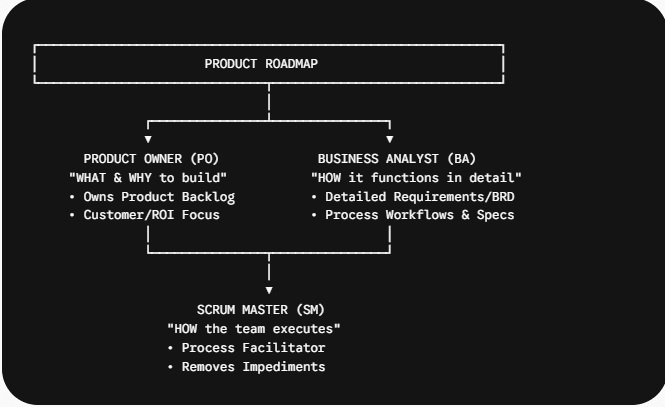
3. BA vs PO vs SM: Direct Comparison Matrix
4. Key Differences in Daily Deliverables
Business Analyst: Requirement Traceability Matrix (RTM), Functional Requirement Documents (FRD), Data Flow Diagrams (DFD), As-Is vs. To-Be workflows.
Product Owner: Product Backlog, Prioritized Epics, Release Plans, User Story Mapping.
Scrum Master: Sprint Burndown Charts, Retrospective Action Items, Team Velocity Tracking, Impediment Logs.
5.Real-Time Industry Scenario
Project Context: Building an automated e-commerce checkout refund feature.
Business Analyst (BA): Speaks with customer support and compliance to detail rules. Outputs detailed edge-case flows, FRD specifications, and precise validation criteria for non-working payment gateways.
Product Owner (PO): Evaluates overall customer impact versus checkout cart abandonment rates. Prioritizes the refund epic at the top of the backlog to hit Q3 retention targets.
Scrum Master (SM): Identifies that developers are waiting on payment API access from a third party. Schedules necessary technical calls, removes access blockers, and keeps the sprint velocity on track.
6. Frequently Asked Questions (FAQs)
Yes. In many organizations—especially mid-sized enterprises or non-tech companies transitioning to Agile—the roles of BA and PO are often combined into a BA/PO hybrid role. The individual manages stakeholder expectations (PO) while simultaneously writing granular requirement specifications (BA).
No coding background is strictly required for a Scrum Master. However, having a foundational understanding of software development lifecycles (SDLC) helps in understanding developer roadblocks and facilitating technical discussions effectively.
Choose BA if you love analytical thinking, writing documentation, and understanding business processes.
Choose PO if you enjoy product strategy, customer research, and prioritization.
Choose SM if you excel at leadership, communication, process facilitation, and coaching team dynamics.
📄 Requirements Engineering & Business Analysis Hub
Explore how core Business Analyst methodologies connect with documentation best practices, Agile delivery, and domain frameworks:
| Knowledge Area | Deep-Dive Guide | Why It Matters for a Business Analyst |
|---|---|---|
| Requirements Documentation | BRD vs FRD: Difference Between BRD and FRD | Master the structural boundaries between high-level business goals and technical specs. |
| Agile Frameworks | Agile Software Development Life Cycle Guide | Understand user stories, sprint cycles, and how BAs operate in iterative delivery. |
| Domain Specialization | Banking Domain Knowledge for BAs | Learn fintech workflows, payment lifecycles, and compliance systems. |
🎁 Become a Better Business Analyst
Join 1,200+ Business Analysts learning every week.
Get instant access to:
📘 FREE Business Analyst Templates
🎯 Interview Preparation Guides
🚀 Agile & Scrum Tutorials
🤖 AI for Business Analysts
📈 Career Growth Tips
100% Free • No Spam • Unsubscribe Anytime
