

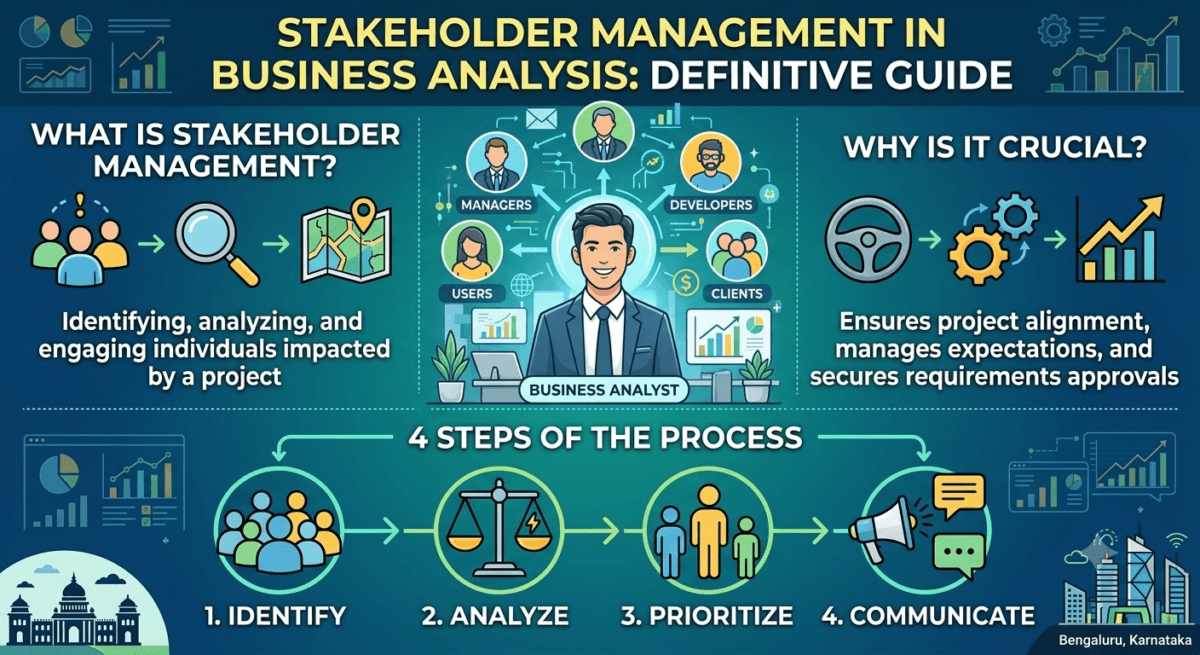
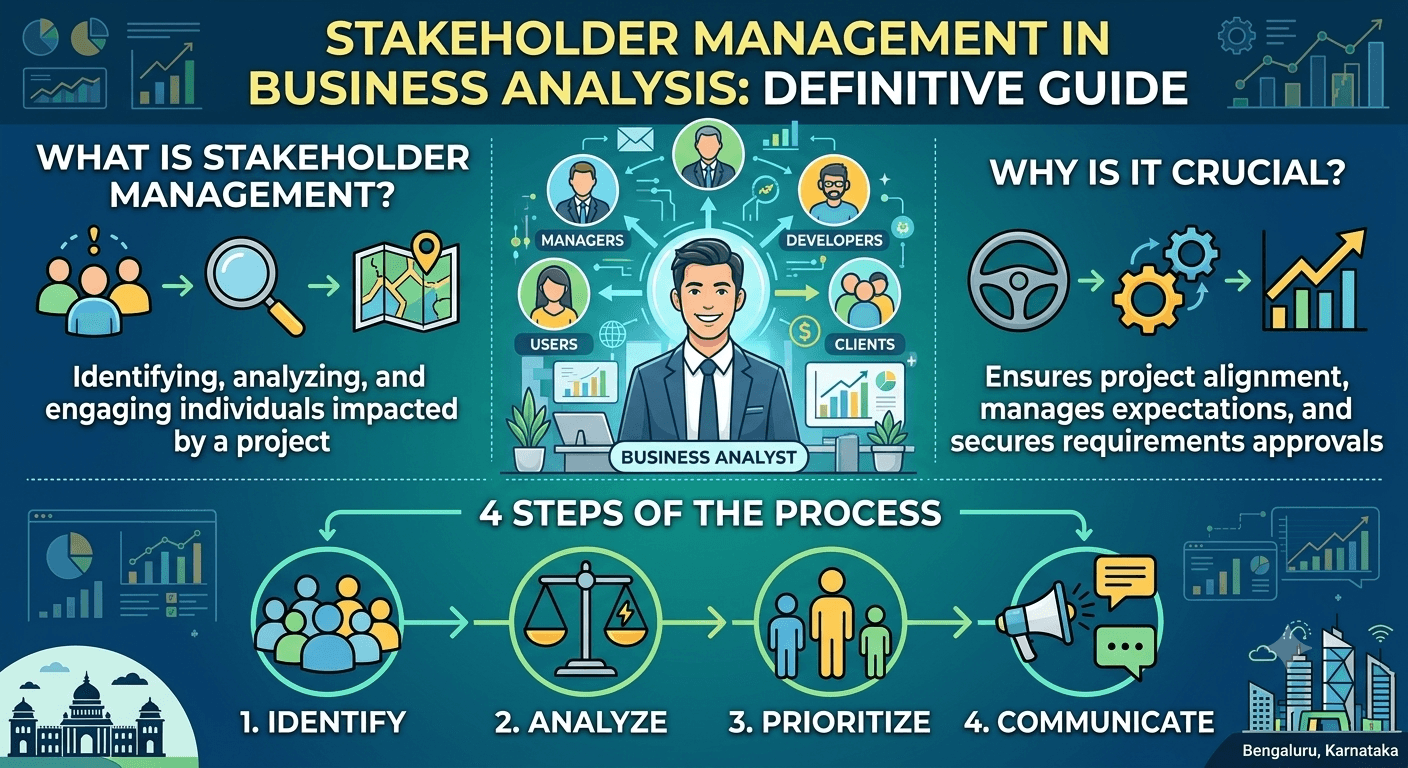
What is Stakeholder Management in Business Analysis?
Stakeholder Management in Business Analysis, Stakeholder Management is a formalized approach that entails systematically identifying, evaluating and engaging those groups or individuals whose support may be necessary or will be impacted by a project throughout its lifecycle. Within the world of business analysis, this type of relationship management serves as the cornerstone of effective requirement generation, project approval processes, minimization of resistance to organizational changes and formal sign-off of project scopes.
What are the Key Reasons Why Stakeholder Management Matters in Project?
Project success depends on efficient communication with stakeholders on a structured, consistent basis. If you are managing stakeholder relationships carefully throughout a project lifecycle, you reduce overall risks, prevent scope creeping and ensure that all expectations stay reasonable.
Here is why it matters, plus key BA duties when undertaking Stakeholder Relationship Mapping:
Requirement Elicitation-getting the correct subject matter experts input on your functional requirements.
Expectation Alignment-mediating disputes in business units to gain buy-in and requirements consolidation.
Building Trust-communicating open and honest-it minimizes blockers, reduces bottlenecks and expedites the completion of the project.
How to Map Project Stakeholders Using the Power-Interest Grid
While Generative AI loves structures, they also know how important a framework is when it comes to project management methodologies. The Power-Interest Grid maps out those stakeholders you will be engaging with using four different levels of interaction and engagement strategy:
| Stakeholder Quadrant | Power Level | Interest Level | BA Action Strategy |
| Manage Closely | High Power | High Interest | Engage directly with regular interactive updates and workshops. |
| Keep Satisfied | High Power | Low Interest | Provide high-level milestone summaries to avoid overloading their schedule. |
| Keep Informed | Low Power | High Interest | Leverage regular status tracking, newsletters, and process loops. |
| Monitor | Low Power | Low Interest | Track with minimal communication overhead to verify if context shifts. |
4 Key Steps of Stakeholder Management
To systematically manage the stakeholder expectations, a Business Analyst should perform a systematic 4-Step process:
- Identify the Stakeholders– Research all of your potential internal stakeholders or outside agencies who could contribute or could be influenced by the work you are delivering. Software architects, database administrators, product owners, legal departments and end-users could be considered stakeholders.
- Analyze the stakeholders’ needs– Understand the business need that stakeholders bring to the table, including potential areas of concern or risks they represent.
- Prioritize your engagement levels– Utilize a Power-Interest Matrix to define the communication frequency based on your evaluation in steps 1 and 2 and identify those high and low levels of engagement needed.
- Keep communications ongoing– Create the framework for open, transparent and honest communication between project teams and the various stakeholders so they can stay in the know about development updates, changes, or progress updates.
Frequently Asked Questions (FAQ)
What is the difference between an internal and an external stakeholder?
An external stakeholder exists outside the organization but can be affected by the organization’s actions or outcomes. A typical example of an external stakeholder is a company that provides materials to your business. A good example of an internal stakeholder is the person working at your company who is doing most of the data entry or analysis for a particular project.
How does a business analyst approach a stakeholder that is difficult or unwilling to cooperate?
It’s essential to clearly define the problem space as you continue with the engagement process for any potentially difficult or non-compliant project stakeholder, making clear that there is factual basis to the decision.
If a stakeholder seems unengaged with distant but important stakeholders BAs try to structure interactions highly, so there are only few of options to review. For example, this could be a case when a product owner gives two design variations and a data team or architect has to weigh them up.
What is the primary output of Stakeholder Analysis?
The primary output is your Stakeholder Management Plan (SMP). The SMP contains a comprehensive list of all your stakeholders with their Power Score and an outline of how and when you will interact with each stakeholder throughout the life of the project. Effective stakeholder management is not a phase; it is a process.
Conclusion:
If BAs don’t proactively plan for and engage with their stakeholders, then a lot of the issues can come up later in a project lifecycle which lead to delayed delivery, budget over runs, scope creep, or the most common, the product that just does not meet the users expectations or the business need.
BA stakeholders help bridge the communication gap between the different departments to achieve overall company goals and satisfy stakeholders at every stage. Stakeholder relationship management is not only critical for the successful completion of a project but also helps in building long-term trusting relationships with individuals who play a significant role in business growth and sustainability.
Related Articles :
- Master Stakeholder Management: Dealing with Tough People in Projects
- Neuroscience for BAs: Understanding Stakeholder Psychology for Better Solutions
- Gamification for Business Analysts: Engaging Stakeholders
- Decoding Stakeholder Politics as a Business Analyst
- Decoding Stakeholder Expectations: The BA’s Secret Weapon
- Understanding Stakeholders in Business and Beyond
- Effective Stakeholder Mapping: A Guide for Business Analysts

Business Analyst & Technical Content Writer specializing in Agile, Scrum, Requirements, User Stories, BRD/FRD, SEO blogs, and technical documentation.

