

Introduction to Scrum Framework
The Scrum Framework is one of the most popular Agile frameworks used to manage complex product development and software projects. It promotes collaboration, transparency, and iterative progress toward well-defined goals.
Scrum is based on empirical process control theory—meaning progress is based on observation and experimentation, not detailed upfront planning.
If you are looking for a foundational breakdown before diving into these real-time scenarios, you can read our entry guide on What is Scrum in agile methodology?
For more detailed understanding of Agile Methodology, you can refer to our article on Agile Methodology for Business Analysts.
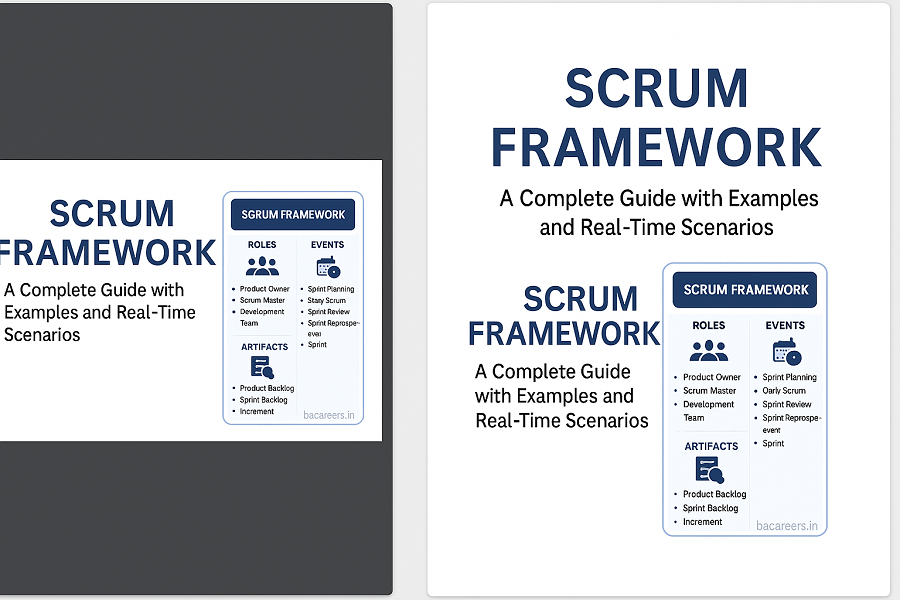
What is Scrum Framework?
The Scrum Framework is a lightweight framework that helps teams generate value through adaptive solutions for complex problems. It follows an iterative and incremental approach and is structured around:
Three Roles
Five Events
Three Artifacts
Let’s explain each in detail.
Scrum Roles: Who Does What?
1. Product Owner
Responsibilities:
Defines the product backlog.
Prioritizes items based on business value.
Represents customer and business interests.
Example:
In a banking software project, the Product Owner decides that the ‘Net Banking Fund Transfer’ feature is more important than the ‘New User Onboarding’ based on customer demand.
2. Scrum Master
Responsibilities:
Acts as a servant-leader for the team.
Ensures Scrum practices are followed.
Removes obstacles (impediments).
Example:
When developers are stuck waiting for database access, the Scrum Master coordinates with the IT department to provide immediate access, ensuring sprint goals stay on track.
3. Development Team
Responsibilities:
Self-organizing and cross-functional.
Delivers potentially shippable product increments at the end of each sprint.
Example:
A team consisting of UI designers, backend developers, and testers work together to deliver a new loan application feature.
The Difference Between a Business Analyst and a Product Owner in Scrum.
| Responsibility | Business Analyst (BA) | Product Owner (PO) |
| Core Focus | Bridges the gap between business stakeholders and tech teams. | Owns the product backlog and maximizes product value. |
| Requirements | Elicits, analyzes, and drafts detailed functional requirements. | Defines the “What” and “Why” via high-level User Stories. |
| Prioritization | Assists the team in understanding technical dependencies. | Has final authority on backlog ranking and business value. |
The Business Analyst Role in Scrum
In Scrum, Business Analyst (BA) is not an official Scrum role, but in real-time projects, BAs play a crucial supporting role:
Helps the Product Owner refine and maintain the product backlog.
Facilitates requirement clarification between stakeholders and development team.
Provides process modeling and requirement elicitation.
Real-Time Scenario:
In an eCommerce project, the BA works with the Product Owner to clearly define user stories for features like ‘Discount Coupon Application’, ensuring the development team understands all conditions and acceptance criteria.
Scenario: Managing Scope Creep during Sprint Planning in a Distributed Team.
For more on the BA role in Agile, read: Agile Business Analyst Responsibilities.
Scrum Events (Ceremonies)
1. Sprint Planning
Sets the stage for the sprint by selecting the highest priority backlog items.
Real Example:
In a fintech app upgrade, Sprint Planning is used to finalize “adding biometric login” feature for the next 2-week sprint.
2. Daily Scrum (Stand-up)
15-minute daily sync to discuss:
What was done?
What will be done?
Any blockers?
Real Example:
Developers report that the payment gateway API is throwing errors during Daily Scrum, and the Scrum Master resolves the issue with the third-party vendor.
3. Sprint Review
Demonstration of the Increment (working product) to stakeholders.
Real Example:
The team demonstrates the “Loan EMI calculator” module to the Product Owner and key stakeholders to collect feedback.
4. Sprint Retrospective
Team discusses what went well, what didn’t, and how to improve in the next Sprint.
5. Sprint
Time-boxed iteration (usually 2-4 weeks) where work is executed to deliver a usable product increment.
Scrum Artifacts
1. Product Backlog
A living list of features, enhancements, fixes maintained by the Product Owner.
Example:
In a healthcare app, the Product Backlog may include items like “Patient appointment booking” and “Medicine delivery tracking.”
2. Sprint Backlog
Selected Product Backlog items for a Sprint, plus a plan to deliver them.
3. Increment
The usable end-product from a Sprint.
Example:
After Sprint 1, the team delivers a working login module for testing.
Real-Time Example of Scrum Implementation
Project: Mobile Banking App Enhancement
Business Requirement: Introduce a ‘Voice Assistant Feature’ for ease of use.
Scrum Approach:
Product Owner refines the backlog item “Voice Assistant”.
BA helps break this into user stories like “As a user, I want to check account balance using voice commands”.
Sprint Planning: Development team picks this story.
Daily Scrums highlight delay due to third-party API unavailability. Scrum Master resolves the blocker.
After the sprint, a working prototype is demoed in the Sprint Review.
Retrospective identifies the need to vet third-party dependencies earlier in future sprints.
Advantages of Scrum Framework
✔ Faster Product Delivery
✔ Improved Collaboration
✔ Early Detection of Issues
✔ High Transparency
Challenges in Scrum (and How to Overcome)
| Challenge | Solution (Scrum Practice) |
|---|---|
| Scope Creep | Regular backlog refinement, PO involvement |
| Unclear Requirements | Engage BA during backlog grooming |
| Team Silos | Promote cross-functional teams via Scrum Master |
Useful External Resources
Conclusion
The Scrum Framework empowers teams to handle complex projects by breaking them into manageable chunks, promoting communication, and delivering continuous value. Business Analysts, though unofficial in Scrum, play a key role in requirement clarity and stakeholder communication.
For more practical insights into BA roles in Agile, explore:
👉 Agile Business Analyst vs Traditional Business Analyst
Frequently Asked Questions: Scrum Framework
Q1: What is the primary role of a Business Analyst in the Scrum Framework?
Answer: While the official Scrum Guide does not explicitly list the title “Business Analyst,” BAs are highly valuable members of the Scrum development team. A BA in Scrum typically works closely with the Product Owner to elaborate on user stories, split epic requirements into actionable tasks, and ensure the development team completely understands the technical and business acceptance criteria.
Q2: What are the 5 core events (ceremonies) of the Scrum Framework?
Answer: The Scrum Framework relies on five specific events to create transparency and regular inspection:
The Sprint: The core 1 to 4-week timebox where the actual work is completed.
Sprint Planning: Where the team defines what can be delivered in the upcoming Sprint and how that work will be achieved.
Daily Scrum: A brief 15-minute daily standup meeting for the team to synchronize activities and identify blockers.
Sprint Review: A collaborative meeting held at the end of the Sprint to demonstrate the working product increment to stakeholders and gather feedback.
Sprint Retrospective: An internal team meeting to inspect how the last Sprint went regarding people, relationships, process, and tools, creating a plan for continuous improvement.
Q3: Can a Business Analyst also act as a Product Owner in Scrum?
Answer: Yes, many professional Business Analysts successfully transition into or take on the responsibilities of a Product Owner. However, the roles have different focuses. The Product Owner holds final decision-making authority over backlog prioritization and business value, whereas a BA focuses heavily on the detailed analytical work, process flows, and bridging communication gaps between the business and technical teams.
Q4: What is the difference between Scrum and Agile?
Answer: Agile is a broad project management philosophy and mindset guided by the four core values and twelve principles of the Agile Manifesto. Scrum is a specific, structured framework under the Agile umbrella that provides concrete roles, artifacts, and events to implement those Agile principles in real-world product development.
Internal Links:
External Links:

Business Analyst & Technical Content Writer specializing in Agile, Scrum, Requirements, User Stories, BRD/FRD, SEO blogs, and technical documentation.

