

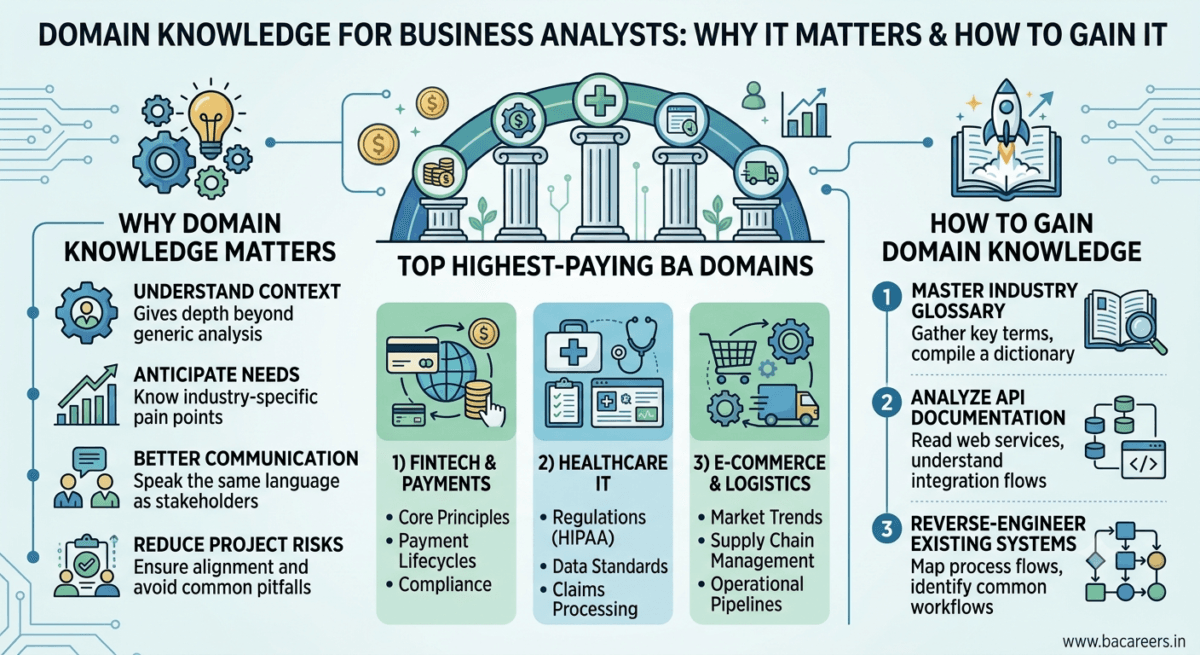
Why Business Analyst Domain Knowledge Is Critical (and How to Acquire It)
When companies look to fill a Business Analyst role, they generally have two very specific skill sets in mind: hardcore BA competencies (user stories, wireframes, requirements gathering) and domain knowledge. While your core BA skills will tell you HOW to do your analysis, domain knowledge provides you with the industry-specific context to understand WHAT you’re analyzing. Without sufficient domain knowledge, a BA can miss crucial compliance requirements, completely misunderstand what stakeholders’ problems are, or architect workflow that simply don’t work in the real world.
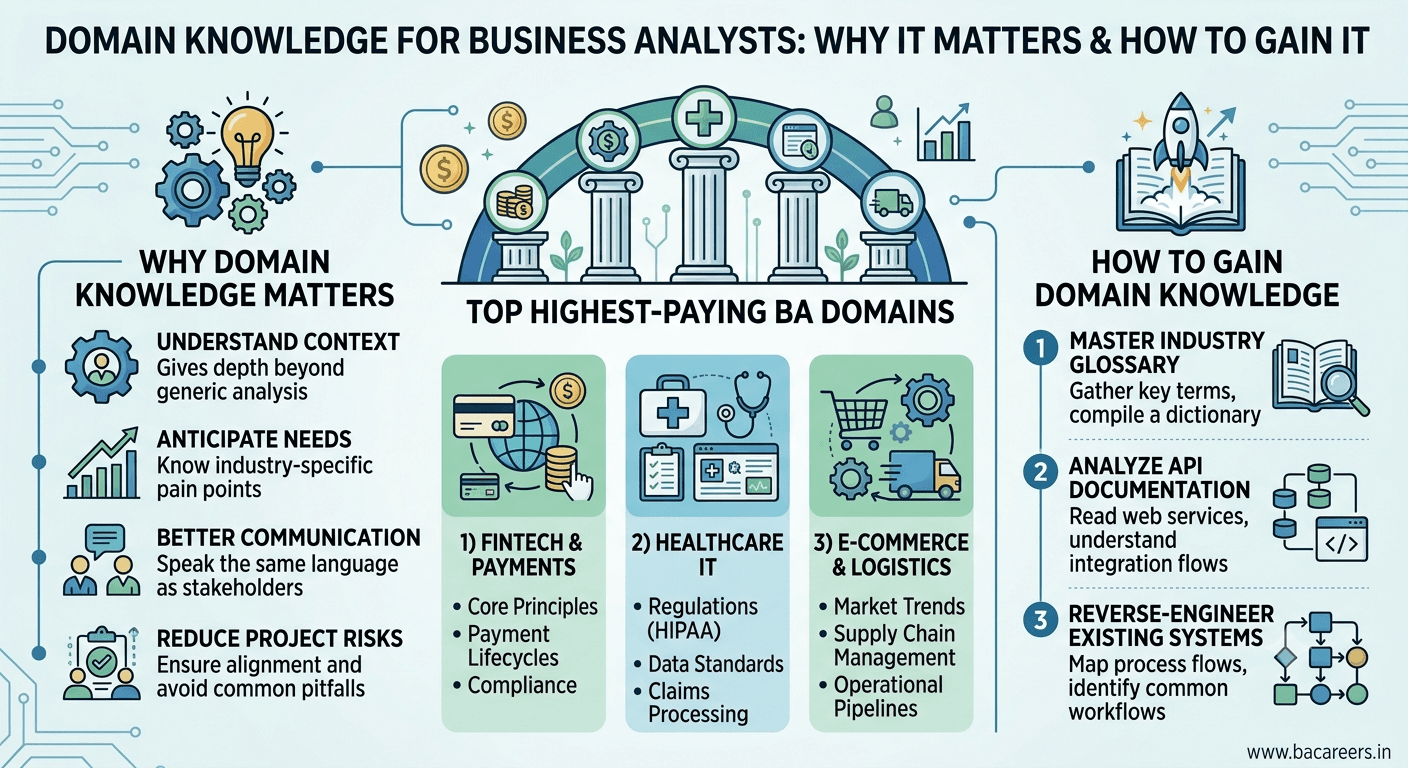
The Top 3 Highest-Paying BA Domains
Although domain knowledge is valuable regardless of the vertical you end up in, the following three high-growth domains will help you move into the higher compensation brackets much faster:
- Fintech & Payments: Working in this space, you’ll be learning about how money is moved through the digital rails. A Payments BA must understand core topics such as transaction clearing lifecycles, merchant acquiring, Merchant Category Codes (MCCs), open banking APIs, global payment message standards like ISO 20022, etc. For a deep dive into functional workflows, see our comprehensive guide on the [Evolving UPI Ecosystem for BAs].
- Healthcare IT: If data standards are a concern for you, look no further. Healthcare IT deals with the complex workflows that power Electronic Health Records (EHR) systems, insurance claims processing and many more – along with the regulatory frameworks governing it.
- E-Commerce & Logistics: If you’re a fan of end-to-end workflows, look no further. A Business Analyst in E-commerce & Logistics must know their way around shopping cart checkouts, online payments, inventory systems, third-party shipping integrations, order management systems, etc.
A Step-By-Step Framework To Build Domain Knowledge
If you’re a junior analyst or a generalist trying to break into an industry of your choice, there’s a structured approach to learning domain knowledge and building your expertise. Here’s our three step process:
Master the Industry Glossary: Most industries have an extensive lexicon of terms and jargon. Compile a list of the top ~50 terms with definitions. You should at least recognize terms like ‘PSP,’ ‘KYC,’ and ‘PCI-DSS’ as part of the Payment domain vocabulary to speak the same language as your business stakeholders.
Analyze Open API Documentation: Today, most modern systems integrate through well-defined web service APIs. Studying publicly accessible documentation for dominant players in your chosen field (such as Stripe or PayPal for payments; Shopify for e-commerce; the FHIR standard for healthcare) gives you an up-close look at data models, request parameters, and typical operational flows.
Reverse-Engineer Existing Systems: Take a popular commercial product within the domain of your choice, and trace the core functionality. Draw out an entire user flow diagram from beginning to end – documenting all background validation logic, data synch events, potential error scenarios and the underlying business rules governing each step
Understanding Domain Knowledge Meaning : The Key to Expertise
Domain Knowledge Meaning : In any field or profession, the term “domain knowledge meaning” holds significant importance. Whether you’re a software developer, a medical professional, or a marketing strategist, possessing domain knowledge is often considered the cornerstone of expertise. But what exactly does domain knowledge entail, and why is it so crucial? Let’s delve into this fundamental concept.

Domain knowledge refers to a specific area or field of expertise that an individual possesses. It plays a crucial role in developing expertise and mastering a particular subject. By understanding domain knowledge, one can gain deeper insights, make better decisions, and solve complex problems more effectively. Experts in their respective fields often have a profound understanding of domain knowledge, which sets them apart from others. Therefore, acquiring and continuously expanding domain knowledge is essential for anyone looking to excel in their field and become an expert in their chosen domain.
Defining Domain Knowledge
At its core, domain knowledge refers to expertise or understanding within a specific subject area, industry, or field of study. It encompasses a deep comprehension of the concepts, terminology, practices, trends, challenges, and opportunities relevant to that particular domain. Essentially, it’s the specialized knowledge that individuals acquire through education, training, and hands-on experience within their respective fields.
Examples of Domain Knowledge
Domain knowledge can vary widely depending on the context. Here are a few examples to illustrate its diversity:
- Medicine: Healthcare professionals possess domain knowledge in areas such as anatomy, physiology, pharmacology, and medical procedures. They understand the intricacies of diagnosing illnesses, administering treatments, and interpreting patient data within the healthcare domain.
- Finance: Professionals in the finance industry have domain knowledge related to investment strategies, financial markets, risk management, and regulatory compliance. They can analyze economic trends, assess the performance of financial assets, and make informed decisions to maximize returns while minimizing risks.
- Engineering: Engineers specialize in various domains such as civil, mechanical, electrical, or software engineering. They possess domain-specific knowledge related to design principles, materials, construction techniques, programming languages, or hardware systems, depending on their area of expertise.
- Education: Educators have domain knowledge in pedagogy, curriculum development, instructional methods, and assessment techniques. They understand how students learn and develop strategies to facilitate effective learning experiences within educational settings.
- Marketing: Marketers possess domain knowledge in consumer behavior, market research, branding, advertising, and digital marketing strategies. They leverage their understanding of target audiences and market dynamics to create compelling campaigns and drive business growth.
The Importance of DomainKnowledge
Domain knowledge is indispensable for several reasons:
- Problem Solving: In any profession, individuals encounter complex challenges that require specialized expertise to solve effectively. Domain knowledge equips professionals with the necessary insights and tools to address these problems efficiently.
- Innovation: Deep understanding of a domain enables professionals to identify gaps, anticipate trends, and develop innovative solutions. Whether it’s creating cutting-edge technology, devising groundbreaking medical treatments, or launching disruptive business ventures, domain knowledge fuels innovation.
- Decision Making: Informed decision making is a hallmark of expertise. Professionals with domain knowledge can evaluate situations, weigh options, and make informed decisions that align with the objectives and requirements of their respective domains.
- Communication: Effective communication is essential for collaboration and knowledge sharing within a domain. Individuals with domain knowledge can articulate ideas, convey information, and engage in meaningful discussions with colleagues, clients, or stakeholders, fostering collaboration and driving progress.
- Continuous Learning: Domain knowledge is not static; it evolves over time due to advancements in technology, changes in regulations, and shifts in market dynamics. Therefore, professionals must engage in continuous learning and stay updated with the latest developments within their domains to maintain their expertise.
Developing Domain Knowledge
Building domain knowledge is a gradual process that requires dedication, curiosity, and perseverance. Here are some strategies to develop expertise within a specific domain:
- Education and Training: Pursue formal education, certifications, or specialized training programs relevant to your field of interest. Acquire foundational knowledge and skills through coursework, workshops, or online learning platforms.
- Hands-on Experience: Gain practical experience by working on real-world projects, internships, or research initiatives within your domain. Practical exposure allows you to apply theoretical knowledge, develop problem-solving skills, and deepen your understanding of domain-specific concepts.
- Networking and Mentorship: Connect with professionals, experts, and mentors within your domain to expand your network and learn from their experiences. Engage in discussions, seek advice, and leverage their insights to accelerate your learning journey.
- Continuous Learning: Stay curious and committed to lifelong learning. Keep abreast of industry trends, research findings, and best practices through reading, attending conferences, participating in webinars, or joining professional associations.
- Reflection and Feedback: Reflect on your experiences, challenges, and successes within your domain. Seek feedback from peers, mentors, or supervisors to gain valuable insights and identify areas for improvement.
In conclusion, domain knowledge is a cornerstone of expertise across various disciplines and industries. It empowers professionals to solve problems, drive innovation, make informed decisions, communicate effectively, and pursue continuous learning. By investing in the development of domain knowledge, individuals can unlock new opportunities, advance their careers, and contribute meaningfully to their respective fields.
Frequently Asked Questions About Business Analyst Domain Knowledge
Q1: Is domain knowledge mandatory for all Business Analysts?
Answer: No, it is not mandatory for entry-level or junior Business Analyst roles. Your ability to effectively gather requirements, model processes, and communicate with stakeholders is paramount. However, to progress to senior roles or specialize in high-paying sectors such as finance and healthcare, acquiring specific domain knowledge becomes crucial for deeper understanding and strategic contribution.
Q2: What is the most effective way for a Business Analyst to acquire new domain knowledge quickly?
Answer: A highly effective and rapid method for BA domain acquisition is to analyze open-source API documentation and reverse-engineer the workflows of established platforms. By dissecting the data exchange and logic of industry-leading systems (like a payment gateway processing a transaction), you gain a concrete grasp of the core business rules and operational intricacies.
Q3: How should I demonstrate domain knowledge on my resume?
Answer: To showcase domain expertise, go beyond listing responsibilities and actively integrate industry-specific terminology and context into your achievements. For instance, instead of saying “Gathered requirements,” say “Elicited and documented functional requirements for a complex core banking system migration, ensuring compliance with stringent data localization regulations.” In today’s competitive technology and business landscape, your technical skills as a Business Analyst are only one piece of the puzzle.
Conclusion: Leveraging Domain Expertise for Career Acceleration
Your ability to elicit requirements, design workflows, and facilitate discussions is certainly essential, but it’s your in-depth understanding of the specific business you’re working within – whether that’s Fintech, Healthcare, E-Commerce, or any other sector – that truly differentiates you.
Possessing deep domain knowledge empowers you to connect the dots between your analysis and the business’s overall strategy, making you a far more valuable and sought-after professional. Fortunately, building that knowledge isn’t an insurmountable task. By systematically tackling jargon, reverse-engineering existing systems, and digging into public API documentation, you can build valuable industry expertise at an accelerated pace. So, if you want to excel as a Business Analyst, commit to learning the functional plumbing of a specific industry and unlock some of the highest-paying opportunities available.
Important Article :
What is Domain Knowledge in software industry?
Exploring the Most Important AI Tools Shaping Our Future

Business Analyst & Technical Content Writer specializing in Agile, Scrum, Requirements, User Stories, BRD/FRD, SEO blogs, and technical documentation.

