Stop letting expensive software licenses hold you back in your career as a Business Analyst or UX Designer.
You don’t need to pay ₹4,000+ every month to create high-quality blueprints that impress stakeholders and accelerate Agile delivery.
Professional wireframing is not about how much you pay for a tool.
It’s about:
Making sense of user paths
Defining clear business rules
Organizing your thoughts
Turning requirements into clear visuals
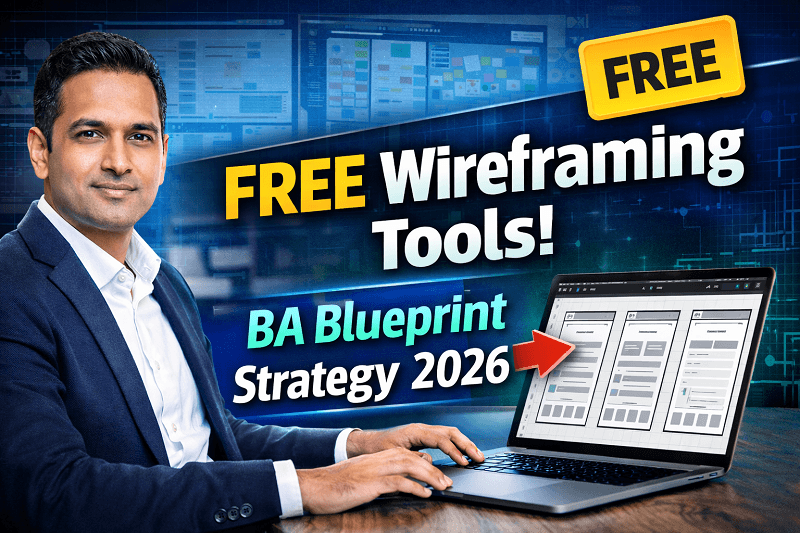
In this guide, you’ll learn how to transform raw requirements into professional, interactive wireframes using free tools — exactly how modern Business Analysts work in Agile environments.
Why Wireframing Matters in 2026
In 2026, a Business Analyst is no longer just a document writer.
You are:
A visual communicator
A workflow designer
A team collaborator
A risk manager
According to the International Institute of Business Analysis, effective communication and requirements visualization are critical BA competencies.
Why Wireframing Is More Important Than Ever
Agile teams move fast — documentation alone isn’t enough
Stakeholders prefer visuals over long BRDs
Developers need clarity before sprint execution
Remote teams depend on shared, interactive artifacts
A wireframe acts as the bridge between what stakeholders want and what developers build.
The Blueprint Strategy
1. Wireframing as the Bridge Between Requirements and Reality
Real-Life Scenario
A Product Owner says:
“We need a faster onboarding flow to reduce drop-offs.”
As a Business Analyst, you:
Collect user stories
Analyze drop-off data
Identify bottlenecks
Define functional requirements
Instead of writing pages of documentation, you visualize:
Screen 1: Enter mobile number
Screen 2: Enter OTP
Screen 3: Set up profile
Screen 4: View dashboard
Now stakeholders can see the journey before development begins.
That’s the power of wireframing.
2. Creating a Professional Interactive Prototype (Without Cost)
Using free tools, you can:
Create layout grids
Add clickable navigation
Simulate dropdowns
Build modals
Show screen transitions
The output looks comparable to premium design tools — at zero cost.
Zero-Cost Professional Toolkit
1. Figma (Free Plan)
Why Business Analysts Love It
Browser-based
Free starter plan
Built-in prototyping
Real-time collaboration
Community UI kits
You can:
Drag and drop components
Link screens together
Share view-only links with stakeholders
2. Penpot
Why It’s Powerful
100% open-source
No licensing cost
Strong community support
Startup-friendly
Easy workspace setup
Best Practices for Organization
Create separate workspaces per project
Use structured naming (e.g., WF-LOGIN-01)
Separate user flows from detailed screens
Install free UI component libraries
This keeps your artifacts clean and professional.
Leveraging Open-Source UI Kits
Instead of designing from scratch:
Use Material UI kits
Use Bootstrap component sets
Use community form templates
Benefits:
Saves time
Ensures consistency
Reduces design errors
Mapping the User Journey
This is where Business Analysts create real strategic value.
Converting User Stories into Screen Flows
Example User Story
“As a user, I want to reset my password so that I can regain access.”
Translate into screens:
Forgot Password Screen
Email Entry
OTP Verification
New Password Screen
Confirmation Screen
Visually connect each step.
Now everyone understands the logic.
Applying the 80/20 Rule
Focus on:
Core user flows
High-risk areas
Revenue-impact screens
Compliance-heavy features
Ignore:
Micro animations
Color themes
Pixel-perfect styling
Wireframes show logic, not final design polish.
Building Navigation Structure
Define clearly:
Header placement
Sidebar navigation
Primary action buttons
Breadcrumb trails
This becomes the structural backbone of your product.
Constructing High-Fidelity Elements
Once structure is approved, enhance clarity.
Adding Interactive Components
Include:
Dropdown menus
Radio buttons
Checkboxes
Modal popups
Error messages
Use UX research from the Nielsen Norman Group to apply standard usability patterns.
Simulating Real Data
Avoid “Lorem Ipsum.” Use realistic data:
Customer Name: Rajesh Kumar
Order ID: ORD-45873
Payment Status: Pending
Discount: 15%
This helps test:
Text overflow
Layout flexibility
Responsive behavior
Making It Clickable
In prototype mode, you can:
Link buttons to screens
Simulate modals
Enable back navigation
During Sprint Planning:
Walk through edge cases
Validate acceptance criteria
Clarify business rules
This significantly reduces development rework.
Refinement and Stakeholder Handoff
Modern tools allow you to:
Add real-time comments
Track version history
Annotate requirements
Tag team members
This eliminates endless email chains.
Developer-Ready Exports
Export your wireframes as:
Shareable web links
PDF walkthroughs
Presentation mode
PNG images for documentation
In Agile Sprint Grooming sessions guided by the Project Management Institute, you can:
Present workflows
Estimate story points
Finalize acceptance criteria
Real-World Case Study
AI-Based Loan Approval Platform
Business Problem
Loan approvals are delayed because required documents are unclear.
As a Business Analyst, You:
Gather stakeholder inputs
Define document requirements
Map the decision logic
Create visual user flows
Screens Designed
Document Upload
AI Validation Result
Missing Document Prompt
Final Approval Dashboard
Results Achieved
40% reduction in rework
Faster sprint cycles
Increased stakeholder confidence
Wireframing exposed missing requirements early — before development began.
How Mastering Free Tools Elevates a Business Analyst
When you master free wireframing tools, you:
Build stakeholder trust
Reduce requirement ambiguity
Improve sprint efficiency
Strengthen your BA portfolio
Demonstrate Agile capability
Professional wireframing is about structured thinking — not tool pricing.
Final Takeaway
Modern Agile success is not hidden behind expensive design software.
It depends on:
Understanding business logic
Creating clear user journeys
Applying standard UX patterns
Visualizing workflows
Communicating effectively
When a Business Analyst delivers interactive blueprints before coding starts — that’s strategic value.
And you can do it for free.

Business Analyst , Functional Consultant, Provide Training on Business Analysis and SDLC Methodologies.
🌐 Founder of BACareers.in| Freelance Business Analyst & Content Writer | Banking Domain Expert | Agile Practitioner | Career Mentor
I am the founder and content creator of BACareers.in, a specialized platform for aspiring and experienced Business Analysts. I share real-world insights, career tips, certification guidance, interview prep, tutorials, and case studies to help professionals grow in the BA career path.
We have strong experience in Banking, Financial Services, and IT. We bring deep domain knowledge and hands-on expertise in core banking systems, payment integrations, loan management, regulatory compliance (KYC/AML), and digital banking transformations.
💼 Business Analyst Expertise
Requirement Elicitation, BRD/FRD, SRS, User Stories, RTM
Agile & Waterfall (Scrum, Kanban) methodologies
Business Process Modeling (BPMN, UML, AS-IS/TO-BE)
Stakeholder Communication & Gap Analysis
UAT Planning, Execution & Support
Core Banking Solutions (Finacle, Newgen BPM, Profile CBS, WebCSR)
✍️ Content Writing & Strategy
Founder of BACareers.in – knowledge hub for BAs & IT professionals
SEO-optimized blogs, training content, case studies & tutorials
Content on Business Analysis, Agile, Banking, IT & Digital Transformation
Engaging, beginner-friendly writing for professionals & learners
🌍 What we Offer
Freelance Business Analysis services: BRD, FRD, UAT, process flows, consulting
Freelance Content Writing: SEO blogs, IT/business content, case studies, LinkedIn posts
A unique blend of analytical expertise + content strategy to turn business needs into solutions and ideas into words that work
📌 Whether you’re an organization seeking BA expertise or a platform needing impactful content, let’s connect and collaborate.
Business Analyst, Agile, BRD, FRD, Banking, Content Writer, SEO writing.