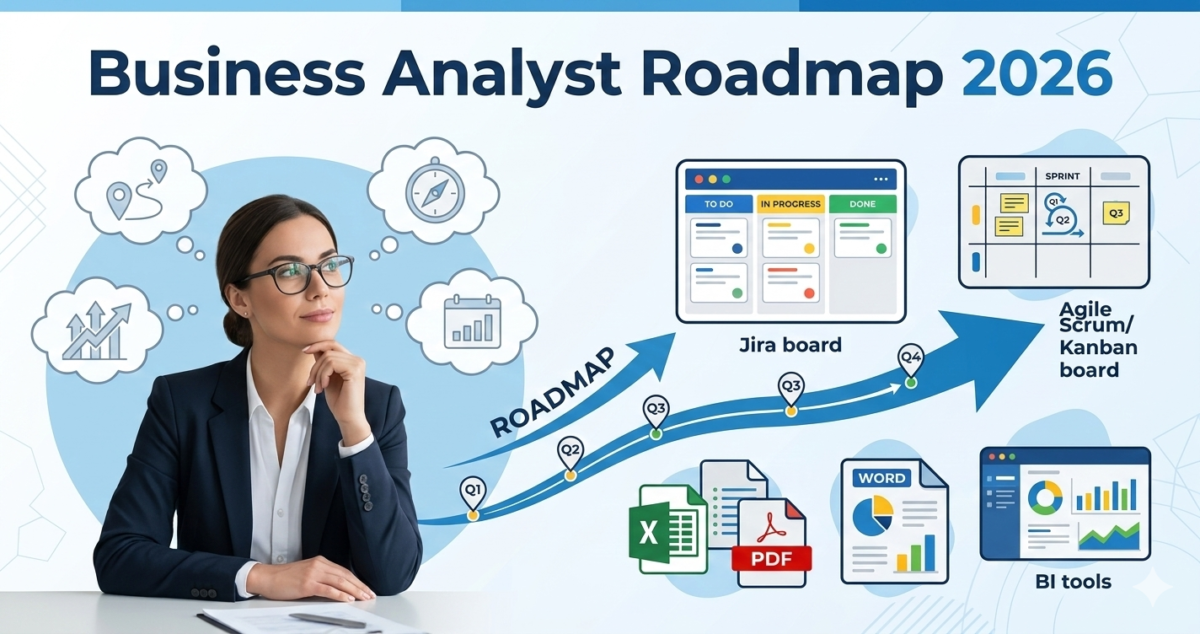
Business Analyst Roadmap 2026 (Complete Beginner Guide)

How to Become a Business Analyst in 2026 – Step by Step Roadmap

Hi friends, do you want to become a Business Analyst in 2026 but don’t know where to start? Business Analyst Roadmap 2026.Β 

Are you confused about skills, certifications, tools, Agile, SQL or whether coding is required to become a business analyst?

In this article we will give you a complete step by step Business Analyst roadmap for 2026, whether you are a fresher or a non-IT professional or already working in IT.

Read till the end because we will also share what not to waste time on, and we will share the important sample documents related to BRD, FRD and Use Case diagrams.

We will share the sample documents at the end and we will also provide answers to important FAQs. On this channel and website we help you build a successful career in Business Analysis with practical guidance, real world examples and structured roadmaps.

Let us break this roadmap into six clear steps.


Step 1: Understand What a Business Analyst Really Does

First, we need to understand that a Business Analyst is not a coder. That means a Business Analyst will not do coding always. It is better to have knowledge of coding, but it is not mandatory for a Business Analyst.

A Business Analyst acts as a bridge between business stakeholders and the technical teams.

That means a Business Analyst understands the business requirements, exactly what requirement is given by the business, and explains that requirement clearly to the internal technical teams.

Here let us understand on which areas we need to concentrate to become a Business Analyst.

Core competencies or core responsibilities of a Business Analyst include:

  • Requirements gathering

  • Writing BRD & FRD

  • Creating user stories

  • Stakeholder communication

  • Process modelling

  • Supporting UAT

Don’t worry about all these terms. We will share the website links where all relevant articles are covered. These articles explain:

  • how to gather requirements

  • how to write BRD and FRD

  • how to create user stories successfully

  • how to do process modelling

  • how to support during UAT

This is Step 1.


Step 2: Learn Business Analysis Concepts

In Step 2, you need to concentrate on Business Analysis concepts.

Here you need to learn about:

  • SDLC

  • Agile

  • Scrum

  • Requirement types

  • Use cases

  • User stories

  • Acceptance criteria

You need to understand and learn these terms clearly.

Documentation skills are also very important because the primary role of a Business Analyst is preparing documents.

A Business Analyst prepares important documents such as:

  • BRD – Business Requirement Document

  • FRD – Functional Requirement Document

  • User Stories

  • RTM – Requirement Traceability Matrix


Tools Business Analysts Need to Learn

Business Analysts should learn some basic tools.

Important tools include:

  • Jira

  • Confluence

  • MS Excel

  • PowerPoint

  • Basic SQL

You need to learn only basic SQL, such as:

  • how to write SELECT queries

  • how to write UPDATE queries

  • how to write DELETE queries

That is more than enough, and it is always good to have knowledge of SQL.


Step 3: Learn Agile Methodology

Now most companies are working on Agile methodology.

So you need to understand and learn about Agile concepts such as:

  • Scrum roles

  • Sprint planning

  • Product backlog

  • Backlog grooming

  • Story estimation

  • UAT support

Understanding Agile is very important for Business Analysts.


Step 4: Build Real Time Projects

This is where most people fail.

Just watching videos will not give practical knowledge. You need to practice creating documents and understanding how to apply the concepts.

Once you understand how to create documents, take sample requirements and try to prepare documents yourself.

If you need sample requirements or sample documents, we can share them.

Here are some practice ideas:

  • Prepare a sample BRD for an e-commerce application

  • Create user stories for a banking application

  • Create a process flow diagram for a hospital system

For example, in a hospital system you can create a workflow starting from patient onboarding until patient discharge.

You can also create a Jira board for practice.


Step 5: Business Analyst Certifications

Certifications are not mandatory, but they can help your career.

If you are interested in certifications, you can consider the following:

  • ECBA – for beginners

  • CCBA – for mid-level professionals

  • CBAP – for experienced professionals

Certifications can help, but skills matter more.


Step 6: Prepare Resume and Start Applying for Jobs

Once you complete the learning process, prepare your resume and start applying for jobs.

Try to apply for at least 5 to 10 jobs per day.

Do not use the same resume for every job. Based on the job description, modify your resume before applying.

You can target roles such as:

  • Junior Business Analyst

  • Business Analyst

  • Functional Consultant

  • Product Analyst

In some companies, Business Analysts are also called Functional Consultants or Product Analysts.

Popular job portals include:

  • Indeed

  • LinkedIn

  • Naukri


What Not to Do in 2026

Now we discussed what to do. Let us also understand what not to do.

  • Do not spend too much time learning coding deeply

  • Do not collect too many certifications

  • Do not wait until you feel 100% ready

  • Do not ignore communication skills


90 Day Action Plan to Become a Business Analyst

Here is a quick 90-day action plan.

Month 1

Focus on Business Analyst fundamentals and practice documentation.

Month 2

Learn Agile methodology and tools, and build two practice projects.

Month 3

Prepare your resume and start applying for jobs.


Final Thoughts

Becoming a Business Analyst in 2026 is absolutely achievable if you follow a structured roadmap.

You do not need luck. You need clarity, consistency, and execution.

If this roadmap helped you, comment β€œRoadmap 2026” and follow for more structured career guidance.

As mentioned earlier, we are also providing useful links in the description to learn more about:

  • Agile

  • Business Analysis skills

  • How to become a Business Analyst

If you are interested, you can go through those resources to improve your knowledge and skills.

If you have any doubts or clarifications, feel free to mention them in the comments so they can be addressed in the next article or video.

Learn more about Agile for Business Analysts

https://www.bacareers.in/agile-methodology-for-business-analysts/

Learn Business Analyst skills

https://www.bacareers.in/soft-skills-for-business-analysts/

How to become a Business Analyst

https://www.bacareers.in/how-to-become-a-business-analyst/

Requirement elicitation techniques

https://www.bacareers.in/effective-requirement-elicitation-techniques/

Is coding required to become a Business Analyst?

No. Coding is not mandatory for Business Analysts. The role mainly focuses on requirement gathering, communication with stakeholders, documentation, and supporting development teams.

Can non-IT professionals become Business Analysts?

Yes. Many professionals from finance, HR, operations, and customer support transition into Business Analyst roles.

What tools should a Business Analyst learn?

Common tools include Excel, Jira, Confluence, PowerPoint, Lucidchart, Visio, and basic SQL.

What is the career path for Business Analysts?

A typical path is Junior Business Analyst β†’ Business Analyst β†’ Senior Business Analyst β†’ Product Owner β†’ Product Manager.

Β 

Is coding required to become a Business Analyst?

No. Coding is not mandatory for Business Analysts. The role mainly focuses on requirement gathering, communication with stakeholders, documentation, and supporting development teams.

Can non-IT professionals become Business Analysts?

Yes. Many professionals from finance, HR, operations, and customer support transition into Business Analyst roles.

What tools should a Business Analyst learn?

Common tools include Excel, Jira, Confluence, PowerPoint, Lucidchart, Visio, and basic SQL.

What is the career path for Business Analysts?

A typical path is Junior Business Analyst β†’ Business Analyst β†’ Senior Business Analyst β†’ Product Owner β†’ Product Manager.

Business Analyst Without Coding: Step-by-Step Career Guide

How to Become a Business Analyst Without Coding

Hi friends, in this article let us see how to become a business analyst without coding.

Most people believe you need coding to enter the IT industry. But what if I told you that one of the highest demand IT careers does not require coding at all?

Thousands of professionals from finance, HR, operations and even non technical backgrounds are already doing it.

That career is called Business Analyst.

Are you from a non technical background and wondering if becoming a business analyst is possible for you?

Then the answer is yes.

And in this article I will show you the exact step by step roadmap to become a business analyst without coding skills or coding knowledge.

Β 


Why Coding is Not Required for Business Analysts

Many people want to move into the IT industry but stop themselves because they think:

  • I don’t know programming

  • I come from non technical background

  • I can’t learn coding

But here is the truth.

A business analyst is not hired for coding skills. They are hired for understanding business problems and finding solutions.

A business analyst acts as a bridge between business teams and technical teams.

  • Business teams explain the problem

  • Developers build the solutions

  • The business analyst ensures both sides clearly understand the requirement


Real World Example of a Business Analyst Role

Let us imagine a simple example.

An online shopping company wants customers to track their orders.

The business team says customers keep calling support asking where their order is.

So what the business wants is an order tracking feature.

But developers cannot build the feature immediately because they need clear requirements. Based on a single line statement they cannot start development.

This is where the Business Analyst comes in.

The BA talks to stakeholders and understands the problem or requirement and documents the requirements and writes user stories.

Then the developers can build their feature based on the documents provided by the Business Analyst.

Note something interesting here.

The business analyst did not write a single line of code.

He prepared the documents and the user stories.


What is a Business Analyst

First, try to understand the role of a business analyst.

A business analyst helps organizations solve problems by analysing business needs and translating them into requirements for development teams.

Typical responsibilities include:

  • Gathering requirements

  • Talking with stakeholders

  • Analysing business processes

  • Documenting requirements

  • Writing user stories

  • Supporting agile teams

Notice something important here.

None of these responsibilities require coding.


Role of a Business Analyst

A business analyst acts as a bridge between business stakeholders and developers.

Business teams know what problem needs to be solved.

Developers know how to build the solution.

The business analyst ensures both sides clearly understand each other.

Example:

The business team says we want customers to track their orders.

The business analyst converts this idea into detailed requirements for developers.


Learn Core Business Analyst Skills

Instead of coding, a business analyst should focus on building core business analysis skills.

Important skills include:

  • Requirement gathering

  • Stakeholder communication

  • Process analysis

  • Documentation

  • Problem solving

You should also understand important business concepts like:

  • BRD (Business Requirement Document)

  • FRD (Functional Requirement Document)

  • User Stories

  • Acceptance Criteria

  • Agile Methodology


Core Skills Required for Business Analysts

To become a successful business analyst, you need:

  • Strong analytical thinking

  • Communication skills

  • Documentation ability

Example:

Imagine a company is losing customers on their website.

A business analyst analyses the situation and discovers that the checkout process is too complicated.

By simplifying the checkout process, the company improves customer experience.

This is the type of problem solving business analysts do every day.


Learn Basic Business Analyst Tools

You don’t need programming languages, but you should learn some important business analyst tools.

Common tools include:

  • Excel

  • PowerPoint

  • Jira

  • Confluence

  • Lucidchart

  • draw.io

  • Visio

Business analysts use tools to manage requirements and communicate with teams.

Examples of tool usage:

  • Excel for data analysis

  • PowerPoint for presenting requirements

  • Jira for managing agile tasks

  • Confluence for documentation

  • Lucidchart for process diagrams

Example:

In Jira, business analysts create user stories that developers use to build features.


Business Analyst Process

Business analysts follow a structured process to analyse business problems.

Typical process:

  1. Understand the problem

  2. Gather requirements

  3. Analyse requirements

  4. Document requirements

  5. Support development and testing

Example:

A bank wants to launch an online loan application system.

The business analyst will:

  • Talk to customers

  • Understand loan rules

  • Document requirements

  • Help developers build the system


Requirement Gathering

Requirement gathering means collecting information from stakeholders to understand their needs.

Common techniques include:

  • Interviews

  • Workshops

  • Surveys

  • Observation

Business analysts use these techniques to capture requirements.

Example:

A hospital wants to build a patient management system.

The business analyst interacts with doctors and hospital staff to understand required features.

Example requirements include:

  • Patient registration

  • Appointment booking

  • Medical records


Writing User Stories

One of the most important tasks of a business analyst is writing user stories.

A simple user story format is:

As a user, I want this feature so that I can get this benefit.

Example:

As a customer, I want to track my order so that I know when my package will arrive.

This helps developers clearly understand what feature they need to build.


Build Practical Knowledge

To become a business analyst, practice with sample projects.

Example projects include:

  • Online shopping system

  • Banking application

  • Hospital management system

  • Food delivery application

Example for an online shopping system:

You can write requirements for:

  • Product search

  • Add to cart

  • Checkout

  • Order tracking


Create a Strong Resume

Your resume should highlight:

  • Analytical skills

  • Business understanding

  • Documentation experience

  • Communication skills

Example:

Instead of writing:

Worked in operations

Write:

Analysed business processes and documented workflow improvements.

You can also use these keywords in your resume:

  • Requirement analysis

  • Stakeholder communication

  • Process improvement

  • Documentation

Even if you come from finance, HR or operations, you can transition into business analyst roles.


Start Applying for Jobs

You can apply for entry level roles such as:

  • Junior Business Analyst

  • Business Analyst Trainee

  • Functional Analyst

  • Business Analyst Associate

Many companies hire candidates without coding experience.


Business Analyst Career Growth Path

Business analysts have excellent career growth opportunities.

Typical career path:

  1. Junior Business Analyst

  2. Business Analyst

  3. Senior Business Analyst

  4. Product Owner

  5. Product Manager

Many experienced business analysts eventually move into product management roles, where they lead entire products.


Final Thoughts

If you are from a non technical background and want to enter the IT industry, becoming a Business Analyst is one of the best options.

You don’t need coding.

You need:

  • Analytical thinking

  • Communication skills

  • Business understanding

If you want more articles about business analyst careers, IT career growth and high paying non coding jobs, make sure to follow BA Careers and start building your dream career today.

Learn more about Business Analyst skills here:
https://www.bacareers.in/soft-skills-for-business-analysts/

Understand Agile methodology for Business Analysts:
https://www.bacareers.in/agile-methodology-for-business-analysts/

If you want to become a Business Analyst, read this guide:
https://www.bacareers.in/how-to-become-a-business-analyst/

FAQ

Can I become a Business Analyst without coding?

Yes. Business Analysts focus on understanding business problems, gathering requirements and communicating with development teams. Coding is usually not required.

Is Business Analyst a good career for non technical people?

Yes. Many professionals from finance, HR, operations and marketing successfully transition into Business Analyst roles.

What skills are required for Business Analysts?

Important skills include requirement gathering, communication, analytical thinking, documentation and understanding business processes.

Β 

Beyond Agile: BA’s Role in Product

Business Analyst in product development

Β 

Are you a Business Analyst feeling stuck in the “Agileway of working? What if your real potential is bigger than just user stories and sprint planning? Today‘s fastmoving digital world needs more than just organizing a backlogβ€”it needs people who can create real value through smart product thinking.

Let’s look at how Business Analysts are stepping out of the Agile box and becoming important players in shaping product strategy, driving innovation, and helping businesses succeed longterm.

Β 

The Changing World of Product Development

Β 

Agile methods like Scrum and Kanban have changed how teams build and deliver valueβ€”faster releases, constant feedback, and stronger teamwork.
But as products get more complex, teams need more than just fast delivery.

Agile taught teams how to work efficiently.
But in 2025’s product world, challenges go beyond sprint speed.

Products now connect with AI, IoT, and global platforms.

Teams are spread out, work with data, and face changing customer needs all the time.

A Business Analyst in this world doesn’t just list requirementsβ€”they need to help find the right problems to solve.

The Rise of Product-Led Growth

Companies like Slack, Zoom, and Notion have started using productled growth (PLG)β€”where the product itself is the main driver of user growth and loyalty.

In PLG models, Business Analysts play a key role in:

Β 

Turning user data into useful ideas

Β 

Connecting business goals like customer churn and activation to the user experience

Making sure the product keeps delivering value

Why Old BA Roles Are No Longer Enough

In the past, a Business Analyst’s role ended with a signed-off requirements list.

Now, Business Analysts must:

Β 

Understand market trends and what competitors are doing
Work with product managers to define a clear product vision
Use analytics to measure results, not just tasks

Β 

Real-World Example:

Β 

A BA at a fintech company used to focus only on loan process requirements.
Now, she uses customer data to find where users stop during the application processβ€”leading to a redesigned flow that reduced abandonment by 25%.

From Requirements to Strategic Vision

Modern Business Analysts don’t just ask β€œWhat does the user need?”
β€”they ask β€œWhy does this problem matter?”

Moving Beyond the β€œWhat”

Traditional requirement gathering is being replaced by strategic discovery.
Now, Business Analysts:

Β 

Look for market opportunities
Compare with competitors
Test ideas with real user data
Facilitating Product Discovery

Β 

Business Analysts work closely with product managers during discovery sessions.
These help teams decide which problems are worth solving and keep everyone lined up on what’s important to customers.

Β 

Example:

Β 

In a healthcare platform, the BA organized a discovery workshop with doctors, designers, and developers.
The result was a simpler appointment system that improved user satisfaction by 40%.

Β 

Translating Strategy into Action

Β 

Once a clear strategic plan is in place, Business Analysts create plans and feature lists that match business goals.

They act as a bridge between strategy and execution.

Β 

The BA as Product Enabler

Β 

Business Analysts are becoming key enablers of product success.
They make sure insights, feedback, and plans flow smoothly across the company.

Β 

Championing User Research

Β 

Today’s Business Analysts work with UX teams to run usability tests, surveys, and A/B tests.

They turn both qualitative and quantitative data into decisions that help drive the business forward.

Β 

Bridging Gaps Across Teams

Β 

In big companies, silos can slow things down.
The BA’s special skill is translating:

Customer input into developerfriendly tasks

Technical limits into business language

Keeping everyone aligned with clear, honest communication

Driving Continuous Feedback Loops

The BA makes sure feedback doesn’t stop after a sprint.
They set up ongoing discovery practices, constantly checking on product performance, gathering insights, and making improvements.

Β 

Scenario:

Β 

A BA at a retail ecommerce company noticed increasing return rates.
By looking at customer feedback and buying patterns, they found an issue with sizing charts. Fixing this led to a 15% drop in returns within a quarter.

Beyond Sprints: Impact on the Full Product Lifecycle

Agile delivery is just part of the picture.
Business Analysts now contribute from strategy to after-launch improvements.

Involvement in Product Strategy

Business Analysts help shape early product strategy by analyzing markets and customer segments.
They figure out which features bring real business value and align them with company goals.

Go-to-Market (GTM) Contributions

During the launch phase, Business Analysts:

Check if pricing and positioning are right

Support marketing plans

Ensure key performance indicators like user adoption are clear and realistic

Post-Launch Optimization

After the product is live, the BA’s analytical skills come into play.

They track performance, gather feedback, and suggest changes to improve the product.

FutureProofing Your BA Career

To keep up in a productfocused world, Business Analysts need to move beyond just writing documents and running meetings.

Develop Important Skills

Strategic Thinking: Look at the big picture, not just daily goals.

Problem-Solving: Handle uncertainty with creativity.

Leadership: Influence without authorityβ€”guide product decisions.

Leverage Emerging Technologies

AI, data, and automation are changing how analysis is done.

Business Analysts who use tools like sentiment analysis and predictive modeling can spot trends quickly and make better decisions.

The Indispensable Modern BA

In 2025 and beyond, the Business Analyst isn’t just a support roleβ€”they drive product success.

They don’t just build productsβ€”they help decide why they should exist.

Β 

Conclusion

Β 

The world has moved on from Agile sprints.
The future belongs to Business Analysts who think like product strategistsβ€”balancing user needs, business value, and technology.

If you’re a BA looking to grow, start embracing product thinking, data fluency, and leadership.

That’s how you go from being a facilitator to a real product driver.

Related Articles:

https://www.iiba.org/business-analysis-resources/baccm/
https://www.iiba.org/business-analysis-resources/future-of-business-analysis/
https://www.pmi.org/

Future-Proof Your BA Career Now

Β 

Introduction

Future-Proof business analyst career – Your Business Analyst (BA) career, as you know it, is about to change. Don’t be caught unprepared. This isn’t just about learning new software β€” it’s about rethinking how you deliver business value in an age defined by automation, artificial intelligence (AI), and data-driven decisions.

The future belongs to Business Analysts who can adapt, innovate, and evolve beyond traditional requirements gathering. This article explores practical strategies, real-world examples, and actionable insights to help you stay ahead of the curve and future-proof your BA career.


The Shifting Sands of BA: Why Now Matters More Than Ever

Automation and AI Impact

Automation and AI are transforming traditional BA tasks like documentation, data collection, and requirement analysis. Tools such as ChatGPT, Power Automate, and UiPath are already handling repetitive work, freeing BAs to focus on strategic thinking and value creation.

Example:
In a banking project, a Business Analyst who once manually gathered transaction data can now use an AI-powered dashboard to auto-generate insights. Instead of spending hours collecting data, the BA focuses on interpreting patterns and recommending customer-centric strategies.

The β€œWhy” Behind the Urgency

The BA role is evolving fast. Those who don’t adapt risk career stagnation. Businesses now expect BAs to be innovation partners, not just requirement documenters.

According to IIBA’s Future of Business Analysis Report, 70% of organizations are integrating AI-driven analysis tools, demanding higher-level analytical and digital fluency from Business Analysts.

Opportunity in Disruption

Disruption creates opportunity. BAs who understand emerging technologies and align business goals with digital initiatives are moving into leadership and product strategy roles.

Scenario:
A BA in a logistics company who upskilled in data visualization and AI-driven route optimization transitioned into a Product Owner role. Instead of reacting to change, they led the transformation.


Beyond Requirements: The Core Skills of the Future-Proof BA

1. Data Storytelling and Analytics

Future BAs must go beyond presenting numbers. They need to translate data into stories that drive decisions. Tools like Power BI and Tableau enable BAs to craft visual narratives that connect business users with data insights.

Example:
A BA in retail used Power BI dashboards to illustrate seasonal buying patterns, helping marketing teams design more effective campaigns.

➑️ Learn more: Data Analysis for Business Analysts


2. Strategic Thinking and Business Acumen

The next-gen BA must think beyond projects β€” they must understand how the business operates. Strategic BAs align solutions with long-term goals and measurable outcomes.

Real-World Tip:
During requirement workshops, ask questions like:

  • β€œHow will this feature impact customer retention?”

  • β€œWhat’s the ROI of automating this process?”

This mindset shifts you from a task executor to a strategic partner.


3. Agile and Product Ownership Mastery

The agile era has redefined how BAs operate. Future-ready BAs embed themselves within Agile and DevOps teams, contributing continuously instead of delivering requirements once.

Example:
A BA working on a SaaS product adopted a Product Owner mindset, participating in sprint planning, backlog prioritization, and release reviews β€” ensuring faster delivery and stronger stakeholder alignment.

➑️ Related article: Agile Methodology for Business Analysts


Tech Stack & Toolbelt: Your Digital Edge

1. Low-Code/No-Code Platforms

Platforms like Mendix, Power Apps, and OutSystems empower BAs to prototype solutions quickly without deep coding knowledge. This accelerates delivery and enhances collaboration with development teams.

Example:
A BA in healthcare used Power Apps to build a claims submission prototype within days β€” saving weeks of development effort.


2. AI/ML Literacy for BAs

Understanding AI and machine learning concepts helps BAs identify opportunities for automation and predictive analytics. You don’t need to be a data scientist β€” just understand how AI supports business processes.

Scenario:
In an insurance project, a BA who understood machine learning helped design a predictive model that identified high-risk claims β€” reducing fraud by 20%.


3. Cloud-Native Environments

Modern BAs must understand how cloud systems (AWS, Azure, Google Cloud) affect business scalability, data privacy, and system integration.

Tip:
When documenting requirements, include β€œcloud implications” such as data residency, security, and integration layers to ensure long-term scalability.


Cultivating a Growth Mindset: Continuous Learning & Networking

1. Identifying Future Trends

Stay proactive. Follow emerging technologies, industry reports, and business models. Sites like Gartner, IIBA, and Harvard Business Review regularly publish insights on the future of business analysis.


2. Strategic Networking

Connect with innovators, thought leaders, and communities. Join IIBA chapters, attend BA webinars, and engage in LinkedIn BA groups. Networking exposes you to trends before they become mainstream.


3. Upskilling and Reskilling Pathways

Continuous learning is your best insurance policy.
Popular certifications include:

  • CBAP (Certified Business Analysis Professional) – for experienced BAs

  • ECBA – for beginners entering the BA field

  • Agile Analysis Certification (AAC) – for BAs in agile environments

➑️ Read: Becoming a Certified Business Analysis Professional (CBAP)


Your Action Plan: From Vision to Execution

1. Personalized Skills Gap Analysis

List your current skills vs. future needs. Identify gaps in areas like data analytics, cloud, or AI literacy. Free tools like LinkedIn Skills Assessment can guide your self-evaluation.


2. Building a 6-Month Learning Roadmap

Break your learning goals into achievable milestones.
Example Plan:

  • Month 1–2: Complete Power BI or Tableau basics

  • Month 3–4: Learn fundamentals of AI & automation

  • Month 5–6: Earn an Agile or Product Ownership certification


3. Showcasing Your Evolution

Update your LinkedIn profile, resume, and portfolio to reflect your new competencies. Share case studies, dashboards, and agile project outcomes that demonstrate your adaptability and digital fluency.

Real-Time Scenario:
A BA who posted a case study on LinkedIn about using ChatGPT for stakeholder communication received multiple job offers from innovative startups.


Conclusion: The Future Belongs to Adaptable BAs

The landscape of business analysis is evolving β€” fast. But it’s not about fearing change; it’s about embracing it. By enhancing your technical literacy, business acumen, and strategic mindset, you’ll not only stay relevant β€” you’ll lead the transformation.

Start today. Future-proof your BA career β€” because tomorrow’s opportunities belong to those who prepare now.

Β 

Β 

error

Enjoy this blog? Please spread the word :)