

Kanban methodology is an Agile continuous-improvement framework designed to visualize work, limit work-in-progress (WIP), and maximize operational throughput.
Originally developed by Taiichi Ohno at Toyota for lean manufacturing, Kanban has become one of the most widely adopted Agile frameworks in software development, IT service management, and business operations.
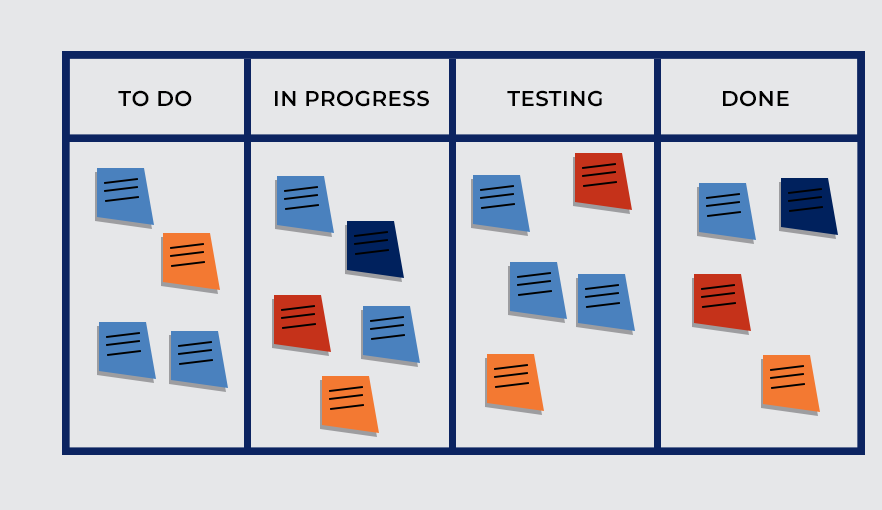
What is Kanban Methodology?
In software development and business analysis, Kanban (a Japanese word for “visual board” or “signboard”) is a pull-based framework for managing workflow in real-time. Kanban’s focus is on delivery in small increments without rigid sprint deadlines.
Unlike some time-boxed frameworks (like Scrum’s 2-week sprints), when capacity opens up on the Kanban board, the next item of highest value in the queue is pulled through.
Key Takeaway: Kanban emphasizes visualizing and limiting the work that flows through your delivery process without predefined sprints.
4 Core Kanban Principles
There are four foundational operational principles for implementing Kanban:
- Start With What You Do Now – Apply Kanban over your existing workflow with the understanding that there is likely room for improvement through changes.
- Agree To Pursue Incremental, Evolutionary Change – Approach the effort as a series of small, continuous improvement efforts, not a radical restructure.
- Respect Current Roles, Responsibilities, And Titles – Utilize your existing processes, roles, and job titles to reduce the initial implementation barrier.
- Encourage Leadership At All Levels – Promote the idea that every member of your delivery team – from the Developer to the QA tester to the Business Analyst – is capable of and encouraged to identify and resolve flow problems and suggest improvements.
The 6 Core Practices of Kanban
To execute Kanban effectively, software delivery teams adhere to six key practices:
| Phase | Kanban Principle | Outcome |
|---|---|---|
| 🔹 Step 1 | Visualize Workflow | Improve visibility of work |
| 🔹 Step 2 | Limit WIP | Prevent bottlenecks and context switching |
| 🔹 Step 3 | Manage Flow | Increase delivery speed and efficiency |
| 🔹 Step 4 | Make Policies Explicit | Standardize processes and expectations |
| 🔹 Step 5 | Implement Feedback Loops | Enable continuous learning and adaptation |
| 🔹 Step 6 | Evolve Collaboratively | Foster continuous improvement across the team |
Implementing Kanban Principles How it applies
1. Visualize the Workflow:
This is the essence of Kanban. Create a Kanban board divided by columns representing your workflow process, from ideation to completion (e.g., Backlog $\rightarrow$ Ready for Analysis $\rightarrow$ Analysis $\rightarrow$ Ready for Dev $\rightarrow$ Dev In Progress $\rightarrow$ Ready for QA $\rightarrow$ QA In Progress $\rightarrow$ Done).
You will typically place your work items in the form of digital cards containing your user stories, tasks, bugs, etc., onto the board.
2. Limit Work-in-Progress (WIP):
The number of cards in a column that are “in-progress” should be limited. For example, if the “Testing” column has a WIP limit of 3, QA can only bring a 4th testing item into that column when another item has exited it.
WIP limits are essential to prevent bottlenecks and avoid burning team members out.
3. Manage and Measure Flow:
Kanban actively monitors and measures the speed at which items move across your board. You’ll be interested in metrics such as: Lead time: How much total time passes between an item being requested and its final delivery Cycle time: How much time work actively spent being worked on from start to finish.
4. Make Process Policies Explicit:
Explicitly defining how work move through the system reduces ambiguity. For example, what criteria does a story need to meet to be “Ready for Dev”?
These policies become your “Definition of Ready”, and the “Definition of Done” shows criteria work has been completed.
5. Implement Feedback Loops:
Hold cadences to check status, inspect performance, and manage risks. This includes daily stand-ups, as well as occasional flow reviews, release planning, and retrospectives to address potential workflow issues.
6. Improve Collaboratively, Evolve Experimentally:
Based on data (like Cumulative Flow Diagrams), the team regularly discusses performance and tries out experiments to optimize its workflow and deliver value more smoothly.
Kanban Board Anatomy: Real-World Example
A standard Kanban board for a software team features explicit columns and enforced WIP limits:
| Backlog (No Limit) | In Analysis (WIP: 2) | Ready for Dev (WIP: 3) | In Dev (WIP: 3) | Testing (WIP: 2) | Done |
| Story A | Story C | Story E | Story G | Story I | Story K |
| Story B | Story D | Story F | Story H | Story J | Story L |
Kanban vs. Scrum: Key Differences
While both Kanban and Scrum are popular Agile frameworks, they manage work differently:
| Metric / Aspect | Kanban Methodology | Scrum Framework |
| Cadence / Delivery | Continuous flow; pull-based | Time-boxed Sprints (1–4 weeks) |
| Planning Mechanism | Continuous replenishment | Sprint Planning at start of cycle |
| Work In Progress (WIP) | Explicit WIP limits per column | Limited by Sprint Backlog commitment |
| Roles | No mandatory roles | Prescribed roles (Scrum Master, PO, Team) |
| Changes During Cycle | Allowed at any time (if capacity exists) | Scope locked during active Sprint |
| Primary Metric | Cycle Time & Lead Time | Velocity (Story Points per Sprint) |
Role of the Business Analyst in a Kanban
Team As a BA on a Kanban team, your primary objective is to ensure healthy flow by maintaining clear communication and anticipating development needs:
Backlog Grooming: Ensuring the “To Do” queue on the Kanban board is continuously prioritized, so the engineering team can pull well-defined, valuable requirements as capacity becomes available.
Managing Analysis WIP: Keeping the “Analysis” columns on your Kanban board within WIP limits ensures requirements aren’t pulled too far in advance for developers.
Defining Explicit Policies: Well-defined user stories, acceptance criteria, and edge cases documented on Kanban story cards help the development team pull complete stories “Ready for Dev.”
Resolving Bottlenecks: Regularly identifying and resolving dependency impediments or blocker issues for work items moving across the Kanban board.
Real-Time Scenario: Managing an Urgent Production Bug in Kanban
The Context
An e-commerce company operates a continuous software delivery team using a Kanban board with enforced WIP limits across their delivery pipeline:
In Analysis (WIP Limit: 2)
In Development (WIP Limit: 3)
In Testing (WIP Limit: 2)
The Event
At 11:00 AM on a Tuesday, customer support reports a critical production issue: “Payment Gateway Error: Users are receiving a 500 status code during credit card checkout.”
Because the team operates under Kanban, they do not have to wait for a 2-week Sprint cycle to end to adjust scope. Instead, they execute the following continuous-flow workflow:
[Customer Bug Reported]
│
▼
[BA Analysis] ──(Triage & Prioritize)──► [Pulled into ‘In Dev’ Column]│
▼
[WIP Limit Exceeded Alert!]│
(Pause Non-Critical Story #102)
│
▼
[Hotfix Developed & Released]
How the Kanban Board Responds
Immediate Ingestion (Pull System):
The Business Analyst (BA) quickly creates an urgent Hotfix Card (
BUG-409).The BA verifies the reproduction steps, adds the acceptance criteria (“Credit card authorization returns 200 OK and generates order confirmation”), and marks it as Expedite / Highest Priority.
Handling the WIP Limit Constraint:
The In Development column already has 3 active feature stories (
STORY-101,STORY-102,STORY-103), hitting its WIP Limit of 3.Under Kanban rules, developers cannot simply add a 4th card and work on 4 things at once (which causes severe context-switching).
The Action: The Lead Developer immediately pauses
STORY-102(moving it to a Blocked/Paused state) to pullBUG-409into active development without violating team capacity limits.
Managing Bottlenecks in Real Time:
BUG-409moves to In Testing. The testing column is now full (WIP Limit reached).Rather than pulling a new feature from In Development, the developer steps in to help the QA engineer validate the fix immediately (Swarming).
Deployment & Metric Impact:
Within 3 hours of the bug being reported,
BUG-409moves to Done and is automatically deployed to production.Outcome:
Lead Time: 3 Hours (From bug report to production resolution).
Cycle Time: 2 Hours (From dev pick-up to production resolution).
Key Takeaways from This Real-Time Scenario
Flexibility over Fixed Scope: Unlike Scrum—where introducing new work during an active Sprint requires scope negotiation—Kanban handles incoming, high-priority work seamlessly.
WIP Limits Protect Quality: Halting
STORY-102ensured developers focused 100% of their effort on resolving the revenue-impacting checkout bug rather than splitting attention across multiple tasks.Team Swarming: WIP limits encouraged the developer to help QA test the hotfix, preventing a bottleneck in the testing stage and speeding up total Cycle Time.
Frequently Asked Questions (FAQ’s)
Yes. Combining Kanban practices with Scrum rules is called Scrumban. Teams keep fixed sprint planning and retrospectives from Scrum while using Kanban boards and WIP limits to manage continuous daily execution.
A Work-in-Progress (WIP) limit is a maximum threshold set on a specific board column. It prevents teams from starting new tasks before finishing current ones, eliminating multitasking and reducing context switching.
Kanban performance is measured using Lead Time, Cycle Time, Throughput (items completed per period), and visual tools like Cumulative Flow Diagrams (CFD) to spot workflow bottlenecks.
🎁 Become a Better Business Analyst
Join 1,200+ Business Analysts learning every week.
Get instant access to:
📘 FREE Business Analyst Templates
🎯 Interview Preparation Guides
🚀 Agile & Scrum Tutorials
🤖 AI for Business Analysts
📈 Career Growth Tips
100% Free • No Spam • Unsubscribe Anytime

Please check this link, https://www.bacareers.in/website-design-and-development/ , hope it will help you.
Thank You
Thank You.
Thank You.
Thank You