

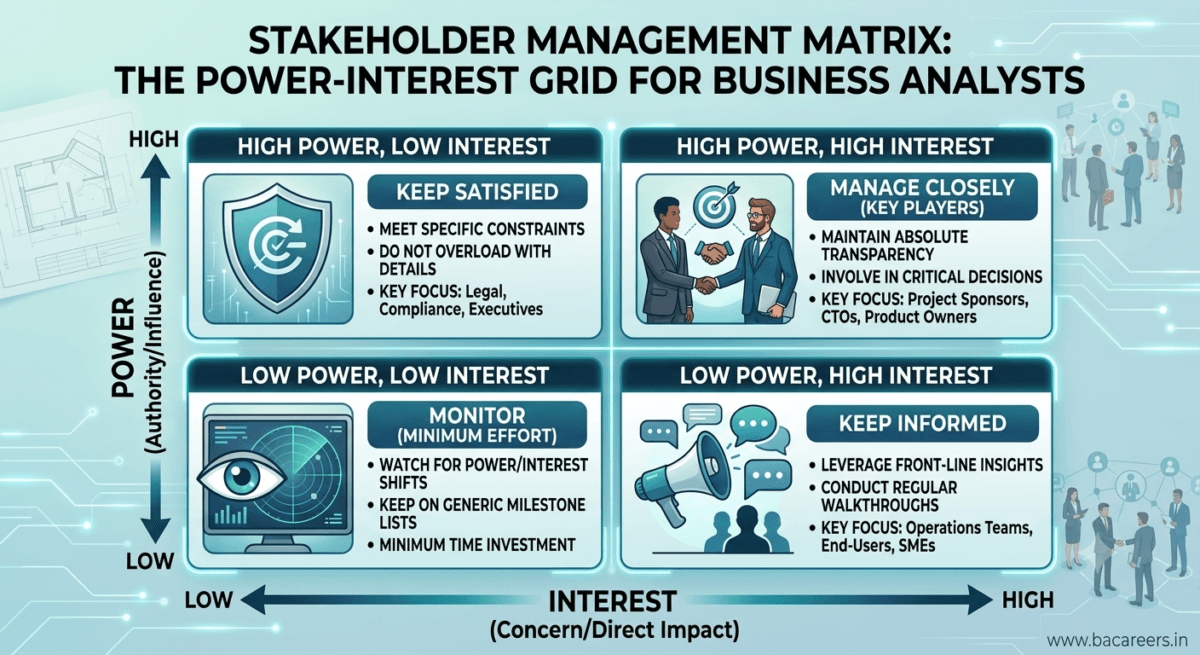
If managing competing requirements across several departments seems difficult and will be the cause of going scope, use a Stakeholder Management Matrix! As a Business Analyst you act as the conduit to a business stakeholders. However in most business’s there are simply more departments, with different objectives, to keep happy.
A Stakeholder Management Matrix is what you need!
If you carry out Stakeholder Analysis, early on the project life cycle you will be able to effectively display the level of influence that people will have over your project. This analysis allows you to understand who you need to communicate to and how effectively to engage stakeholders so as to gain trust through effective business relationships. We look at what a stakeholder matrixis, how the classic Power-Interest Grid with real world examples work and how you can take this forward to keep your stakeholders happy.
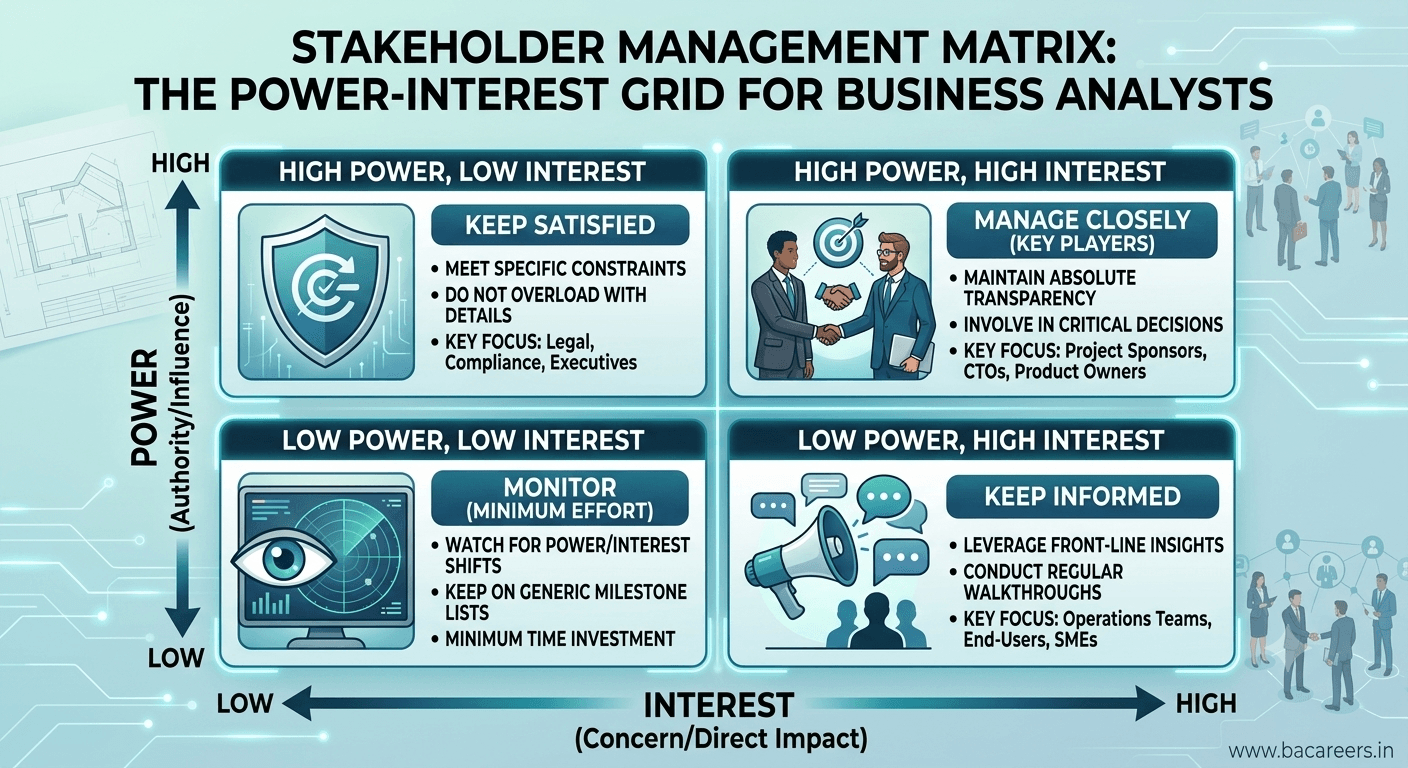
What is a Stakeholder Management Matrix?
A Stakeholder Management Matrix is what you call a power/interest grid, it displays who has an influence on your project based on their power/influence level, versus interest in the outcome of the project, into one of four distinct categories:
- Power : Power is defined as the degree to which a stakeholder has control over a decision in the project.
- Interest : Interest is defined as the extent to which a stakeholder’s business unit or team will be affected by the outcome of the project.
Once you plot every stakeholder onto the matrix, you remove the assumption of what type of communication is needed. In the four quadrants, there are four types of people to deal with.
1. High Power / High Interest (Manage Closely)
These are people that will be making the final calls in a project, and as the projects impacts them, they have a direct vested interest in what the outcomes will be. They could include Project Sponsors or key members of senior management.
2.High Power / Low Interest (Keep Satisfied)
These stakeholders possess a lot of authority, and they can kill your project with one fell swoop of a pen but their lack of interest can lead to complacency if you do not act in the correct way. Examples of high power / low interest stakeholders could be a legal department or a company secretary.
3. Low Power / High Interest (Keep Informed)
Stakeholders that are likely to be end-users of the new product are going to have a high interest.
However due to their lower level of authority they may feel frustrated that they are unable to effect change on the project.
The Customer Services Team is a prime example of Low Power / High Interest individuals.
4. Low Power / Low Interest (Monitor)
The least number of stakeholder engagement time is spent managing this type of stakeholder as they have little say or say in the final outcome.
However, they could turn out to be of significance in the project if their roles or importance shifts. The company secretary is a classic example of low power/ low interest and it can easily be managed through generic updates on the project development.
Stakeholder Management Example – Scenario We will take on a Stakeholder Management Matrix scenario – creating a new customer billing system.
The Finance Director (High Power / High Interest). : They are signing off the expenditure on the new system so their say is important. Their department has to enter invoices from the old system into the new system, and as the systems are different, they feel the new process will impact on the business so we manage closely.
The CSO (Chief Security Officer) has High Power but Low Interest in the details of a new UI/UX. They will want a sign-off on the security requirements in order to release the project.
Keep Satisfied by ensuring their concerns are put to rest through validation checks etc.
The heads of customer services (Low Power / High Interest). Their departments will all be using the new billing system to access the data for their teams to be able to work from, so the interest levels are high as their processes need to be efficient and it must be user friendly.
The head of IT operations (Low Power / Low Interest) as his team have the role to implement it. Keep them in the loop via general updates but nothing more detailed.
Conclusion
Mastering the Stakeholder Management Matrix transforms the way a Business Analyst navigates complex corporate environments. Instead of managing relationships reactively, this structured framework allows you to proactively tailor your communication, align project expectations early, and build lasting professional trust. By understanding exactly who needs deep collaborative engagement and who simply requires high-level status updates, you can efficiently focus your time where it matters most, effectively neutralizing project resistance and preventing costly scope creep before it begins.
Frequently Asked Questions: Stakeholder Management Matrix
Q1: What is a stakeholder management matrix?
Answer: A stakeholder management matrix (often called a Power-Interest Grid) is a project management framework used to analyze and categorize stakeholders based on their level of authority (power) and their level of concern (interest) in a project’s outcome. It helps Business Analysts determine the most effective communication and engagement strategy for each group.
Q2: Why is stakeholder analysis important for a Business Analyst?
Answer: Stakeholder analysis ensures that a Business Analyst uncovers potential project resistance early, establishes trust, and effectively manages expectations. Mismanaging stakeholders is a primary cause of scope creep, making early alignment vital to keeping project delivery schedules on track.
Q3: How often should a stakeholder matrix be updated?
Answer: A stakeholder matrix is a living document that should be reviewed at the start of every project phase or whenever organizational restructuring occurs. Stakeholder power and interest levels can shift dramatically as a project transitions from initial requirements gathering to active technical development and final system deployment.
Related Articles :
- Requirement Elicitation Techniques
- Business Analyst Roadmap 2026 (Complete Beginner Guide)
- Business Requirements Documents (BRDs)
- Scrum Framework: A Complete Guide with Examples and Real-Time Scenarios (2026)

Business Analyst & Technical Content Writer specializing in Agile, Scrum, Requirements, User Stories, BRD/FRD, SEO blogs, and technical documentation.

