

How to Write BRD (Business Requirement Document)
Introduction
Hi friends, many software products fail because requirements are not documented properly. If you want to become a business analyst, you must learn how to write a BRD, business requirement document.
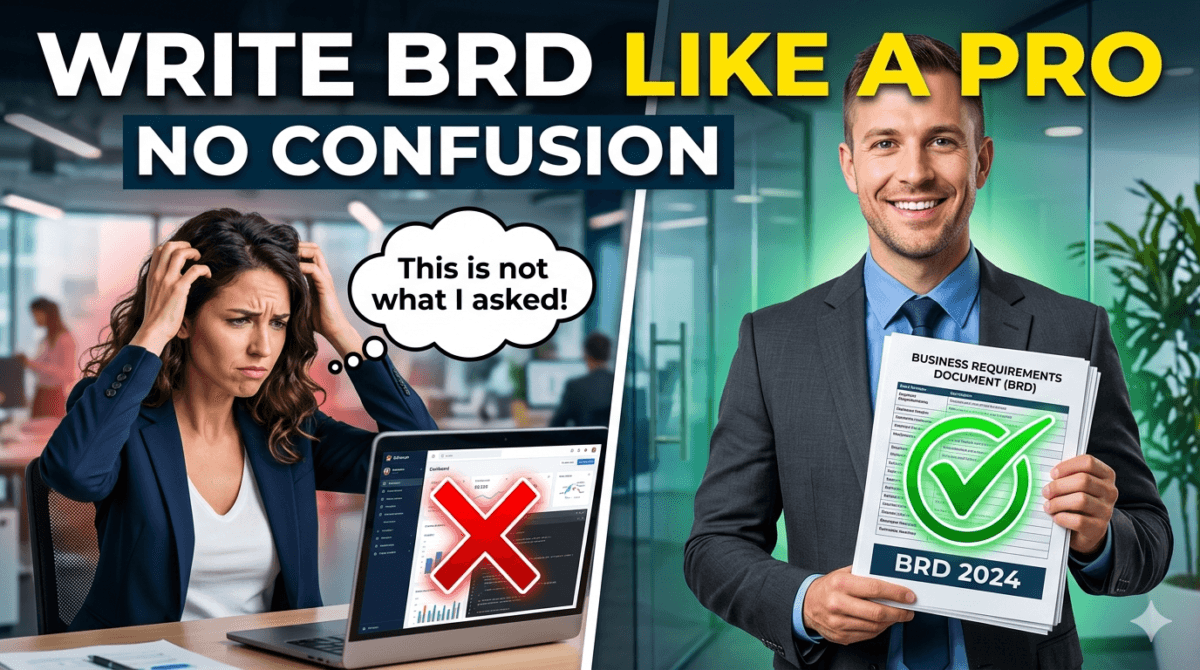
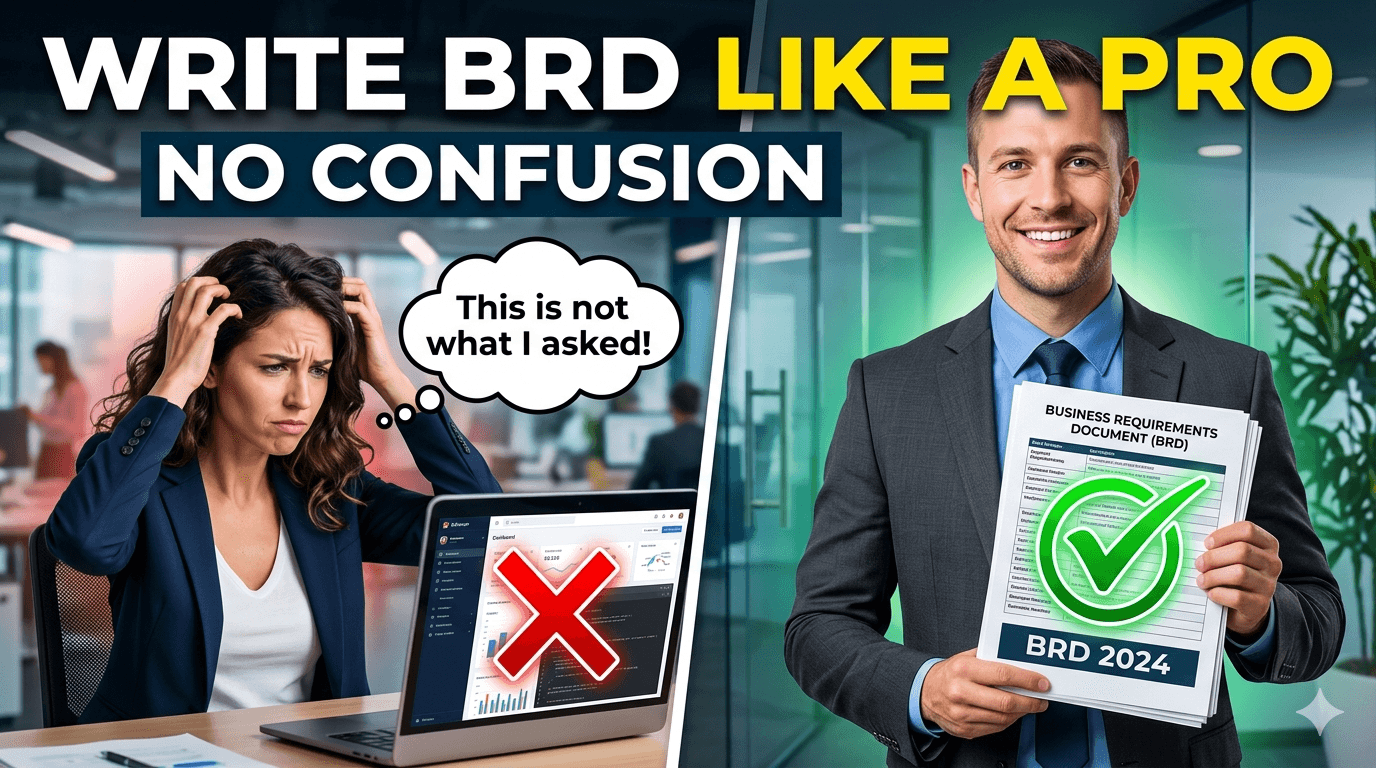
Imagine this situation, a company spends million of dollars to build a software, but when the project is completed, the client says this is not what we asked for.
Why does this happen? Because requirements are not documented properly. And that is exactly why business requirement documents BRD are so important.
In this article, I will show you how to write a professional BRD step by step.
Understanding BRD
Many beginners think writing a BRD is just copying requirements, writing long documents using complex templates. But the truth is a good BRD clearly explains the business problem and solutions.
Let us see how to write business requirement document step by step.
Example Scenario
Let us take a simple example. A bank wants to create a mobile app for customers. Customer should be able to check balance, transfer money and pay bills.
Before developers start coding, the business analyst must create a BRD document explaining the requirements.
Let us see what goes inside that document.
BRD Section 1: Document Overview
The first section includes project name, document version, author, date.
Example:
- Project name: Mobile Banking Application
- Version: 1.0
- Author: Business Analyst
BRD Section 2: Business Objective
This section explains why the project exists.
Example:
To enable customers to perform banking transactions using a mobile application.
This helps everyone understand the business goal.
BRD Section 3: Scope
Scope explains what is included and what is not included.
Example:
- Included: balance checking, fund transfer and bill payment
- Not included: loan processing
BRD Section 4: Stakeholders
Stakeholders are people involved in this project.
Example:
- Business Manager
- Product Owner
- Development Team
- QA Team
This section helps identify who is responsible for decisions.
BRD Section 5: Business Requirements
This is the most important section.
Example Requirements:
- Requirement 1: The system should allow users to log in using username and password
- Requirement 2: The system should allow users to transfer funds between accounts
Requirements must be clear, testable and measurable. Always you should keep in mind that the requirement should be clear, testable and measurable.
BRD Section 6: Business Rules
Business rules define restrictions.
Example:
Daily transfer limit 1 lakh per day.
BRD Section 7: Assumptions and Constraints
Example Assumptions:
Users have internet access
Example Constraints:
Project must be completed within 6 months
BRD Section 8: Approval
The final section includes approval from the stakeholders.
Example:
- Business Manager
- Product Owner
- Project Manager
This confirms everyone agrees with the requirements.
Conclusion
Writing a good BRD helps teams understand requirements clearly, reduce project errors, improve project success.
If you want to learn more about business analyst skills, BA interview preparation, BA career roadmap, subscribe to career growth lab.
And if you want sample documents, you can download from the website.
Related Articles
- https://www.bacareers.in/how-to-become-a-business-analyst/
- https://www.bacareers.in/business-analyst-career-path/
- https://www.bacareers.in/business-analyst-interview-questions/
- https://www.bacareers.in/user-story-writing-best-practices/
❓ FAQs
1. What is BRD in business analysis?
BRD stands for Business Requirement Document. It explains business needs and project requirements clearly.
2. Why is BRD important?
BRD helps avoid misunderstandings between stakeholders and development teams.
3. What are the key sections in a BRD?
Document overview, business objective, scope, stakeholders, requirements, business rules, assumptions, constraints, and approvals.
4. Who prepares BRD?
A Business Analyst prepares the BRD.
5. What makes a good BRD?
A good BRD is clear, testable, and measurable.
{
  "@context": "https://schema.org",
  "@type": "Article",
  "headline": "How to Write BRD (Business Requirement Document) Step by Step",
  "description": "Learn how to write a BRD with simple steps, examples, and structure. Perfect guide for beginners.",
  "author": {
    "@type": "Person",
    "name": "Business Analyst"
  },
  "publisher": {
    "@type": "Organization",
    "name": "BA Careers",
    "logo": {
      "@type": "ImageObject",
      "url": "https://www.bacareers.in/logo.png"
    }
  },
  "mainEntityOfPage": "https://www.bacareers.in/",
  "articleSection": "Business Analysis",
  "keywords": [
    "BRD",
    "Business Requirement Document",
    "How to write BRD",
    "BRD example",
    "Business Analyst"
  ]
}
FAQ’s
BRD stands for Business Requirement Document. It explains business needs and project requirements clearly.
BRD helps avoid misunderstandings between stakeholders and development teams.
Document overview, business objective, scope, stakeholders, requirements, business rules, assumptions, constraints, and approvals.
A Business Analyst prepares the BRD.
A good BRD is clear, testable, and measurable.

Business Analyst & Technical Content Writer specializing in Agile, Scrum, Requirements, User Stories, BRD/FRD, SEO blogs, and technical documentation.

