Introduction
Agile Business Analyst responsibilities ; In the world of Agile software development, the role of a Business Analyst (BA) is more dynamic and collaborative than ever before. Unlike traditional Waterfall methods where requirements are frozen early, Agile methodologies like Scrum and Kanban encourage flexibility, fast feedback, and ongoing requirement refinement.
This makes the Agile Business Analyst (Agile BA) a crucial link between stakeholders and the development team, ensuring that user needs are continuously understood and translated into valuable deliverables.
In this article, we explore in detail the core responsibilities of an Agile Business Analyst, real-time examples, and practical tools BAs use to deliver success in Agile teams.
What Is an Agile Business Analyst?
An Agile Business Analyst acts as a bridge between stakeholders and the Agile development team, helping define, clarify, and prioritize requirements in a fast-paced, iterative environment. Unlike traditional BAs, Agile BAs participate in daily stand-ups, sprint planning, retrospectives, and more.
🔗 Related Internal Link: Business Analyst role in Agile vs Waterfall
Core Responsibilities of an Agile Business Analyst
Here are the most common and essential responsibilities performed by Agile Business Analysts in real-time projects.
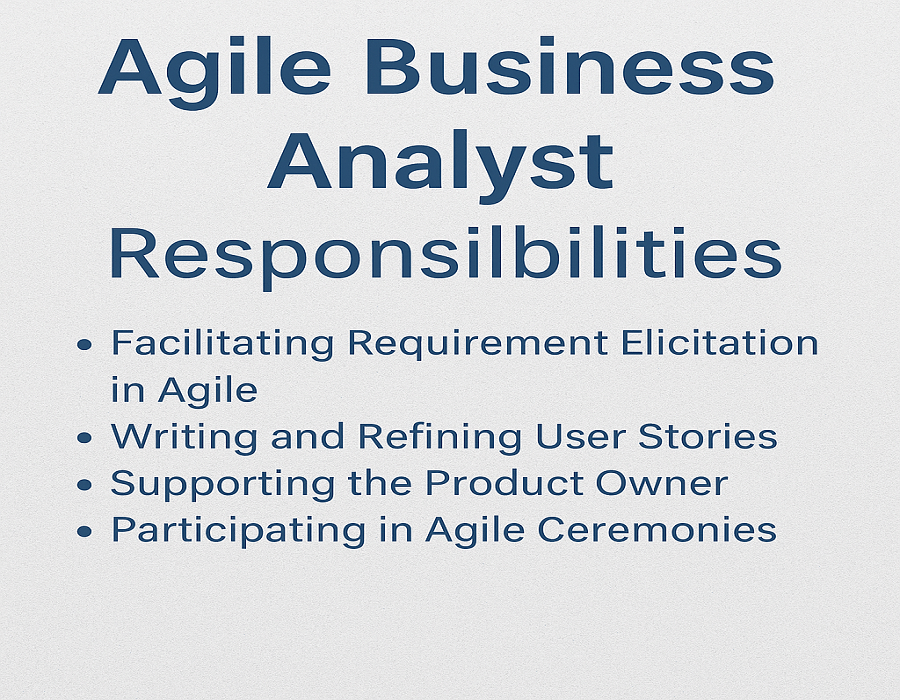
1. Facilitating Requirement Elicitation in Agile
In Agile, requirements evolve, and so must the approach to capturing them. An Agile BA:
Works closely with Product Owners (POs), customers, and end-users
Gathers high-level and detailed requirements in user story format
Encourages iterative discovery through collaboration
🧠 Real-Time Example:
In a fintech mobile app development, the BA conducts regular workshops with end-users to understand their needs and translates them into user stories like:
“As a user, I want to receive instant loan approval notifications so that I can act quickly.”
🔗 Related Internal Link: User Story Writing Best Practices
2. Writing and Refining User Stories & Acceptance Criteria
User stories form the backbone of Agile delivery. Agile BAs are responsible for:
Writing clear, concise, and testable user stories
Collaborating with QA and developers to define acceptance criteria
Prioritizing the product backlog in alignment with the PO
📌 Tip: Agile BAs often use the INVEST principle for user stories:
Independent, Negotiable, Valuable, Estimable, Small, Testable
3. Supporting the Product Owner
The BA often works as an assistant to the Product Owner by:
Helping maintain and refine the backlog
Conducting stakeholder interviews
Assisting in defining the Minimum Viable Product (MVP)
🧠 Real-Time Scenario:
In an e-commerce project, the PO is overloaded. The BA takes over backlog grooming, works with UI/UX teams to gather design feedback, and ensures features are properly scoped for the next sprint.
4. Participating in Agile Ceremonies
Agile BAs are active participants in:
Daily stand-ups: To track progress and clarify any blockers
Sprint planning: To help estimate and clarify stories
Retrospectives: To suggest improvements in business processes
🎯 Real-Time Role:
During a Sprint Retrospective, the BA identifies that vague requirements led to rework. As a result, they introduce a checklist to validate user stories before sprint commitment.
5. Promoting Continuous Feedback and Collaboration
One of the Agile values is “Customer collaboration over contract negotiation.” Agile BAs:
Regularly demo features to stakeholders
Collect feedback and refine requirements
Ensure the delivered product meets real-world needs
6. Ensuring Business Value Delivery
Agile BAs are responsible for ensuring that every user story and sprint goal is aligned with business outcomes, such as:
Increased efficiency
Cost reduction
Improved user experience
🧠 Real-Time Example:
In a logistics management system, the Agile BA helps prioritize a feature that enables real-time tracking of shipments, directly impacting customer satisfaction KPIs.
Agile Business Analyst in Scrum Teams
In Scrum, the Agile BA doesn’t have a formally defined role but acts in support of:
Product Owner: For backlog management and stakeholder communication
Scrum Master: By facilitating smoother collaboration and process improvement
Development Team: As the go-to person for clarifying requirements
🔗 Read more about Business Analyst Roles in Agile Scrum
Tools Commonly Used by Agile Business Analysts
| Tool | Purpose |
|---|---|
| Jira / Azure DevOps | Managing backlogs and sprints |
| Confluence | Documentation and collaboration |
| Lucidchart / Draw.io | Process modeling and wireframes |
| Balsamiq / Figma | UI/UX prototyping |
| ChatGPT / AI tools | Quick mockups and requirement drafting |
Key Skills Required for an Agile Business Analyst
To succeed, Agile BAs need a blend of soft and hard skills:
🔧 Technical & Analytical Skills
Understanding of Agile frameworks (Scrum, Kanban, SAFe)
Basic knowledge of software development cycles
Proficiency in tools like Jira, Confluence, Excel
💬 Soft Skills
Strong communication and facilitation
Critical thinking and problem-solving
Adaptability and emotional intelligence
🔗 Explore: Top Soft Skills for Business Analysts
Challenges Faced by Agile Business Analysts
Ambiguous or rapidly changing requirements
Stakeholder availability
Balancing speed with documentation
Integrating non-functional requirements into sprints
External Resources
Conclusion
The Agile Business Analyst is no longer a static requirements gatherer. In today’s fast-paced Agile environment, BAs are collaborative problem-solvers, trusted advisors, and value maximizers. By staying involved throughout the Agile lifecycle—from idea to iteration—they ensure that what’s being built is what truly matters to the business.
Suggested Internal Links:

Business Analyst , Functional Consultant, Provide Training on Business Analysis and SDLC Methodologies.
🌐 Founder of BACareers.in| Freelance Business Analyst & Content Writer | Banking Domain Expert | Agile Practitioner | Career Mentor
I am the founder and content creator of BACareers.in, a specialized platform for aspiring and experienced Business Analysts. I share real-world insights, career tips, certification guidance, interview prep, tutorials, and case studies to help professionals grow in the BA career path.
We have strong experience in Banking, Financial Services, and IT. We bring deep domain knowledge and hands-on expertise in core banking systems, payment integrations, loan management, regulatory compliance (KYC/AML), and digital banking transformations.
💼 Business Analyst Expertise
Requirement Elicitation, BRD/FRD, SRS, User Stories, RTM
Agile & Waterfall (Scrum, Kanban) methodologies
Business Process Modeling (BPMN, UML, AS-IS/TO-BE)
Stakeholder Communication & Gap Analysis
UAT Planning, Execution & Support
Core Banking Solutions (Finacle, Newgen BPM, Profile CBS, WebCSR)
✍️ Content Writing & Strategy
Founder of BACareers.in – knowledge hub for BAs & IT professionals
SEO-optimized blogs, training content, case studies & tutorials
Content on Business Analysis, Agile, Banking, IT & Digital Transformation
Engaging, beginner-friendly writing for professionals & learners
🌍 What we Offer
Freelance Business Analysis services: BRD, FRD, UAT, process flows, consulting
Freelance Content Writing: SEO blogs, IT/business content, case studies, LinkedIn posts
A unique blend of analytical expertise + content strategy to turn business needs into solutions and ideas into words that work
📌 Whether you’re an organization seeking BA expertise or a platform needing impactful content, let’s connect and collaborate.
Business Analyst, Agile, BRD, FRD, Banking, Content Writer, SEO writing.