

FREE DOWNLOAD: Business Analyst Documentation Toolkit
Get instant access to real-world BRD, FRD, and project story templates used by senior BAs.
Download Free Templates PDFIn Agile product development and Scrum frameworks, INVEST is an acronym and quality assurance checklist used by Business Analysts and Product Owners to ensure that User Stories are well-formed, actionable, and ready for development during sprint planning.
Created by Bill Wake in 2003, the INVEST model serves as a standard definition of quality for backlog refinement, helping team members evaluate whether a user story is granular enough to deliver value without causing dependencies or development bottlenecks.

The test for determining whether or not a story is well understood and ready for the team to start working on it is the INVEST acronym:
- Independent — The story should be independent.
- Negotiable — Can this story be changed or removed without impact to everything else?
- Valuable — Does this story have value to the end user?
- Estimable — Can you estimate the size of the story?
- Small —Is it small enough?
- Testable — User story should be testable.
The INVEST Acronym Breakdown
The word INVEST stands for six essential attributes of a high-quality Agile user story:
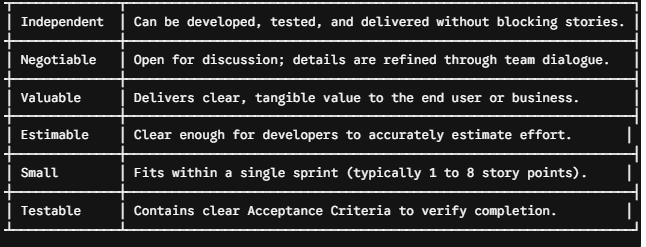
Detailed Explanation of the 6 INVEST Criteria with Examples
1. I – Independent
Meaning: User stories should be decoupled so that they can be developed, tested, prioritized, and deployed in any order without depending heavily on another active story.
Bad Example: “As a user, I want my credit card processed so I can checkout.” (Cannot be built until the payment gateway configuration story is completed).
Good Solution: Split technical setup from business value. Create a mock service API so feature stories remain independent during testing.
2. N – Negotiable
Meaning: A user story is not an explicit contract or fixed document. It is a baseline conversation starter between the Business Analyst, Product Owner, and engineering team.
Bad Example: A 15-page functional specification detailing precise database schema types and hardcoded pixel dimensions.
Good Solution: Focus on user needs and business outcome in the story text, leaving implementation details open for team collaboration during backlog refinement.
3. V – Valuable
Meaning: Every story must deliver explicit functional value to an end-user persona or commercial value to the business organization.
Bad Example: “As a developer, I want to create a database table for users.” (Delivers technical debt work, not end-user value).
Good Solution: “As a registered customer, I want to update my profile address so that my orders ship to the correct location.”
4. E – Estimable
Meaning: The delivery team must understand the scope and technical implications well enough to assign an effort estimate (e.g., Story Points using Planning Poker).
Why Stories Lack Estimability: Unclear acceptance criteria, missing third-party API documentation, or hidden technical unknowns.
5. S – Small (Sized Appropriately)
Meaning: Stories should be small enough to complete within a single sprint iteration (ideally taking 1 to 3 days of effort, or fitting within 1 to 8 story points).
Action for BAs: If a user story exceeds 13 story points or spans across sprints, it is likely an Epic or Feature that requires slicing.
6. T – Testable
Meaning: Every user story must have unambiguous Acceptance Criteria so QA engineers can write test cases and verify pass/fail criteria.
Bad Example: “The search page should load fast and look modern.”
Good Solution: “When the user clicks Search, search results must display within $2.0\text{ seconds}$ for up to 500 records.”
INVEST Matrix: Good vs. Poor User Story Comparison
| Criterion | Poor User Story (Fails INVEST) | High-Quality User Story (Passes INVEST) |
| Independent | “Process payment after user fills profile page.” | “As a customer, I want to save credit card details for 1-click checkout.” |
| Negotiable | “Must use PostgreSQL v14 with exact column constraints.” | “As an admin, I want to search user logs by date range.” |
| Valuable | “Refactor backend microservice routing logic.” | “As a mobile user, I want faster screen loading times under $2\text{ seconds}$.” |
| Estimable | “Integrate machine learning into application.” | “As a shopper, I want recommended products based on my purchase history.” |
| Small | “Build entire KYC customer onboarding flow.” | “As an applicant, I want to upload my government ID photo.” |
| Testable | “System should be secure and reliable.” | “If 3 invalid login attempts occur within $5\text{ minutes}$, lock account for $15\text{ minutes}$.” |
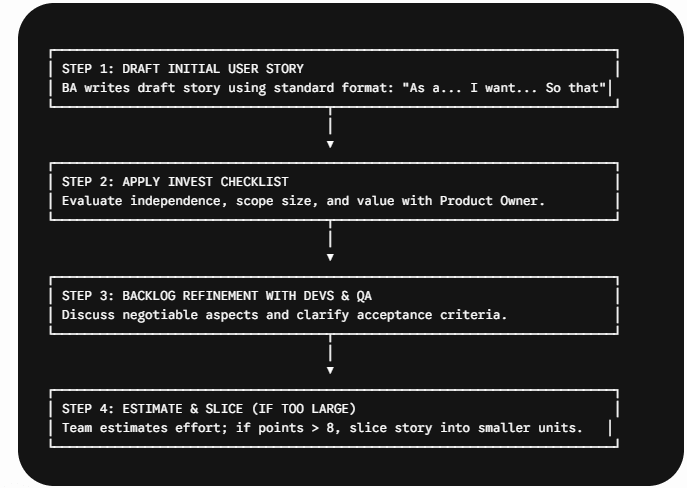
How Business Analysts Apply INVEST During Backlog Refinement
Agile & Business Analysis – Knowledge Hub
Below is the structured Knowledge Area matrix connecting Agile frameworks, requirements documentation, and delivery workflows:
| Knowledge Area | Deep-Dive Article | Why It Matters for a Business Analyst |
| Agile Frameworks | User Story Guide with Examples | Detailed tutorial on writing user stories using INVEST and Given-When-Then criteria. |
| What is Epic in Agile? | Explains how large business initiatives are broken down into INVEST-compliant user stories. | |
| Scrum Roles – Detailed Guide | Details how BAs, Product Owners, and Scrum teams collaborate during backlog refinement. | |
| Requirements Engineering | BRD vs FRD Difference | Guidance on transitioning from traditional requirements to Agile story backlogs. |
| Requirement Prioritization Techniques | Prioritizing INVEST-compliant stories using MoSCoW and value-vs-effort matrices. | |
| Documents Prepared by Business Analyst | Master list of core business analysis documentation deliverables across Agile and Waterfall. | |
| Testing & Execution | UAT Meaning and Importance | Validating that user stories meet Acceptance Criteria during User Acceptance Testing. |
| Requirement Traceability Matrix (RTM) | Tracing user stories back to overarching business goals and test cases. |
Frequently Asked Questions (FAQ)
The Business Analyst and Product Owner take the lead in drafting stories according to INVEST, while the Development Team evaluates estimability and sizing during backlog refinement.
If a story is too large or not independent, the BA should split (slice) the story by workflow step, data parameter, or user persona until each resulting story meets INVEST criteria.
Yes. INVEST applies to any flow-based or iterative Agile delivery model where items must be well-defined before pulling them into active development.
🎁 Become a Better Business Analyst
Join 1,200+ Business Analysts learning every week.
Get instant access to:
📘 FREE Business Analyst Templates
🎯 Interview Preparation Guides
🚀 Agile & Scrum Tutorials
🤖 AI for Business Analysts
📈 Career Growth Tips
100% Free • No Spam • Unsubscribe Anytime
