
Introduction: What Is an Agile Mindset?
An Agile Mindset refers to a way of thinking that embraces adaptability, collaboration, continuous learning, and customer-focused delivery. It’s not just about following Agile practices or frameworks like Scrum or Kanban—it’s about how you think and respond to change.
Instead of rigid planning and resistance to change, people with an Agile Mindset are open to feedback, quick in making decisions, and focused on delivering value.
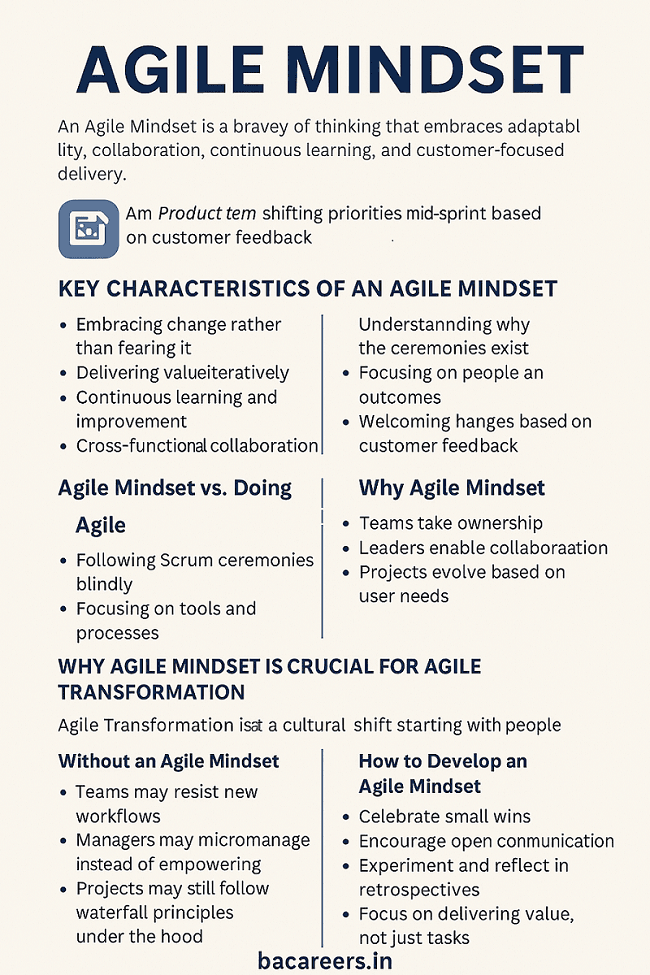
✅ Example: A product team shifting priorities mid-sprint based on customer feedback—rather than sticking to an outdated plan—is demonstrating an Agile Mindset.
Key Characteristics of an Agile Mindset
An Agile Mindset is rooted in four core values from the Agile Manifesto:
Individuals and interactions over processes and tools
Working software over comprehensive documentation
Customer collaboration over contract negotiation
Responding to change over following a plan
🔑 Additional Traits Include:
Embracing change rather than fearing it
Delivering value iteratively
Continuous learning and improvement
Cross-functional collaboration
Failing fast and adapting quickly
Agile Mindset vs. Doing Agile
| Doing Agile | Being Agile (Agile Mindset) |
|---|---|
| Following Scrum ceremonies blindly | Understanding why the ceremonies exist |
| Focusing on tools and processes | Focusing on people and outcomes |
| Sticking to plans even when needs change | Welcoming changes based on customer feedback |
💡 Real-time Scenario:
A software development team was using Scrum but missed all deadlines. Upon inspection, they were doing Agile—daily standups, sprint planning, and retrospectives—but lacked ownership, adaptability, and customer focus. Once they adopted an Agile Mindset, including real customer feedback loops and flexible sprint goals, delivery improved dramatically.
Why Agile Mindset is Crucial for Agile Transformation
Agile Transformation is more than adopting new tools or processes—it’s a cultural shift that begins with people.
Without an Agile Mindset:
Teams may resist new workflows.
Managers may micromanage instead of empowering.
Projects may still follow waterfall principles under the hood.
With an Agile Mindset:
Teams take ownership.
Leaders enable collaboration.
Projects evolve based on user needs.
🧠 Learn more about Agile Transformation.
Role of Business Analyst in Agile Mindset and Transformation
Business Analysts (BAs) are critical in facilitating Agile Mindset within teams and stakeholders.
🎯 Responsibilities of a BA in Agile Transformation:
Championing Agile Values:
Helping teams understand customer needs and shift from documentation-heavy to interaction-based workflows.Continuous Communication:
Ensuring Product Owners, Developers, and stakeholders stay aligned through constant feedback.Eliciting Flexible Requirements:
Writing user stories that allow change and promote incremental delivery.Driving Customer-Centric Thinking:
Shifting focus from “What do we want to build?” to “What does the customer need?”Facilitating Agile Ceremonies:
Participating in or even moderating standups, retrospectives, backlog grooming sessions.
✅ Real-World Example:
In a banking project, the BA helped transform the waterfall-based product design into short Agile iterations. Instead of collecting all requirements upfront, they broke them into features and delivered them sprint-by-sprint. This reduced risk and improved product-market fit.
How to Develop an Agile Mindset
Here are ways both individuals and teams can foster an Agile Mindset:
🧩 For Individuals:
Practice active listening
Welcome feedback instead of defending your stance
Be comfortable with uncertainty
Learn continuously—attend Agile meetups, read case studies
🧩 For Teams:
Celebrate small wins
Encourage open communication
Experiment and reflect in retrospectives
Focus on delivering value, not just tasks
Tools and Techniques That Support Agile Mindset
While mindset is about how you think, tools can support the journey:
| Tool / Technique | Purpose |
|---|---|
| JIRA / Azure DevOps | Sprint tracking and backlog management |
| User Story Mapping | Visualize user journey and prioritize value |
| Kanban Boards | Promote transparency and flow |
| Retrospectives | Encourage continuous improvement |
🔗 Check out: Business Analysis Techniques and Tools
Agile Mindset in Action: Real-Time Scenarios
📌 Scenario 1: Marketing Campaign Pivot
A marketing team launches a campaign but sees poor engagement. With an Agile Mindset, they quickly run a user survey, analyze feedback, and redesign the messaging—all within one sprint.
📌 Scenario 2: Software Release Delay
A Dev team finds a critical bug near release. Instead of hiding it, they alert stakeholders, delay the launch, fix the issue, and win long-term trust.
📌 Scenario 3: BA Aligning Product Vision
A BA collaborates with end-users, discovers they prefer mobile-first design, and shifts the product roadmap to reflect this insight, resulting in 30% more usage.
Challenges in Adopting an Agile Mindset
While the benefits are clear, there are some common hurdles:
Resistance to change from leadership or senior stakeholders
Lack of training or awareness
Misunderstanding Agile as just a set of ceremonies
Fear of accountability in transparent environments
✅ Solution:
Conduct mindset workshops, include real-time feedback mechanisms, and engage BAs as transformation facilitators.
Benefits of Agile Mindset for Business Analysts
Stronger collaboration with cross-functional teams
Faster delivery of customer value
Increased stakeholder trust
Enhanced adaptability and career growth
📖 Related: How to Become a Business Analyst
Conclusion: Think Agile, Act Agile
An Agile Mindset is not a destination but a continuous journey. Whether you’re a developer, tester, manager, or business analyst, embracing agility can transform the way you work and the value you deliver.
In today’s rapidly changing business landscape, adopting an Agile Mindset is no longer optional—it’s a necessity.
🔗 Internal Links (from bacareers.in):
🌐 External Links:
 20
20 638
638 20
20 70
70
Business Analyst , Functional Consultant, Provide Training on Business Analysis and SDLC Methodologies.
🌐 Founder of BACareers.in| Freelance Business Analyst & Content Writer | Banking Domain Expert | Agile Practitioner | Career Mentor
I am the founder and content creator of BACareers.in, a specialized platform for aspiring and experienced Business Analysts. I share real-world insights, career tips, certification guidance, interview prep, tutorials, and case studies to help professionals grow in the BA career path.
We have strong experience in Banking, Financial Services, and IT. We bring deep domain knowledge and hands-on expertise in core banking systems, payment integrations, loan management, regulatory compliance (KYC/AML), and digital banking transformations.
💼 Business Analyst Expertise
Requirement Elicitation, BRD/FRD, SRS, User Stories, RTM
Agile & Waterfall (Scrum, Kanban) methodologies
Business Process Modeling (BPMN, UML, AS-IS/TO-BE)
Stakeholder Communication & Gap Analysis
UAT Planning, Execution & Support
Core Banking Solutions (Finacle, Newgen BPM, Profile CBS, WebCSR)
✍️ Content Writing & Strategy
Founder of BACareers.in – knowledge hub for BAs & IT professionals
SEO-optimized blogs, training content, case studies & tutorials
Content on Business Analysis, Agile, Banking, IT & Digital Transformation
Engaging, beginner-friendly writing for professionals & learners
🌍 What we Offer
Freelance Business Analysis services: BRD, FRD, UAT, process flows, consulting
Freelance Content Writing: SEO blogs, IT/business content, case studies, LinkedIn posts
A unique blend of analytical expertise + content strategy to turn business needs into solutions and ideas into words that work
📌 Whether you’re an organization seeking BA expertise or a platform needing impactful content, let’s connect and collaborate.
Business Analyst, Agile, BRD, FRD, Banking, Content Writer, SEO writing.













I have read a few good stuff here. Certainly worth bookmarking for revisiting. I wonder how much effort you put to make such a great informative web site.