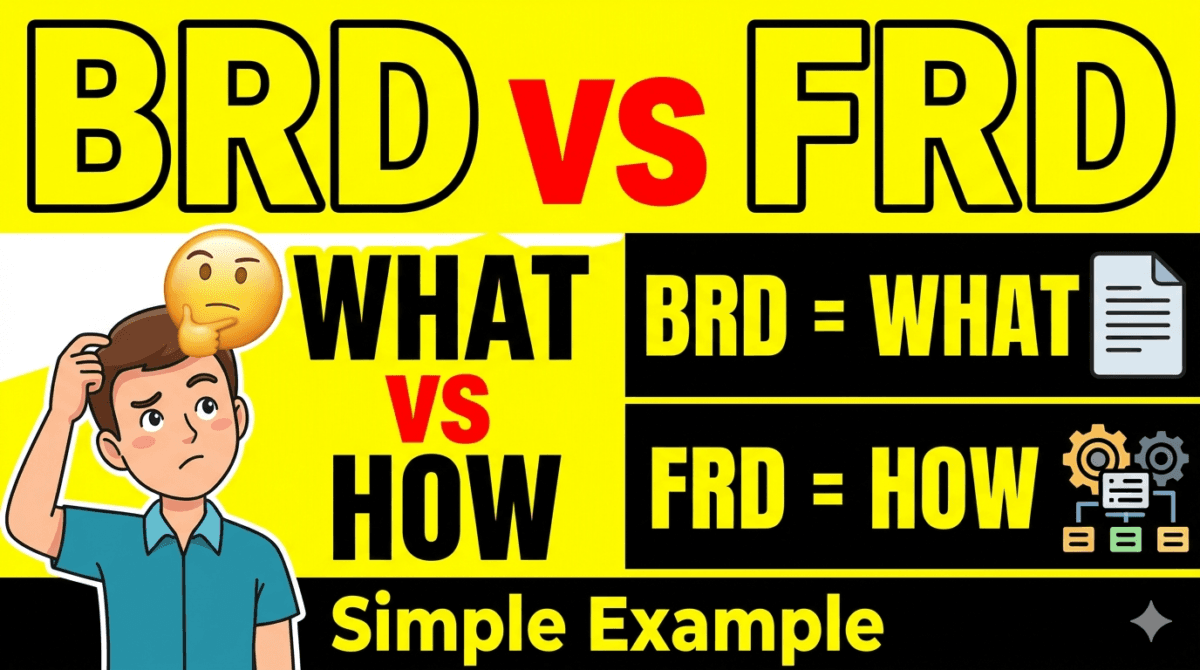
BRD vs FRD – Difference with Examples
Many business analyst beginners confuse BRD and FRD. If you are preparing for a business analyst interviews, you must know the difference between BRD and FRD. One document explains what the business needs and the other explains how the system will work.
Many beginners in business analysis get confused between two important documents that is BRD and FRD. Some people even think they are the same document but in real products they serve very different purposes. If you want to become a business analyst or prepare for interviews, you must clearly understand BRD versus FRD.
In this article, I will explain the difference with simple examples. Most people try to remember the difference using definitions but definitions are hard to remember. So in this article, we will understand the difference using a real project example so that you can remember this very easily.
Real-Time Example (Food Delivery App)
Imagine a company wants to build a food delivery mobile app. Customer should be able to browse restaurants, place orders, make payments. Here you can imagine Zomato app or Swiggy app.
Before development starts, business analysts prepare two important documents. The first document is BRD and the second document is FRD. But these documents explain different levels of details.
What is BRD?
What is business requirement document? BRD explains business goals, project objectives, high-level requirements.
Example BRD requirement:
The system should allow customers to order food online.
Notice something important here. BRD explains what the business needs. That means what client is expecting or what customer is expecting from the IT company.
What is FRD?
What is FRD? Functional requirement document. FRD explains system functionality, detailed workflows, technical behavior.
Example FRD:
User selects a restaurant, adds food items, proceeds to checkout, payment is processed, order confirmation is generated.
FRD explains how the system will work.
Simple Trick to Remember
Here is a simple trick to remember what is BRD and what is FRD.
What does the business need?
BRD answers what does the business need or what does the business requirement.
FRD answers how will the system implement it.
This is the core difference between BRD and FRD.
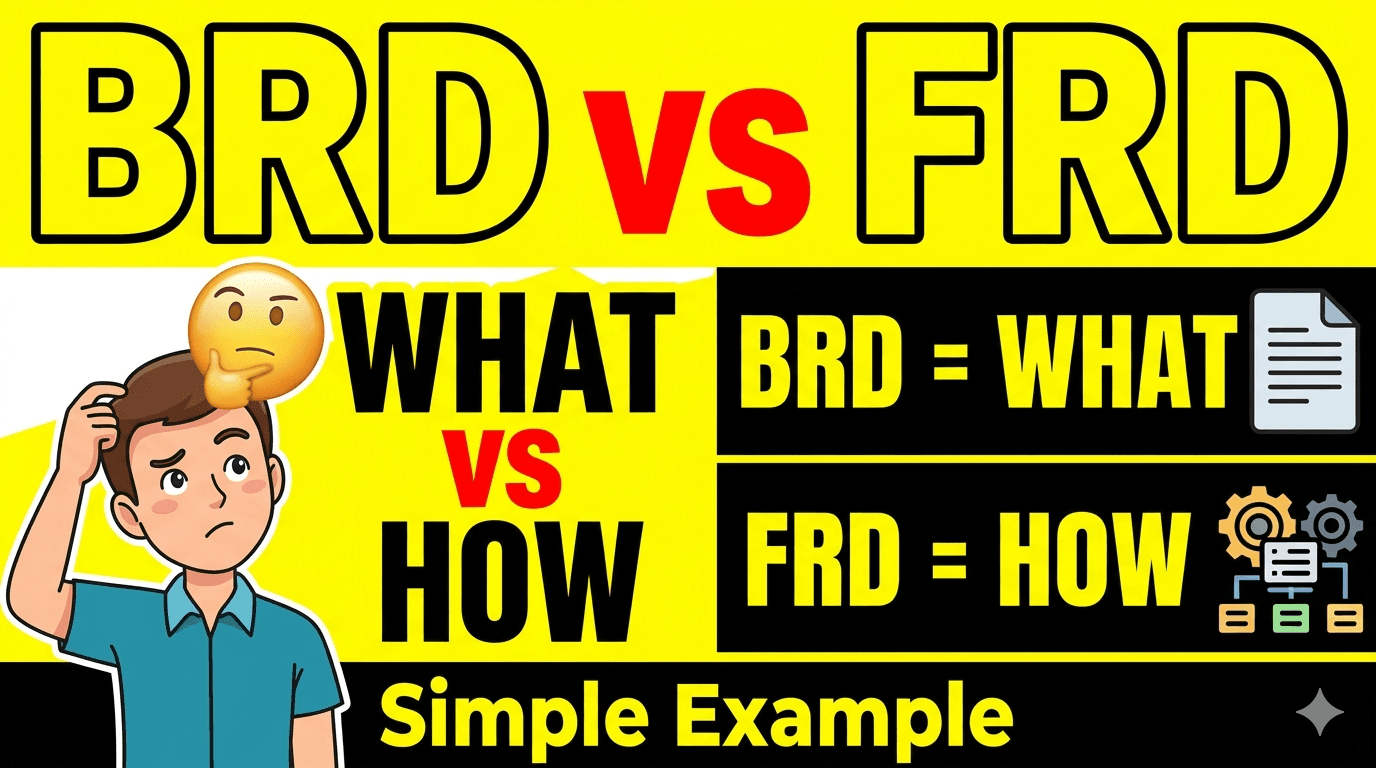
BRD vs FRD – Difference with Examples
Many business analyst beginners confuse BRD and FRD. If you are preparing for a business analyst interviews, you must know the difference between BRD and FRD. One document explains what the business needs and the other explains how the system will work.
Many beginners in business analysis get confused between two important documents that is BRD and FRD. Some people even think they are the same document but in real products they serve very different purposes. If you want to become a business analyst or prepare for interviews, you must clearly understand BRD versus FRD.
In this article, I will explain the difference with simple examples. Most people try to remember the difference using definitions but definitions are hard to remember. So in this article, we will understand the difference using a real project example so that you can remember this very easily.
Real-Time Example (Food Delivery App)
Imagine a company wants to build a food delivery mobile app. Customer should be able to browse restaurants, place orders, make payments. Here you can imagine Zomato app or Swiggy app.
Before development starts, business analysts prepare two important documents. The first document is BRD and the second document is FRD. But these documents explain different levels of details.
What is BRD?
What is business requirement document? BRD explains business goals, project objectives, high-level requirements.
Example BRD requirement:
The system should allow customers to order food online.
Notice something important here. BRD explains what the business needs. That means what client is expecting or what customer is expecting from the IT company.
What is FRD?
What is FRD? Functional requirement document. FRD explains system functionality, detailed workflows, technical behavior.
Example FRD:
User selects a restaurant, adds food items, proceeds to checkout, payment is processed, order confirmation is generated.
FRD explains how the system will work.
Simple Trick to Remember
Here is a simple trick to remember what is BRD and what is FRD.
What does the business need?
BRD answers what does the business need or what does the business requirement.
FRD answers how will the system implement it.
This is the core difference between BRD and FRD.
BRD vs FRD Comparison
BRD focus business perspective, audience stakeholders and managers content high-level requirement.
FRD focus system functionality, audience developers and testers content detailed technical requirements.
Another Real-Time Example
Let us compare one requirement
BRD requirement:
The system should allow users to transfer money.
FRD requirement:
User enters account number system validates account user enters amount system checks the balance then transaction completed.
Now you can clearly see the difference between BRD and FRD.
When are BRD and FRD Created?
Then have these these documents created.
BRD is created first. It defines the business need. Sometimes even client will prepare the BRD and they will share with us.
Based on that BRD our BS will prepare the functional specification document or FRD.
FRD is created after the BRD. It explains how developers will build the system.
BRD vs FRD Comparison Table (SEO Optimized)
| Aspect | BRD (Business Requirement Document) | FRD (Functional Requirement Document) |
|---|---|---|
| Definition | BRD explains what the business needs | FRD explains how the system will work |
| Purpose | Defines business goals and objectives | Defines system functionality and behavior |
| Focus | Business perspective | Technical/system perspective |
| Level of Detail | High-level requirements | Detailed and structured requirements |
| Audience | Stakeholders, clients, managers | Developers, testers, technical teams |
| Prepared By | Business Analyst / Client | Business Analyst / System Analyst |
| When Created | Created first (before development) | Created after BRD |
| Content Includes | Business goals, scope, high-level requirements | Workflows, use cases, functional logic |
| Example | The system should allow customers to order food online | User selects restaurant, adds items, makes payment, order confirmed |
| Nature | Non-technical | Semi-technical / technical |
| Usage | Understanding business needs | System design and development |
| Change Frequency | Less frequently changed | May change based on technical updates |
| Dependency | Independent document | Depends on BRD |
| Goal | To define what the client expects | To define how developers will build the solution |
👉 “The above BRD vs FRD comparison table clearly explains the difference between business requirement document and functional requirement document with examples, making it easier for beginners to understand.”
BRD vs FRD Comparison
BRD focus business perspective, audience stakeholders and managers content high-level requirement.
FRD focus system functionality, audience developers and testers content detailed technical requirements.
Another Real-Time Example
Let us compare one requirement
BRD requirement:
The system should allow users to transfer money.
FRD requirement:
User enters account number system validates account user enters amount system checks the balance then transaction completed.
Now you can clearly see the difference between BRD and FRD.
When are BRD and FRD Created?
Then have these these documents created.
BRD is created first. It defines the business need. Sometimes even client will prepare the BRD and they will share with us.
Based on that BRD our BS will prepare the functional specification document or FRD.
FRD is created after the BRD. It explains how developers will build the system.
Why BRD and FRD are Important?
Understanding the difference between BRD and FRD is an important skill for business analysts because these documents help teams understand requirements clearly, reduce project mistakes, build the correct solution.
If you want to learn more about business analyst skills, BA documentation, BA career roadmap then please visit our website:
👉 https://www.bacareers.in
Related Articles :
- https://www.bacareers.in/how-to-write-brd/ (How to Write BRD)
- https://www.bacareers.in/business-analyst-skills/ ( Business Analyst Skills)
- https://www.bacareers.in/ba-career-roadmap/ (BA Career Roadmap)
- https://www.bacareers.in/requirement-elicitation-techniques/ ( Requirement Elicitation Techniques)
FAQ’s
BRD explains what the business needs, while FRD explains how the system will implement those requirements.
Business analysts usually prepare BRD, and based on that FRD is created for developers and testers.
Yes, BRD is created first and FRD is created after BRD.
In some projects, BRD and FRD can be combined into a single document, but generally they are separate.
BRD helps in understanding business goals and ensures the project meets client expectations.
 20
20 638
638 20
20 70
70
Business Analyst , Functional Consultant, Provide Training on Business Analysis and SDLC Methodologies.
🌐 Founder of BACareers.in| Freelance Business Analyst & Content Writer | Banking Domain Expert | Agile Practitioner | Career Mentor
I am the founder and content creator of BACareers.in, a specialized platform for aspiring and experienced Business Analysts. I share real-world insights, career tips, certification guidance, interview prep, tutorials, and case studies to help professionals grow in the BA career path.
We have strong experience in Banking, Financial Services, and IT. We bring deep domain knowledge and hands-on expertise in core banking systems, payment integrations, loan management, regulatory compliance (KYC/AML), and digital banking transformations.
💼 Business Analyst Expertise
Requirement Elicitation, BRD/FRD, SRS, User Stories, RTM
Agile & Waterfall (Scrum, Kanban) methodologies
Business Process Modeling (BPMN, UML, AS-IS/TO-BE)
Stakeholder Communication & Gap Analysis
UAT Planning, Execution & Support
Core Banking Solutions (Finacle, Newgen BPM, Profile CBS, WebCSR)
✍️ Content Writing & Strategy
Founder of BACareers.in – knowledge hub for BAs & IT professionals
SEO-optimized blogs, training content, case studies & tutorials
Content on Business Analysis, Agile, Banking, IT & Digital Transformation
Engaging, beginner-friendly writing for professionals & learners
🌍 What we Offer
Freelance Business Analysis services: BRD, FRD, UAT, process flows, consulting
Freelance Content Writing: SEO blogs, IT/business content, case studies, LinkedIn posts
A unique blend of analytical expertise + content strategy to turn business needs into solutions and ideas into words that work
📌 Whether you’re an organization seeking BA expertise or a platform needing impactful content, let’s connect and collaborate.
Business Analyst, Agile, BRD, FRD, Banking, Content Writer, SEO writing.