

Interaction Diagram : Interaction diagrams are crucial tools in Unified Modeling Language (UML) that help visualize how objects in a system interact with each other. These diagrams are essential for designing and understanding complex systems, offering a clear view of the interactions between various components. In this article, we will explore interaction diagrams, their types, differences from sequence diagrams, how to create them online, and provide an example using a library management system.
Interaction Diagram Overview
An interaction diagram showcases the flow of messages between objects. It helps in understanding the behavior of a system, illustrating how objects collaborate to accomplish a task. Interaction diagrams can be categorized into two main types: sequence diagrams and collaboration diagrams.
Interaction Diagram Columns
The columns in an interaction diagram represent objects or participants. Each column indicates a separate entity, and messages exchanged between these entities are shown as arrows. The flow of interactions from top to bottom represents the sequence of events.
Example of an Interaction Diagram
Let’s consider a simple example: a user borrowing a book from a library. The interaction involves three primary objects: the User, Library System, and Book.

Interaction Diagrams in UML
Interaction diagrams in UML are detailed representations of interactions within a system. They can be either sequence diagrams or collaboration diagrams:
- Sequence Diagrams: These diagrams show the interaction between objects in a sequential order. Each object has a lifeline, and messages are exchanged in a time-ordered manner.
- Collaboration Diagrams: Also known as communication diagrams, these illustrate interactions focusing on the structural organization of objects. They emphasize the relationships between objects rather than the sequence of messages.
Interaction Diagram vs Sequence Diagram
While both interaction and sequence diagrams depict interactions between objects, they have distinct differences:
- Sequence Diagrams: Highlight the chronological order of messages. They are more time-focused, showing the exact sequence in which interactions occur.
- Interaction Diagrams (Collaboration Diagrams): Focus on the relationships and interactions between objects. They emphasize the structural aspect, providing a broader view of how objects collaborate.
Creating Interaction Diagrams Online
Several online tools can help create interaction diagrams with ease. Some popular options include:
- Lucidchart: An intuitive diagramming tool that supports various UML diagrams, including interaction diagrams.
- Draw.io: A free online diagramming tool with robust UML capabilities.
- Creately: Offers collaborative diagramming features with templates for UML diagrams.
Interaction Diagram for Library Management System
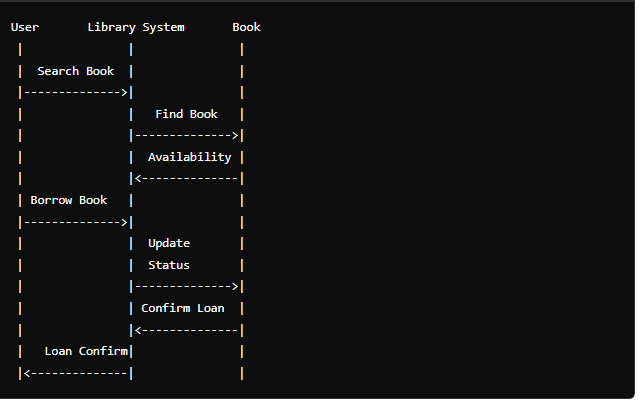
Let’s create an interaction diagram for a library management system, focusing on the process of borrowing a book. The primary participants are the User, Library System, and Book.
Scenario: A user searches for a book and borrows it if available.
- User: Initiates the process by searching for a book.
- Library System: Checks the availability of the book.
- Book: Represents the entity being checked out.
Diagram:
Conclusion
Interaction diagrams are essential in UML for visualizing the flow of interactions between objects in a system. Understanding the differences between interaction diagrams and sequence diagrams helps in choosing the right tool for modeling system behavior. Online tools make creating these diagrams easier and more accessible. By using interaction diagrams, designers and developers can better understand and communicate the dynamics within a system, leading to more efficient and effective system designs.
Related Articles

