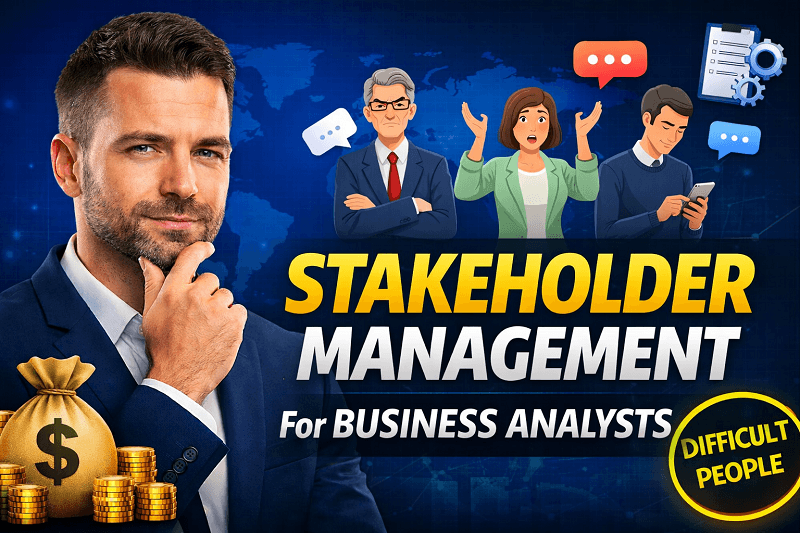
Managing stakeholders is one of the most important—and most challenging—responsibilities of a Business Analyst.
Even when requirements are clear and documentation is flawless, a single difficult stakeholder can derail an entire project.
In this article, we explore the most common types of difficult stakeholders Business Analysts face and share practical, real-world strategies to manage them effectively. You’ll learn how to communicate clearly, negotiate smartly, and apply proven tools to keep projects on track, reduce conflict, and achieve successful outcomes.
Problem-Solution Hook: Why Stakeholders Feel Like “Herding Cats”
Have you ever felt like you’re herding cats instead of managing a project?
One stakeholder constantly criticizes everything, another can’t make a decision, and a third disappears whenever approval is needed.
This isn’t bad luck—it’s ineffective stakeholder management.
👉 A skilled Business Analyst doesn’t avoid difficult stakeholders.
👉 They anticipate, adapt, and influence them.
Intrigue Hook: What If Difficult Stakeholders Became Your Allies?
Imagine a project where:
The critic improves overall quality
The indecisive stakeholder finally commits
The absentee responds on time
Sounds unrealistic?
It’s absolutely possible.
With the right Business Analyst tools, communication techniques, and mindset, even the toughest stakeholders can be managed effectively.
Unmasking Project Personalities: Stakeholders BAs Commonly Face
The “Always Right” Critic
How they act:
Constantly find faults
Challenge every requirement
Publicly question BA decisions
Why it happens:
Fear of losing control
Deep subject-matter expertise
Desire for recognition
BA Strategy to Deal With Them:
Acknowledge their expertise early
Ask structured, fact-based questions
Separate valid risks from unnecessary criticism
👉 Real-time scenario:
During a UAT meeting, a senior stakeholder criticizes every user story.
The BA responds:
“You’ve raised some important risks. Let’s identify which ones impact customer experience now and which can be scheduled as future improvements.”
📌 Result: The stakeholder feels respected, and progress continues.
The “Can’t Decide” Indecisive Stakeholder
How they act:
Frequently change their mind
Ask for more and more information
Delay approvals
Why it happens:
Fear of making the wrong decision
Too many options
Lack of clarity on impact
BA Strategy:
Limit choices to two or three clear options
Explain the consequences of delays
Set firm decision deadlines
👉 Role of the BA:
A Business Analyst enables decisions—not just provides information.
🔗 Internal link:
https://www.bacareers.in/stakeholder-engagement-strategies/
The “Ghosting” Absentee Stakeholder
How they act:
Miss meetings
Ignore emails
Delay approvals
Why it happens:
Competing priorities
Low perceived project importance
Unclear responsibilities
BA Strategy:
Escalate using facts, not emotion
Keep communication short and specific
Involve the project sponsor when required
👉 Real-world example:
A BA sends a detailed BRD—no response.
Next step: a three-point email with a clear question and deadline.
📌 Result: Faster response and engagement.
Your Proactive Toolkit: Prevent Problems Before They Start
Pre-emptive Stakeholder Mapping
Business Analysts should map stakeholders based on:
Influence
Interest
Decision-making authority
This helps BAs:
Anticipate resistance
Customize communication
Plan escalation paths
🔗 External reference:
https://www.iiba.org/standards-and-resources/babok/
Tailored Communication Plans
Different stakeholders need different communication styles:
Data-driven updates for executives
Visuals for operations teams
Stories and examples for non-technical users
👉 BA responsibility: Translate business needs into each stakeholder’s language.
Setting Clear Boundaries
From the beginning, the BA should define:
Decision-makers
Approval timelines
Scope ownership
📌 Clear boundaries prevent future conflicts.
Mastering Difficult Conversations as a Business Analyst
The PREP Method for Conflict Resolution
PREP Framework:
Prepare – Know facts and objectives
Respond – Stay calm and factual
Empathize – Acknowledge concerns
Propose – Offer solutions
👉 BA superpower: Remaining composed under pressure.
Active Listening & Validation
Stakeholders want to feel heard—not controlled.
Use phrases like:
“I understand your concern…”
“Let me confirm I’ve understood this correctly…”
📌 Validation reduces resistance, even during disagreements.
Framing Feedback for Impact
Instead of:
“This won’t work.”
Say:
“Here’s the risk with this approach—and an alternative we can consider.”
👉 Business Analysts transform criticism into constructive action.
Negotiation & Influence Hacks for BAs
Finding Shared Ground
Always link discussions to:
Business goals
Customer outcomes
Risk reduction
📌 Shared objectives reduce personal conflict.
Leveraging Data & Evidence
Stakeholders argue opinions.
Business Analysts present facts, metrics, and impact analysis.
🔗 External reference:
https://www.pmi.org/learning/library/stakeholder-management-best-practices-10052
The Art of Saying “No” (Politely)
A strong BA says no to:
Unrealistic timelines
Scope creep
Last-minute changes
Instead of “No,” say:
“Yes—if we adjust scope, cost, or timeline.”
Sustaining Project Harmony Long-Term
Regular Pulse Checks
Quick check-ins help:
Identify issues early
Prevent escalation
Celebrating Small Wins
Recognition:
Builds trust
Reduces tension
Strengthens collaboration
👉 Respected BAs face fewer conflicts.
Post-Project Debrief
After completion:
Review stakeholder challenges
Document lessons learned
Improve engagement strategies
🔗 Internal link:
https://www.bacareers.in/change-management-for-business-analysts/
Final Thoughts: Stakeholder Management Is a BA’s True Test
Technical skills help you get hired.
Stakeholder management determines your success.
The best Business Analysts don’t avoid tough stakeholders—
they understand, influence, and lead them.
Master these strategies, and you won’t just deliver better projects—you’ll elevate your Business Analyst career.
 20
20 638
638 20
20 70
70
Business Analyst , Functional Consultant, Provide Training on Business Analysis and SDLC Methodologies.
🌐 Founder of BACareers.in| Freelance Business Analyst & Content Writer | Banking Domain Expert | Agile Practitioner | Career Mentor
I am the founder and content creator of BACareers.in, a specialized platform for aspiring and experienced Business Analysts. I share real-world insights, career tips, certification guidance, interview prep, tutorials, and case studies to help professionals grow in the BA career path.
We have strong experience in Banking, Financial Services, and IT. We bring deep domain knowledge and hands-on expertise in core banking systems, payment integrations, loan management, regulatory compliance (KYC/AML), and digital banking transformations.
💼 Business Analyst Expertise
Requirement Elicitation, BRD/FRD, SRS, User Stories, RTM
Agile & Waterfall (Scrum, Kanban) methodologies
Business Process Modeling (BPMN, UML, AS-IS/TO-BE)
Stakeholder Communication & Gap Analysis
UAT Planning, Execution & Support
Core Banking Solutions (Finacle, Newgen BPM, Profile CBS, WebCSR)
✍️ Content Writing & Strategy
Founder of BACareers.in – knowledge hub for BAs & IT professionals
SEO-optimized blogs, training content, case studies & tutorials
Content on Business Analysis, Agile, Banking, IT & Digital Transformation
Engaging, beginner-friendly writing for professionals & learners
🌍 What we Offer
Freelance Business Analysis services: BRD, FRD, UAT, process flows, consulting
Freelance Content Writing: SEO blogs, IT/business content, case studies, LinkedIn posts
A unique blend of analytical expertise + content strategy to turn business needs into solutions and ideas into words that work
📌 Whether you’re an organization seeking BA expertise or a platform needing impactful content, let’s connect and collaborate.
Business Analyst, Agile, BRD, FRD, Banking, Content Writer, SEO writing.