

A Cost-Benefit Analysis (CBA) is a fundamental analytical framework used by Business Analysts (BAs), Project Managers, and executive leaders to evaluate the financial feasibility of a proposed project, software investment, or strategic change. By systematically comparing total expected costs against total anticipated benefits, organizations can determine if an initiative delivers a positive return on investment (ROI).
For Business Analysts, performing a thorough Cost-Benefit Analysis is critical during project initiation, business case development, and solution evaluation.

What Is Cost-Benefit Analysis (CBA)?
Cost-Benefit Analysis is a quantitative and qualitative process used to measure the financial and strategic value of a project relative to its resource consumption.
Core Objective: Provide decision-makers with an objective, data-backed rationale to approve, reject, or prioritize competing business initiatives.
Primary Metric: A positive net benefit—where total projected financial and operational gains exceed total estimated deployment and operational costs.
Types of Costs and Benefits in Business Analysis
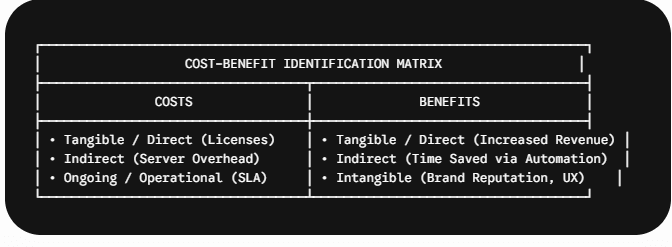
To build an accurate CBA model, a Business Analyst must identify and categorize all direct, indirect, tangible, and intangible elements.
1. Cost Categories
Direct Costs: Hardware, software licenses, developer salaries, training vendor fees.
Indirect Costs: Server electricity, administrative overhead, utility allocation.
One-Time Costs: Upfront infrastructure setup, initial system integration, data migration.
Ongoing (OPEX) Costs: Annual cloud hosting fees, software maintenance, customer support operations.
2. Benefit Categories
Tangible Benefits: Direct revenue increase, lower transaction processing fees, headcount reduction.
Indirect Benefits: Reduced manual processing time enabling employees to focus on high-value tasks.
Intangible Benefits: Improved customer satisfaction, enhanced brand reputation, better regulatory compliance.
4 Essential Cost-Benefit Analysis Financial Techniques
To calculate project feasibility, Business Analysts employ four primary quantitative valuation techniques:
1. Net Present Value (NPV)
Calculates the present value of future cash inflows minus current and future cash outflows, factoring in the time value of money (discount rate $r$).

2. Return on Investment (ROI)
Measures the profitability efficiency of an investment expressed as a percentage.

3. Payback Period
Determines the exact length of time required for a project to generate enough net cash flow to recover its initial investment.

4. Benefit-Cost Ratio (BCR)
Compares the total present value of benefits to the total present value of costs.

Real-World Scenario: CBA for Automated Invoice Processing
Client Context: A mid-sized logistics enterprise receives 10,000 vendor invoices per month. Processing is currently 100% manual.
Proposed Solution: Implement an AI-driven Optical Character Recognition (OCR) invoice parsing tool.
Financial Breakdown (Over a 3-Year Lifecycle)
Project Costs:
Initial Software Implementation & Integration: $50,000 (One-time)
Annual Cloud Licensing & Maintenance: $10,000 / year $\times$ 3 years = $30,000 (Ongoing)
Total 3-Year Project Cost: $80,000
Financial Benefits:
Manual Effort Savings: Reduces invoice processing from 15 minutes to 1 minute per invoice. Saves 2 FTE salaries = $60,000 / year $\times$ 3 years = $180,000.
Elimination of Late Payment Fees: Saves $10,000 / year $\times$ 3 years = $30,000.
Total 3-Year Gross Benefit: $210,000
CBA Financial Calculation Results:
Net Benefit: $\$210,000 – \$80,000 = \mathbf{\$130,000}$
ROI: $(\$130,000 / \$80,000) \times 100 = \mathbf{162.5\%}$
Payback Period: Recovers initial $50,000 investment in 10 months.
What Are the 5 Steps of Cost-Benefit Analysis?
A systematic approach to cost-benefit analysis involves the following steps:
- Identify the Project or Decision:
Define the scope, objectives, and key stakeholders involved. - List Costs and Benefits:
Create a detailed list of all direct, indirect, tangible, and intangible costs and benefits. - Quantify Costs and Benefits:
Assign monetary values to each item on the list. Use market research, historical data, and expert opinions for accuracy. - Compare Costs and Benefits:
Use methods like NPV or BCR to compare the monetary value of costs and benefits. - Make a Decision:
Based on the comparison, decide whether to proceed with the project or consider alternatives.
What Are Cost-Benefit Evaluation Techniques?
Cost-benefit evaluation techniques provide a framework to assess project feasibility. These include:
- Sensitivity Analysis: Examining how changes in variables like costs or interest rates affect outcomes.
- Scenario Analysis: Testing various “what-if” scenarios to predict potential outcomes.
- Monte Carlo Simulation: Using statistical modeling to understand risk and uncertainty.
What Are the Methods of Cost Analysis?
Cost analysis focuses on understanding the costs associated with a project. The methods include:
- Activity-Based Costing (ABC): Allocates costs to specific activities for a more accurate understanding of resource utilization.
- Lifecycle Costing: Evaluates costs over the entire lifecycle of a product or project.
- Incremental Cost Analysis: Compares additional costs incurred with incremental benefits received.
Cost-Benefit Analysis Template
Here’s a simple CBA template:
| Category | Description | Amount ($) |
|---|---|---|
| Initial Costs | ||
| Recurring Costs | ||
| Total Costs | ||
| Direct Benefits | ||
| Indirect Benefits | ||
| Total Benefits | ||
| Net Benefit | (Benefits – Costs) |
Template Structure:
| Category | Details | Monetary Value |
|---|---|---|
| Costs | Software, Training | $60,000 |
| Benefits | Productivity, ROI | $100,000 |
| Net Benefit | $40,000 |
You can download free cost-benefit analysis templates from external resources like Template.net or Smartsheet.
Cost-Benefit Analysis Techniques in Business
In business, cost-benefit analysis is used to:
- Evaluate new projects or investments.
- Assess operational changes or upgrades.
- Compare alternative solutions.
Related Articles
For additional insights:
- Check out Effective Requirement Elicitation Techniques for gathering project data.
- Learn more about Business Process Modeling Techniques for better project evaluation.
- Visit Investopedia’s Guide to Cost-Benefit Analysis for a deeper understanding.
- Explore Harvard Business Review articles for CBA in strategic decision-making.
Conclusion
Cost-benefit analysis techniques provide a structured approach to evaluating the feasibility of projects. By understanding the methods, steps, and formulas involved, businesses can make data-driven decisions that maximize ROI and minimize risks.
For more insights, explore our article on Business Process Modeling Techniques.
For more articles on business analysis and decision-making techniques, visit BACareers.
Cost-Benefit Analysis (CBA) is a systematic financial framework used to evaluate project viability by comparing projected total costs against total estimated business benefits.
A comprehensive Cost-Benefit Analysis helps Business Analysts calculate quantitative valuation metrics including Net Present Value (NPV), Return on Investment (ROI), Payback Period, and Benefit-Cost Ratio (BCR).
📄 Business Analysis Documentation Hub
Explore where Cost-Benefit Analysis fits into the complete software documentation lifecycle:
| Knowledge Area | Deep-Dive Article | Why It Matters for a Business Analyst |
|---|---|---|
| Business Strategy & Analytics | Business Analysis Templates & Examples | Access standardized templates for Business Cases, BRDs, FRDs, and Financial Feasibility models. |
| Business Strategy & Analytics | Business Analysis in Digital Marketing | Learn how to apply CBA to evaluate MarTech investments, conversion funnels, and Customer Acquisition Costs (CAC). |
| Requirements Engineering | SRS Full Form in Software Engineering | Understand how business case budget parameters and financial constraints feed directly into software requirements specifications. |
| Software Lifecycles | Waterfall Methodology in Software Development | Details how formal CBA sign-offs are conducted during the early initiation phase of linear SDLC projects. |
Frequently Asked Questions (FAQs)
CBA provides an objective, data-driven framework that enables BAs to justify project investments, evaluate alternative solutions, and present compelling business cases to executive sponsors.
Intangible benefits (such as employee morale or customer brand trust) are quantified by translating them into proxy metrics, such as reduced customer turnover rates, lower churn, or saved support ticket hours.
Payback Period measures how quickly an investment is recovered in time, while Net Present Value (NPV) measures overall financial value and profitability accounting for the time value of money.
🎁 Become a Better Business Analyst
Join 1,200+ Business Analysts learning every week.
Get instant access to:
📘 FREE Business Analyst Templates
🎯 Interview Preparation Guides
🚀 Agile & Scrum Tutorials
🤖 AI for Business Analysts
📈 Career Growth Tips
100% Free • No Spam • Unsubscribe Anytime
