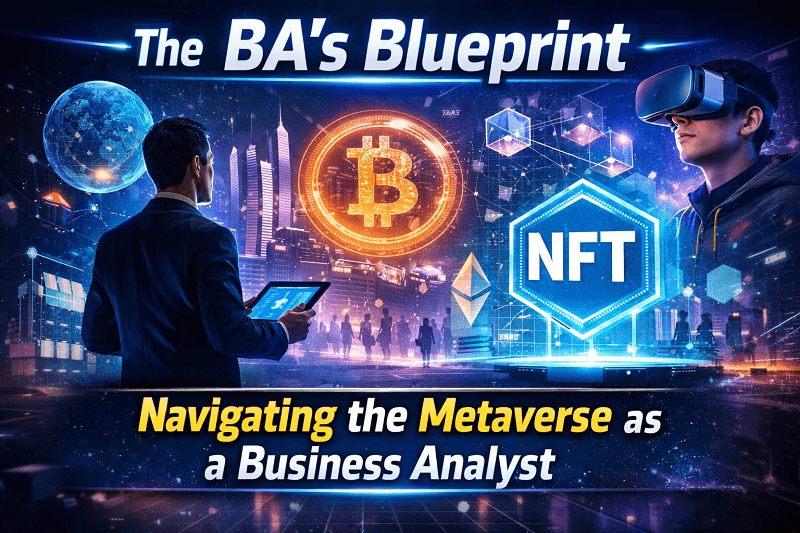
The metaverse isn’t just a concept from video games or a vague idea anymore.
It’s becoming a real digital economy where businesses are starting to create virtual offices, training programs, online stores, and platforms that work without a central authority.
For Business Analysts, this change brings both challenges and chances.
The usual ways of gathering and managing requirements don’t always work in the metaverse, especially with things like digital coins, virtual things, and decentralized networks. But BAs who are willing to adjust their skills can become key players in shaping this new digital world.
This article gives a guide for Business Analysts to understand, define, gather, and manage requirements in the metaverse—using familiar BA methods, but tailored for digital worlds that are more immersive and decentralized.
Welcome to the Immersive Frontier
The Metaverse: More Than Just Gaming – Why Business Analysts Are Important
Although platforms like Roblox, Decentraland, and Horizon Worlds started off as places for playing games and socializing, now companies are using them for:
- Helping new employees learn about their jobs
- Collaborating with teams from different places
- Showing products in a 3D way
- Creating virtual stores where people can shop
- Training people for different kinds of jobs
In all these cases, Business Analysts help by turning business goals into clear, testable, and scalable requirements.
Without a Business Analyst, metaverse projects can become expensive attempts with unclear results.
Where the Metaverse Is Right Now
Roblox: Used by brands for marketing and events
Decentraland: A virtual world based on blockchain where people can own digital land
Horizon Worlds: A platform focused on social interaction and teamwork from Meta
Enterprise Metaverse: Companies using private digital spaces for learning, reviews, and working together
BA Insight:
Just like ERP or mobile app projects in the past, metaverse initiatives are still in the early stages.
That’s where structured business analysis adds clarity and direction.
The “Wild West” of the Metaverse
Right now, the metaverse is similar to the early days of the internet—full of possibilities but not yet clear standards.
For Business Analysts, this means:
- Uncertain how users will behave
- Rapidly changing technologies
- Not clear about the laws that apply
- High expectations from stakeholders
This is where Business Analysts excel—by adding order, organization, and requirement management to a fast–moving environment.
- Breaking Down Metaverse Requirements
- Virtual Economies and Digital Assets
- Unlike traditional apps, metaverse platforms often involve:
- Ownership of digital items
- Using digital money to buy things
- Economies that operate within virtual spaces
- Assets that users create themselves
- BA Role in Virtual Economies
- A Business Analyst must define:
- How people can buy, sell, or trade virtual items
- Rules about ownership and how things are passed on
- How to handle refunds, stop fraud, and keep records
Example:
If you’re working on a platform for buying virtual land, you need to write about:
- How someone goes through the process of buying land
- What happens when they make a purchase using a smart contract
- What rules are set by different countries
Immersive User Experience (UX)
In the metaverse, the user experience is different from what you see on a screen.
Requirements could include:
- How avatars behave and interact
- Using voice and gestures to control things
- Moving around in a space
- Getting physical feedback from the environment
- How BAs Gather UX Requirements
- Watch how users behave in these virtual spaces
- Work closely with UX designers
- Turn things users feel or do into clear requirements
Example:
“As a visitor to a virtual store, I want my avatar to grab a product and look at it in 3D, so I can decide if I want to buy it.”
- Decentralized Platforms and Interoperability
- Most metaverse environments depend on:
- Blockchain networks
- Smart contracts that automatically carry out agreements
- Systems that let people have digital identities
BA Challenges
- There’s no single authority running things
- Transactions are permanent and can’t be changed
- Connecting different virtual worlds can be difficult
BA Responsibility:
- Define requirements that allow things to work across platforms:
- Being able to move digital assets between different spaces
- Confirming user identities
- Connecting with existing systems like CRM, ERP, and LMS
- BA Toolkit: Adjusting for Virtual Worlds
- Gathering Requirements in the Metaverse
- Traditional meetings are evolving into:
- Virtual group discussions
- Interviews with avatars
- Observing users in real–time in a digital space (like live observation)
Example:
A Business Analyst holds a meeting in a virtual conference room, noting requirements while watching how people interact with the space, items, and each other.
Modeling Immersive Systems
Business Analysts can use known tools but adapt them:
- UML diagrams showing how things flow in a 3D space
- Maps of user journeys through a virtual environment
- Processes for how things work in a digital world
Example:
A map showing how a user walks into a virtual mall, looks around, interacts with products, and completes a purchase using a blockchain–based system.
Risk Management in Decentralized Systems
Key risks include:
- Security threats to digital information
- Improper handling of personal data
- Uncertain laws in different places
- Flaws in smart contracts that can cause problems
BA Role:
Spot, document, and reduce these risks early, especially when dealing with international digital environments.
Real–World Metaverse Business Analyst Case Studies
- Enterprise Training Simulations
- Companies use virtual environments for:
- Training about safety
- Helping people develop leadership skills
- Practicing technical jobs
BA Contribution:
- Define what people should learn
- Set up how to measure performance
- Connect the training to business goals
- Virtual Retail and E-Commerce
Brands are creating virtual stores where people can experience products in a digital space.
BA Tasks:
- Plan how customers move through a virtual store
- Set up how payments work
- Capture requirements for collecting user data
- Event and Collaboration Platforms
- Virtual conferences and workspaces are becoming the norm.
BA Responsibilities:
- Plan for how these services can handle a growing number of users
- Capture how people work together in virtual settings
- Ensure everyone can participate and feel included
- Your Metaverse Business Analyst Playbook
Important Skills for the Future Business Analyst
To succeed in the metaverse, Business Analysts should focus on:
- Being flexible and always ready to learn
- Understanding the basics of blockchain
- Thinking about how people interact in 3D spaces
- Communicating with stakeholders in virtual environments
- Resources for Continuous Learning
Call to Action: Shape the Future as a Metaverse Business Analyst
The metaverse isn’t replacing traditional business analysis—it’s adding to it.
Business Analysts who embrace this change can become leaders in the future of digital business, helping to turn business goals into immersive solutions.
Now is the time to step forward—not just as a viewer, but as a key player in building the future of digital experiences.
Related Articles:
“future career paths for Business Analysts”
👉 https://www.bacareers.in/business-analyst-career-paths/“digital transformation role of a Business Analyst”
👉 https://www.bacareers.in/digital-transformation-for-business-analysts/“emerging technologies every Business Analyst should understand”
👉 https://www.bacareers.in/advanced-business-analysis-techniques/“how Business Analysts adapt to new technology-driven projects”
👉 https://www.bacareers.in/business-analysis-in-startups/
 20
20 638
638 20
20 70
70
Business Analyst , Functional Consultant, Provide Training on Business Analysis and SDLC Methodologies.
🌐 Founder of BACareers.in| Freelance Business Analyst & Content Writer | Banking Domain Expert | Agile Practitioner | Career Mentor
I am the founder and content creator of BACareers.in, a specialized platform for aspiring and experienced Business Analysts. I share real-world insights, career tips, certification guidance, interview prep, tutorials, and case studies to help professionals grow in the BA career path.
We have strong experience in Banking, Financial Services, and IT. We bring deep domain knowledge and hands-on expertise in core banking systems, payment integrations, loan management, regulatory compliance (KYC/AML), and digital banking transformations.
💼 Business Analyst Expertise
Requirement Elicitation, BRD/FRD, SRS, User Stories, RTM
Agile & Waterfall (Scrum, Kanban) methodologies
Business Process Modeling (BPMN, UML, AS-IS/TO-BE)
Stakeholder Communication & Gap Analysis
UAT Planning, Execution & Support
Core Banking Solutions (Finacle, Newgen BPM, Profile CBS, WebCSR)
✍️ Content Writing & Strategy
Founder of BACareers.in – knowledge hub for BAs & IT professionals
SEO-optimized blogs, training content, case studies & tutorials
Content on Business Analysis, Agile, Banking, IT & Digital Transformation
Engaging, beginner-friendly writing for professionals & learners
🌍 What we Offer
Freelance Business Analysis services: BRD, FRD, UAT, process flows, consulting
Freelance Content Writing: SEO blogs, IT/business content, case studies, LinkedIn posts
A unique blend of analytical expertise + content strategy to turn business needs into solutions and ideas into words that work
📌 Whether you’re an organization seeking BA expertise or a platform needing impactful content, let’s connect and collaborate.
Business Analyst, Agile, BRD, FRD, Banking, Content Writer, SEO writing.