🚀 Agile Thinking: The Mindset Behind Successful Agile Transformation
🔍 Introduction to Agile Thinking
In the fast-paced world of business, speed, adaptability, and innovation are essential for survival. Agile Thinking is not just a methodology—it’s a mindset that empowers individuals and teams to embrace change, collaborate effectively, and deliver continuous value.
While Agile methodology focuses on frameworks like Scrum or Kanban, Agile Thinking is about cultivating the right attitude and decision-making approach to thrive in an ever-changing environment.
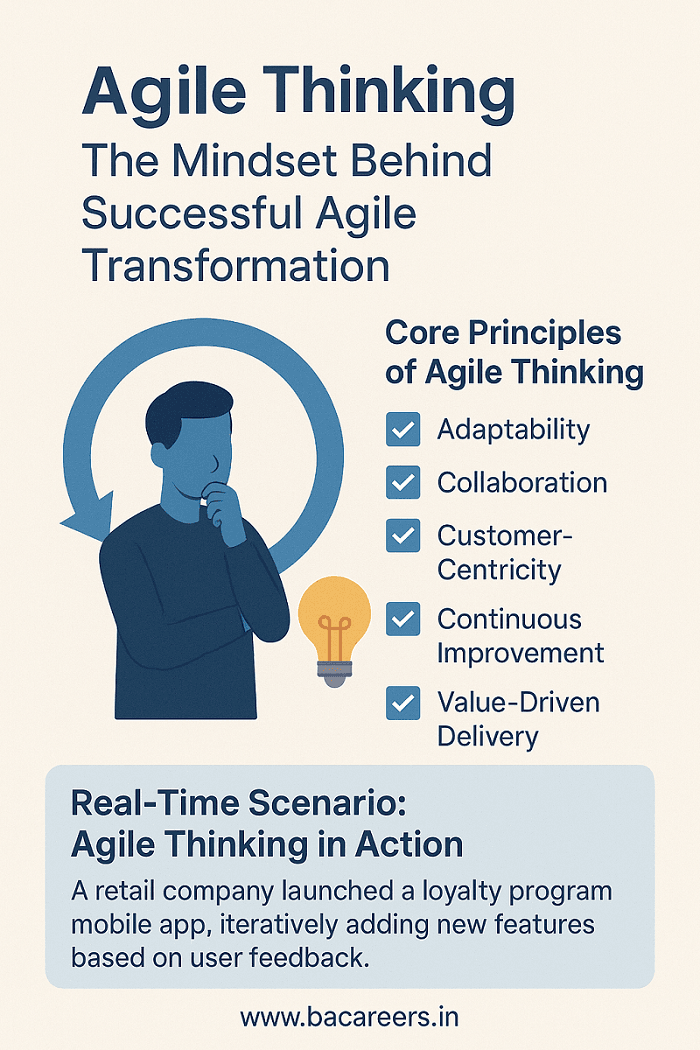
💡 What is Agile Thinking?
Agile Thinking is the mental approach that guides actions and decisions in line with Agile principles. It focuses on:
- Customer value over process rigidity
- Collaboration over silos
- Learning and adapting over sticking to fixed plans
- Delivering value quickly and continuously
🔗 You can explore the Agile Manifesto principles here: Agile Manifesto.
🌟 Why Agile Thinking Matters
Agile Thinking enables organizations to respond faster to market changes, reduce risks, and improve customer satisfaction. Without this mindset, even the best Agile tools and processes may fail.
Example:
A company adopts Scrum but still forces teams to follow long approval chains before implementing changes. Even though they “use Agile,” the lack of Agile Thinking slows delivery and reduces flexibility.
🧠 Core Principles of Agile Thinking
1. Adaptability
Agile thinkers accept that requirements can change and see it as an opportunity to improve.
2. Collaboration
Success comes from cross-functional teamwork rather than individual heroics.
3. Customer-Centricity
Every decision is made with the end-user’s needs in mind.
4. Continuous Improvement
Teams reflect on their work regularly to find better ways of delivering value.
5. Value-Driven Delivery
Focus on delivering small, usable chunks rather than waiting for a big release.
📌 Real-Time Scenario: Agile Thinking in Action
Scenario:
A retail company wants to launch a new loyalty program mobile app.
- Traditional approach: Create a detailed plan for the next 12 months, design all features upfront, and release the final product at the end.
- Agile Thinking approach: Launch a basic version with core features (signup, points tracking) in 3 months, collect customer feedback, and iteratively add features like special offers and gamification.
Outcome:
- Customers start benefiting earlier.
- The company adapts features based on real user needs.
- Risks are reduced because changes happen in small increments.
👩💼 Business Analyst Role in Agile Transformation
When organizations shift to Agile, Business Analysts (BAs) play a key role in driving Agile Thinking within teams.
Responsibilities in Agile Transformation:
- Championing Agile principles within teams and stakeholders.
- Helping translate business goals into user stories and backlog items.
- Facilitating collaboration between business teams, developers, and product owners.
- Encouraging continuous feedback loops with customers and stakeholders.
- Identifying areas where traditional processes slow down delivery and recommending Agile-friendly improvements.
Example:
In a software product transformation project, the BA works with stakeholders to prioritize features based on customer impact rather than internal politics. This helps the Agile team focus on high-value items first.
🔗 Related Reading: Agile Methodology for Business Analysts
🧰 Best Practices to Develop Agile Thinking
1. Embrace Change
See changes as an opportunity for improvement, not a threat.
2. Focus on Collaboration
Encourage cross-functional meetings and open communication channels.
3. Prioritize Value
Always ask: “How does this benefit the customer?”
4. Deliver in Small Iterations
Avoid long, risky projects—break them into small, testable pieces.
5. Reflect and Improve
Hold retrospectives after each iteration to identify lessons learned.
📊 Agile Thinking vs Agile Doing
| Aspect | Agile Thinking | Agile Doing |
|---|---|---|
| Focus | Mindset & values | Processes & tools |
| Approach | Flexible, adaptable | Structured according to framework |
| Risk Handling | Embraces change | Often tries to stick to plan |
| Team Behavior | Empowered & proactive | Process-driven |
| Outcome | Sustainable agility | Short-term process compliance |
📈 Benefits of Agile Thinking
- 🚀 Faster time to market
- 🎯 Higher customer satisfaction
- 💡 More innovation
- 🤝 Stronger team collaboration
- 🔄 Reduced risks through early feedback
🔗 Internal Links
- Agile Methodology for Business Analysts
- Agile Mindset
- Agile Transformation
- Top 10 Business Analysis Tools
🌐 External Resources
🏁 Conclusion
Agile Thinking is the foundation of successful Agile Transformation. It’s not enough to just follow Agile processes—leaders, Business Analysts, and team members must embrace a mindset that values adaptability, collaboration, and delivering customer value.
By cultivating Agile Thinking, businesses can stay ahead in an ever-changing world and build products that truly matter to customers.
 20
20 638
638 20
20 70
70
Business Analyst , Functional Consultant, Provide Training on Business Analysis and SDLC Methodologies.
🌐 Founder of BACareers.in| Freelance Business Analyst & Content Writer | Banking Domain Expert | Agile Practitioner | Career Mentor
I am the founder and content creator of BACareers.in, a specialized platform for aspiring and experienced Business Analysts. I share real-world insights, career tips, certification guidance, interview prep, tutorials, and case studies to help professionals grow in the BA career path.
We have strong experience in Banking, Financial Services, and IT. We bring deep domain knowledge and hands-on expertise in core banking systems, payment integrations, loan management, regulatory compliance (KYC/AML), and digital banking transformations.
💼 Business Analyst Expertise
Requirement Elicitation, BRD/FRD, SRS, User Stories, RTM
Agile & Waterfall (Scrum, Kanban) methodologies
Business Process Modeling (BPMN, UML, AS-IS/TO-BE)
Stakeholder Communication & Gap Analysis
UAT Planning, Execution & Support
Core Banking Solutions (Finacle, Newgen BPM, Profile CBS, WebCSR)
✍️ Content Writing & Strategy
Founder of BACareers.in – knowledge hub for BAs & IT professionals
SEO-optimized blogs, training content, case studies & tutorials
Content on Business Analysis, Agile, Banking, IT & Digital Transformation
Engaging, beginner-friendly writing for professionals & learners
🌍 What we Offer
Freelance Business Analysis services: BRD, FRD, UAT, process flows, consulting
Freelance Content Writing: SEO blogs, IT/business content, case studies, LinkedIn posts
A unique blend of analytical expertise + content strategy to turn business needs into solutions and ideas into words that work
📌 Whether you’re an organization seeking BA expertise or a platform needing impactful content, let’s connect and collaborate.
Business Analyst, Agile, BRD, FRD, Banking, Content Writer, SEO writing.