

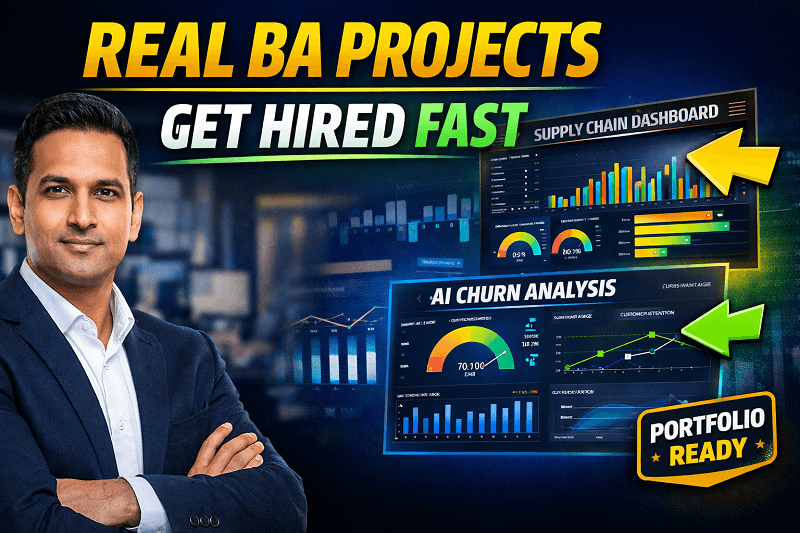
In today’s tough job market, just taking a Business Analyst course isn’t enough. Employers don’t look at certificates alone.
What they really want to see is real experience that proves you can do the job.
To get noticed, you need a strong Business Analyst portfolio that demonstrates:
Your ability to understand and translate stakeholder needs into clear requirements
Your skill in writing professional Business Requirement Documents (BRDs)
Your ability to analyze data and extract meaningful insights
Your understanding of end-to-end business processes
Your communication and strategic thinking capabilities
This article will help you build two strong real-world Business Analyst projects that can significantly improve your chances of getting hired.
We’ll also show you how to present them in your portfolio, LinkedIn profile, and resume to stand out in a competitive job market.
Why So Many BA Portfolios Don’t Work (And How to Avoid These Mistakes)
Many aspiring Business Analysts make common mistakes when building their portfolios.
❌ Common Portfolio Mistakes
Showing only certificates
Including theoretical documents without business context
Writing BRDs without real stakeholders or measurable outcomes
Failing to demonstrate business impact
Employers want to know:
“Can this person solve real business problems?”
Your portfolio must clearly show:
Problem → Analysis → Solution → Measurable Results
That’s what makes you stand out.
Project 1: End-to-End Supply Chain Optimization
Supply chain management is a critical business function across industries such as:
Manufacturing
Retail
E-commerce
Logistics
Large companies like Amazon, Flipkart, and Tata Consultancy Services actively hire Business Analysts to improve supply chain efficiency.
Business Scenario
Imagine a retail company struggling with:
Late deliveries
High warehouse costs
Frequent stockouts
Poor supplier coordination
As a Business Analyst, your role would include:
Identifying process inefficiencies
Analyzing operational data
Engaging stakeholders
Recommending system and process improvements
Step 1: Stakeholder Identification
Identify key stakeholders such as:
Procurement Manager
Warehouse Manager
Logistics Head
Finance Controller
IT Systems Team
Your Responsibilities:
Conduct stakeholder interviews
Document pain points
Capture expectations
Prioritize requirements
Step 2: Requirement Gathering and BRD Creation
Your portfolio should include:
Clear business problem statement
Current process (As-Is model)
Improved process (To-Be model)
Functional requirements
Non-functional requirements (security, performance, scalability)
Risk assessment
Cost-benefit analysis
You can reference your detailed BRD guide here:
👉 https://www.bacareers.in/how-to-write-a-brd/
Also consider best practices from the International Institute of Business Analysis (IIBA).
Step 3: Data Analysis and Optimization
Important metrics to analyze:
Inventory turnover ratio
Lead time
Order fulfillment rate
Supplier performance score
Tools You Can Use:
Excel
SQL
Power BI
Tableau
Create dashboards that visualize:
Shipment delays
Demand forecasting trends
Warehouse utilization
Step 4: Measurable Business Impact
Even if the project is simulated, include realistic measurable outcomes:
Reduced inventory cost by 18%
Improved on-time delivery by 22%
Reduced supplier delays by 15%
This shows you understand business value creation, not just documentation.
Project 2: AI-Driven Customer Churn Analysis
Customer churn analysis is highly valuable in:
FinTech
SaaS
Telecom
E-commerce
Companies like PayPal and Infosys invest heavily in churn prediction.
Business Scenario
A subscription company experiences:
25% monthly churn rate
Low renewal rates
High customer acquisition cost
Your role as a Business Analyst:
Define churn metrics
Collaborate with data scientists
Translate AI outputs into business strategies
Recommend retention initiatives
Step 1: Requirement Elicitation
Engage with:
Marketing Head
Customer Success Manager
Data Science Team
Product Manager
Document:
Definition of churn
Available data sources
KPIs
Timeline and constraints
Step 2: Functional & Analytical Requirements
Example requirements:
System should predict churn probability
Dashboard should highlight high-risk customers
Alerts should trigger if churn probability exceeds 70%
Your job is to bridge business goals and technical implementation.
Step 3: Data & AI Collaboration
You don’t build the models — but you must understand:
Classification models
Logistic regression
Model accuracy metrics
Your responsibilities:
Define success criteria
Ensure interpretability of AI outputs
Align AI insights with business actions
Step 4: Business Recommendations
Strategic recommendations may include:
Targeted discount campaigns
Personalized engagement emails
Loyalty programs
Potential Results:
Churn reduced from 25% to 16%
Increased customer lifetime value
Reduced acquisition cost
This demonstrates strategic thinking and measurable business transformation.
How to Present These Projects in Your Portfolio
1️⃣ Create Structured Case Studies
Each case study should include:
Executive Summary
Business Problem
Stakeholder Map
BRD Overview
Wireframes
Dashboard Screenshots
Results & Impact
2️⃣ Show Wireframes
Use tools such as:
Figma
Balsamiq
Adobe XD
Include:
Dashboard layouts
Notification flows
User journey maps
3️⃣ Highlight Communication Skills
Include examples of:
Meeting summaries
Email communications
Risk mitigation plans
Conflict resolution strategies
Senior roles value communication as much as technical skills.
Skills That Make Your Portfolio Strong
Technical Skills
SQL
Excel
Power BI
Tableau
Jira
Confluence
Analytical Skills
Root Cause Analysis
SWOT Analysis
Process Mapping
Cost-Benefit Analysis
Strategic Skills
Stakeholder Management
Executive Presentations
Business Case Development
Change Management
Industries That Need Strong BA Portfolios
FinTech
Healthcare Analytics
SaaS
Manufacturing
E-commerce
For senior roles, your portfolio must demonstrate:
Strategic thinking
Cross-functional collaboration
Measurable results
Your Action Plan to Stand Out
Follow this roadmap:
Build two deep case studies, not ten shallow ones
Focus on measurable results
Share projects on LinkedIn
Add GitHub or personal portfolio links
Practice explaining your projects confidently
When a recruiter asks:
“Tell me about a project you worked on.”
You’ll present a structured, strategic, impact-driven story.
Final Thoughts
The difference between an average Business Analyst and a hired Business Analyst is evidence.
A strong portfolio proves that:
You understand business
You know technical tools
You think strategically
You communicate effectively
In today’s competitive market, your portfolio is your proof of capability.
Build it smartly.
Present it confidently.
Position yourself not just as a Business Analyst —
But as a Business Problem Solver.

Business Analyst & Technical Content Writer specializing in Agile, Scrum, Requirements, User Stories, BRD/FRD, SEO blogs, and technical documentation.

