

Mastering Requirement Elicitation and Analysis in Software Engineering: A Comprehensive Guide for Success
In software engineering, projects often fail not because of poor coding or lack of technology, but due to unclear or misunderstood requirements. This is why requirement elicitation and analysis is considered one of the most critical stages in the software development lifecycle. It ensures that both technical teams and business stakeholders have a shared understanding of what needs to be built.
This article explores the importance of elicitation, the process, tools, challenges, and real-world examples—all while highlighting the vital role of Business Analysts in Agile Transformation.
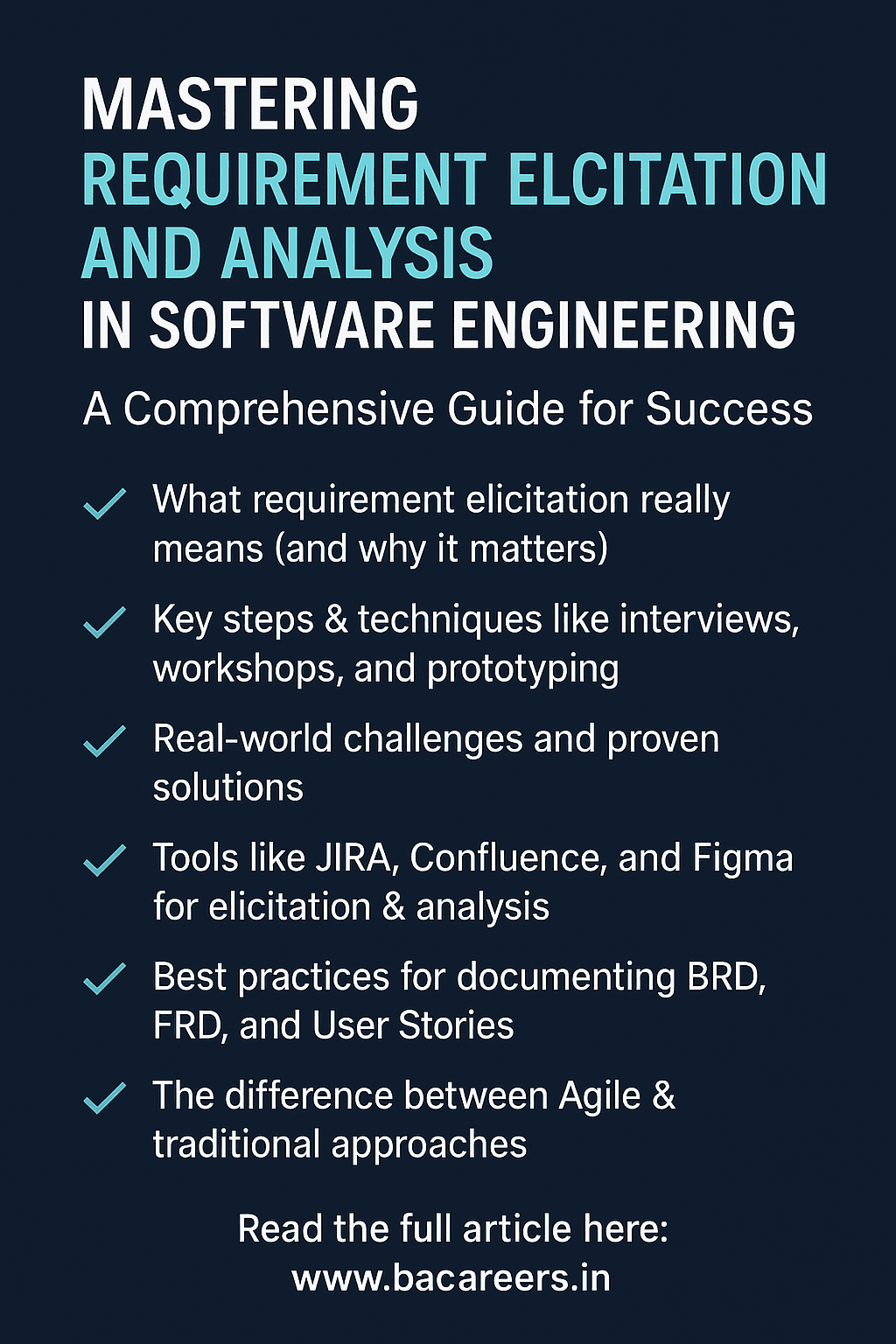
Understanding Requirement Elicitation: Definition and Importance
Requirement elicitation is the process of gathering, discovering, and clarifying what stakeholders expect from a software system. It goes beyond simply “collecting” requirements—it’s about understanding needs, goals, and constraints to design a solution that delivers value.
Why it’s important:
Prevents scope creep and rework.
Aligns business needs with technical outcomes.
Improves stakeholder satisfaction and project success.
Example:
Suppose a university wants a student management portal. Without proper elicitation, developers might build only course enrollment features, ignoring crucial elements like attendance tracking or exam scheduling. This gap would result in wasted effort and dissatisfied users.
👉 Read about Advanced Business Analysis Techniques.
The Requirement Elicitation Process: Key Steps and Techniques
The elicitation process follows a structured approach:
Identify stakeholders – Who will use or be impacted by the system?
Plan elicitation activities – Decide whether to use interviews, workshops, or surveys.
Conduct elicitation – Gather information through selected techniques.
Analyze requirements – Clarify, prioritize, and remove conflicts.
Validate and confirm – Review findings with stakeholders for accuracy.
Common Techniques:
Interviews: One-on-one sessions to capture detailed insights.
Workshops: Collaborative meetings for brainstorming.
Observation: Watching end-users perform tasks.
Prototyping: Building mockups to visualize solutions.
Surveys: Collecting input from a larger audience.
Scenario:
In an e-commerce project, conducting a stakeholder workshop revealed that warehouse managers required inventory automation, a feature not initially requested but critical for efficiency.
Common Challenges in Requirement Elicitation and How to Overcome Them
Elicitation is not without its difficulties.
Challenges and Solutions:
Unclear stakeholder needs → Use prototypes and user stories.
Conflicting requirements → Conduct prioritization workshops.
Changing requirements → Adopt Agile for iterative refinement.
Communication gaps → Use visual models and diagrams.
Example:
A banking application project faced conflicts between compliance and marketing teams. By organizing a prioritization workshop, the BA aligned both sides—first addressing compliance requirements, then adding marketing enhancements.
👉 Explore Risk Management in Business Analysis.
Effective Communication Strategies for Eliciting Requirements
Clear communication is the heart of elicitation.
Best Strategies:
Use active listening to uncover hidden needs.
Ask open-ended questions instead of yes/no.
Document discussions in simple, non-technical language.
Conduct regular feedback sessions to avoid gaps.
Real-time scenario:
In a healthcare software project, patients struggled to explain their needs in technical terms. The BA created visual mockups and walked them through each screen, ensuring clarity and alignment.
Tools and Techniques for Requirement Analysis
Once requirements are elicited, they must be analyzed for clarity, feasibility, and priority.
Popular Tools:
JIRA – Tracking user stories and requirements.
Confluence – Documentation and collaboration.
Lucidchart / Visio – Modeling workflows and processes.
Figma / Balsamiq – Prototyping and wireframes.
Techniques for Analysis:
Requirement prioritization (MoSCoW method)
Requirements Traceability Matrix (RTM)
Gap analysis
SWOT analysis
👉 Check out Top Business Analyst Tools.
The Role of Stakeholders in Requirement Elicitation
Stakeholders are central to the elicitation process.
Types of stakeholders:
End-users: The people who will use the system.
Business owners: Sponsors who define goals.
Regulators: Ensure compliance with laws.
IT teams: Implement and maintain the system.
Scenario:
In a government project, regulators demanded data security compliance, while users focused on usability. The BA balanced both requirements by ensuring strong authentication without compromising user experience.
Best Practices for Documenting Requirements
Documenting requirements properly avoids misunderstandings.
Best Practices:
Use clear, non-ambiguous language.
Choose appropriate formats: BRD (Business Requirement Document), FRD (Functional Requirement Document), or User Stories in Agile.
Maintain a Requirements Traceability Matrix.
Get stakeholder sign-offs before development starts.
Example:
In a POS (Point of Sale) project, the BA replaced bulky BRDs with user stories + acceptance criteria, making requirements simpler and faster to validate in Agile sprints.
👉 Learn more about BRD vs FRD.
Agile vs. Traditional Approaches to Requirement Elicitation
Traditional (Waterfall) approach:
Requirements gathered upfront.
Less flexibility to change.
Works well for stable environments (e.g., government projects).
Agile approach:
Requirements evolve through sprints.
User stories replace lengthy documents.
Continuous feedback from stakeholders.
Encourages adaptability and collaboration.
Business Analyst in Agile Transformation:
Facilitates backlog refinement with product owners.
Translates business needs into user stories.
Acts as a bridge between business and development teams.
Ensures continuous alignment with stakeholder needs.
👉 Read about Agile Methodology for Business Analysts.
Case Studies: Successful Requirement Elicitation in Software Projects
Case Study 1: Healthcare System
A BA used workshops and prototypes with doctors and patients to refine requirements. This collaboration reduced appointment booking errors by 30%.
Case Study 2: Banking App
In an Agile environment, requirements were refined every sprint using JIRA and sprint reviews. This reduced rework by 40% and accelerated time-to-market.
Conclusion: Elevating Your Software Engineering Projects through Effective Requirement Elicitation
Requirement elicitation and analysis is more than just gathering needs—it’s about continuous collaboration, clarity, and alignment. By using the right techniques, tools, and documentation methods, software teams can avoid costly errors and deliver solutions that truly add value.
As Agile becomes the norm, requirement elicitation is shifting from a one-time phase to a continuous process. Business Analysts, with their ability to bridge the gap between business and IT, are key drivers of this transformation.
By mastering elicitation and analysis, you’re not just building software—you’re building the right software.

Business Analyst & Technical Content Writer specializing in Agile, Scrum, Requirements, User Stories, BRD/FRD, SEO blogs, and technical documentation.

