In software engineering, the foundation of any successful project lies in understanding what the customer truly needs. This process is known as requirements elicitation—the art and science of gathering, analyzing, and defining the requirements of a software system. Without proper elicitation, projects risk scope creep, budget overruns, or complete failure.
In this guide, we’ll explore the importance, principles, techniques, tools, and real-world scenarios of requirements elicitation, while also highlighting the evolving role of Business Analysts in Agile Transformation.
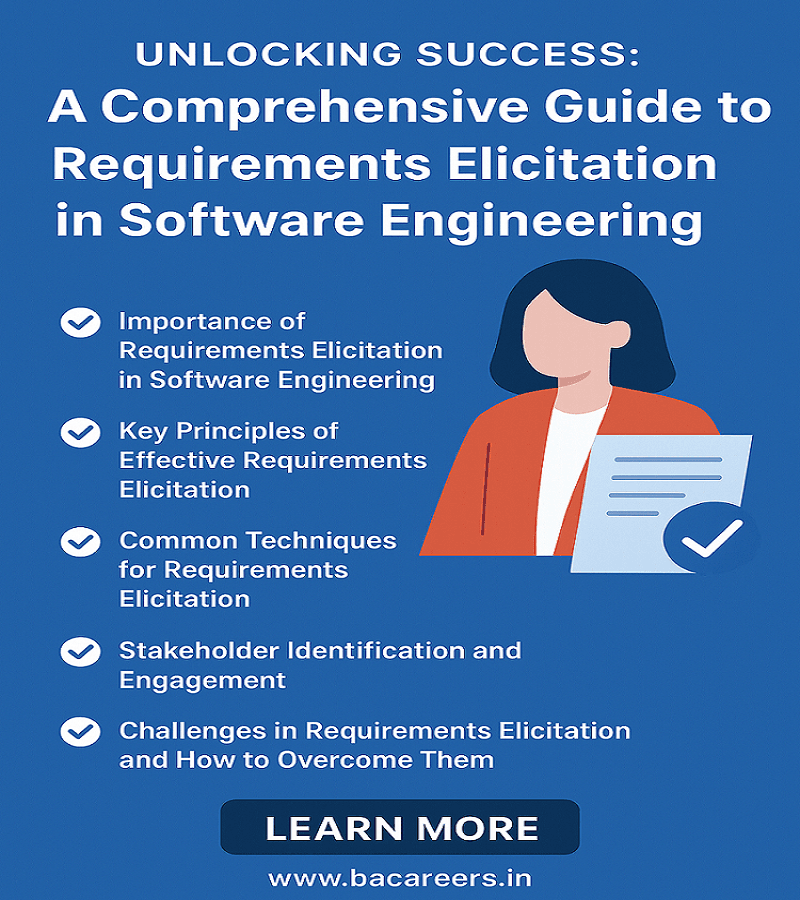
In the fast-evolving world of software engineering, the key to project success lies in understanding the intricate needs of stakeholders. “Unlocking Success: A Comprehensive Guide to Requirements Elicitation in Software Engineering” delves into the essential practices that can transform how teams capture, analyze, and prioritize user requirements. As projects become increasingly complex, mastering the art of requirements elicitation is not just beneficial—it’s crucial. Through insightful techniques and innovative strategies, this guide empowers software engineers, project managers, and product owners to communicate effectively, mitigate risks, and enhance collaboration. Discover how to navigate the nuances of stakeholder interactions and lead your projects towards successful outcomes. This comprehensive resource aims to equip you with the tools necessary to bridge the gap between ideas and implementation, unlocking the true potential of your software engineering endeavors. Dive in and start mastering the skills that will elevate your projects and drive success!
Importance of Requirements Elicitation in Software Engineering
Requirements elicitation acts as the bridge between stakeholders and developers. If the requirements are unclear, incomplete, or misunderstood, the entire software development process is jeopardized.
Why it matters:
Ensures software aligns with business goals.
Reduces rework, saving time and cost.
Enhances stakeholder satisfaction.
Minimizes risks of delivering irrelevant or faulty solutions.
Example:
Imagine a healthcare company building an online patient portal. If requirements are not elicited properly, developers may focus on features like appointment scheduling but ignore critical compliance needs like HIPAA data privacy. This mistake could delay the project and lead to legal complications.
👉 Read more about Business Analysis techniques here.
Key Principles of Effective Requirements Elicitation
To elicit requirements effectively, software engineers and business analysts follow certain guiding principles:
Active Listening: Understand what stakeholders say, and what they don’t explicitly say.
Asking the Right Questions: Open-ended questions reveal hidden expectations.
Collaboration: Involving all stakeholders to avoid biases.
Validation: Continuously confirming requirements with stakeholders to ensure alignment.
Adaptability: Adjusting methods based on project size, complexity, and domain.
Real-Time Scenario:
During an Agile project in a fintech company, the BA discovered through active listening that users wanted real-time payment notifications, which were not initially mentioned. This small insight greatly improved customer satisfaction.
Common Techniques for Requirements Elicitation
Different projects demand different techniques. Some of the most popular ones include:
Interviews – One-on-one discussions with stakeholders.
Workshops – Collaborative sessions with multiple stakeholders.
Surveys/Questionnaires – Useful for large user groups.
Observation/Job Shadowing – Watching how users perform tasks.
Prototyping – Building mockups to visualize requirements.
Brainstorming – Generating creative solutions collectively.
👉 Explore Business Process Modeling examples here.
Stakeholder Identification and Engagement
Not all stakeholders have the same influence or interest in a project. Identifying the right stakeholders is crucial.
Types of stakeholders:
Primary stakeholders – End-users of the software.
Secondary stakeholders – Managers, regulators, or IT support staff.
Key decision-makers – Executives, product owners, or sponsors.
Example:
In an e-commerce platform project, customers are primary stakeholders, warehouse managers are secondary stakeholders, and the CEO or product manager is the key decision-maker.
Engagement Strategy:
Hold regular sprint reviews (Agile).
Maintain open communication channels.
Document feedback and track decisions.
Challenges in Requirements Elicitation and How to Overcome Them
Requirements elicitation is not always smooth. Some common challenges include:
Unclear Stakeholder Needs – Overcome with prototyping.
Conflicting Requirements – Resolve through prioritization workshops.
Changing Business Environments – Agile methodology helps adapt quickly.
Language Barriers or Miscommunication – Use visual models and user stories.
Real-Time Example:
A banking project faced conflicting requirements from compliance and marketing teams. By conducting a workshop, the BA prioritized compliance requirements first, followed by marketing features, ensuring both teams were satisfied.
Tools and Software to Facilitate Requirements Elicitation
Modern tools simplify elicitation and collaboration. Some popular ones include:
JIRA – For Agile requirement tracking.
Confluence – For documentation and collaboration.
Lucidchart / Visio – For process modeling.
Balsamiq / Figma – For wireframing and prototyping.
👉 Check out Top 10 Business Analyst Tools.
Best Practices for Documenting Requirements
Capturing requirements is just as important as eliciting them. Best practices include:
Use clear, concise language (avoid jargon).
Structure requirements using BRD (Business Requirement Document) or FRD (Functional Requirement Document).
Incorporate user stories in Agile projects.
Maintain a Requirements Traceability Matrix (RTM).
Get formal sign-off from stakeholders.
Example:
In a retail POS (Point of Sale) project, the BA used user stories with acceptance criteria instead of lengthy documents, making requirements easier to understand for both business and technical teams.
Case Studies: Successful Requirements Elicitation in Action
Case Study 1: Healthcare Portal
A BA team used prototyping and workshops to gather requirements for a hospital’s patient portal. By involving doctors, patients, and IT staff early, they delivered a system that reduced appointment no-shows by 25%.
Case Study 2: Banking Application
In an Agile banking project, BAs used JIRA and sprint reviews to refine requirements iteratively. This approach reduced rework by 40% and improved time-to-market.
Role of Business Analyst in Agile Transformation
Business Analysts are central in Agile environments:
Facilitate backlog refinement with Product Owners.
Translate business needs into user stories.
Engage stakeholders in sprint planning and reviews.
Act as a bridge between business vision and technical execution.
👉 Learn more about Agile Business Analyst skills.
Conclusion and Future Trends in Requirements Elicitation
Requirements elicitation is no longer just about collecting needs—it’s about continuous discovery, collaboration, and adaptation. With Agile and DevOps gaining ground, elicitation is becoming an ongoing process, not a one-time activity.
Future Trends:
Increased use of AI-powered tools for analyzing requirements.
More reliance on prototypes and visual models than traditional documents.
Greater emphasis on customer-centric elicitation in Agile frameworks.
By mastering elicitation techniques and tools, and by adapting to Agile Transformation, Business Analysts can ensure projects not only succeed but deliver lasting value.

Business Analyst , Functional Consultant, Provide Training on Business Analysis and SDLC Methodologies.
🌐 Founder of BACareers.in| Freelance Business Analyst & Content Writer | Banking Domain Expert | Agile Practitioner | Career Mentor
I am the founder and content creator of BACareers.in, a specialized platform for aspiring and experienced Business Analysts. I share real-world insights, career tips, certification guidance, interview prep, tutorials, and case studies to help professionals grow in the BA career path.
We have strong experience in Banking, Financial Services, and IT. We bring deep domain knowledge and hands-on expertise in core banking systems, payment integrations, loan management, regulatory compliance (KYC/AML), and digital banking transformations.
💼 Business Analyst Expertise
Requirement Elicitation, BRD/FRD, SRS, User Stories, RTM
Agile & Waterfall (Scrum, Kanban) methodologies
Business Process Modeling (BPMN, UML, AS-IS/TO-BE)
Stakeholder Communication & Gap Analysis
UAT Planning, Execution & Support
Core Banking Solutions (Finacle, Newgen BPM, Profile CBS, WebCSR)
✍️ Content Writing & Strategy
Founder of BACareers.in – knowledge hub for BAs & IT professionals
SEO-optimized blogs, training content, case studies & tutorials
Content on Business Analysis, Agile, Banking, IT & Digital Transformation
Engaging, beginner-friendly writing for professionals & learners
🌍 What we Offer
Freelance Business Analysis services: BRD, FRD, UAT, process flows, consulting
Freelance Content Writing: SEO blogs, IT/business content, case studies, LinkedIn posts
A unique blend of analytical expertise + content strategy to turn business needs into solutions and ideas into words that work
📌 Whether you’re an organization seeking BA expertise or a platform needing impactful content, let’s connect and collaborate.
Business Analyst, Agile, BRD, FRD, Banking, Content Writer, SEO writing.